

Choosing between active RFID and passive RFID tags can be confusing — both rely on radio frequency identification (RFID) to wirelessly track and identify objects using radio waves, yet they differ in how they’re powered, their signal range, and overall cost. These differences have a major impact on performance, scalability, and which solution fits your asset tracking or inventory management needs best.
In this article, we’ll explain exactly how active RFID tags and passive RFID tags work, compare their pros and cons, and help you determine which RFID tag type is right for your application.
What is RFID Technology?

RFID technology — short for Radio Frequency Identification — is a wireless communication method that uses electromagnetic fields to identify and track objects through small electronic devices called RFID tags.
Every RFID system consists of three components:
- RFID Tags: Contain a microchip or integrated circuit that stores data about the object.
- RFID Reader: A device that emits radio frequency waves and receives signals from the tags.
- Antenna: Enables communication between the reader and tag.
Depending on the power source, tags are classified as either active RFID tags, passive RFID tags, or semi-passive RFID tags (sometimes called battery-assisted passive tags).
What Are Active RFID Tags?
How They Work
Active RFID tags are powered by an internal battery that enables them to continuously broadcast signals to an RFID reader. Because these active tags have their own internal power source, they don’t depend on energy from the reader to transmit data. This makes them ideal for real-time tracking in environments where high visibility and long read ranges are essential.
Active RFID tags operate as part of active RFID systems, which often include active beacon tags that send data at preset intervals. These are commonly used in logistics, manufacturing, and defense for tracking assets and vehicle tracking.
Typical Range
Active RFID tags typically have a range of up to 300 – 900 feet, depending on environmental conditions and frequency band (LF, HF, or UHF RFID). UHF RFID tags are the most common for supply chain visibility applications because of their longer frequency range and faster data transmission capabilities.
Ideal Uses
Active RFID excels when continuous, real-time tracking of moving physical assets is critical. Common use cases include:
- Access control in secure facilities
- Vehicle tolling and traffic monitoring
- Supply chain visibility and logistics
- Animal tracking in agriculture or research
Pros and Cons
Pros:
- Long signal range
- Excellent for real-time tracking
- Strong data transmission and accuracy
- Suitable for challenging environments
Cons:
- Higher cost and maintenance due to internal power source
- Limited battery life (usually 3–5 years)
- Larger tag size than passive tags
What Are Passive RFID Tags?
How They Work
Unlike active tags, passive RFID tags don’t contain a battery. Instead, passive RFID tags operate by drawing power from the electromagnetic field emitted by an RFID reader. When the reader sends out radio frequency waves, the tag’s antenna captures that energy to power its integrated circuit, which sends back stored data.
This energy-efficient design allows passive RFID systems to be lightweight, cost-effective, and durable — making them the most widely used RFID tag type in inventory management, access control, and basic asset tracking.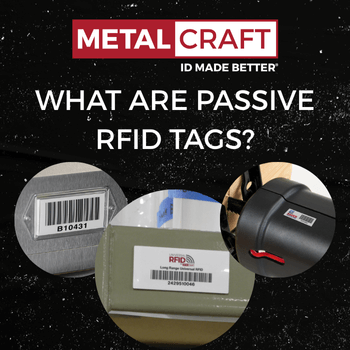
Typical Range
Passive RFID has a shorter signal range than active RFID — typically a few inches to 50 feet, depending on the tag’s design and frequency range. Low-frequency (LF RFID) and high-frequency (HF) tags are used for close-proximity applications like access cards and animal identification, while UHF RFID tags can extend that range for inventory management and supply chain operations.
Ideal Use Case
Passive RFID tags are ideal when affordability, simplicity, and low maintenance are more important than long-range communication. They work best in:
- Asset management systems for tools, vehicles, and containers
- Retail and warehouse inventory management
- Access control systems (like employee badges)
- Library tracking and document management
- Supply chain management
- RFID-based systems for tracking small or disposable items
Pros and Cons
Pros:
- Low cost per tag
- No internal battery or maintenance needed
- Long lifespan (10+ years)
- Small tag size suitable for tight spaces
Cons:
- Lower signal range and no real-time location updates
- Dependent on RFID reader proximity
- Limited data transmission speed compared to active RFID tags
Active vs Passive RFID: Quick Comparison
Power Source and Signal Range
The biggest difference between active RFID vs passive RFID lies in the power source.
- Active RFID tags use an internal power source, enabling them to transmit signals independently and reach ranges of up to hundreds of meters.
- Passive RFID tags rely on the RFID reader for power, offering a lower signal range but much lower costs.
Tag Lifespan and Maintenance
Passive RFID tags work without a battery, so they have longer lifespans and require almost no maintenance. Active RFID tags, on the other hand, depend on battery life, typically between 3–5 years. Once the battery depletes, the tag must be replaced, adding maintenance overhead to active RFID systems.
Cost and Implementation Complexity
Passive RFID systems are less expensive to deploy because tags are cheap and easy to produce. Active RFID systems, while more powerful, are significantly costlier — both in initial setup and ongoing battery maintenance.
Common Use Cases by Industry
| Industry | Active RFID Applications | Passive RFID Applications |
|---|---|---|
| Logistics & Supply Chain | Fleet & container tracking | Pallet-level inventory management |
| Healthcare | Equipment & patient tracking | Medication & lab sample tracking |
| Manufacturing | Real-time asset monitoring | Work-in-progress tracking |
| Retail | Warehouse asset tracking | Store-level inventory management |
| Transportation | Vehicle tracking, vehicle tolling | Ticketing & baggage tagging |
How to Choose the Right RFID Tag Type
Selecting the best RFID tag type depends on your RFID tracking system goals:
- Choose active RFID tags if you need real-time tracking, longer ranges, and are willing to manage battery life. They’re ideal for large-scale asset tracking and supply chain visibility.
- Choose passive RFID tags if you need affordable, scalable tagging for smaller items or fixed assets. Perfect for inventory management, access control, and RFID-based systems in retail or healthcare.
- Consider semi-passive RFID tags (or semi-passive tags) as a middle ground — they use an internal battery to power the chip but rely on the RFID reader for communication, helping conserve battery life and extend range.
Your choice should balance range, cost, environment, and data transmission requirements. A robust asset tracking system might even combine both passive and active tags for different asset classes.
Frequently Asked Questions
- What is the main difference between active and passive RFID?
The main difference is that active RFID tags have an internal power source while passive RFID tags do not. This affects their signal range, cost, and battery life. - How do passive RFID tags work?

They draw power from the RFID reader’s emitted signal, using it to activate the tag’s integrated circuit, which sends stored data back to the reader. - Can passive RFID be used for real-time tracking?
Not usually — passive RFID tags require reader proximity and aren’t suited for continuous updates. For real-time tracking, active RFID tags or semi-passive RFID systems are better options. - Which industries benefit most from RFID?
RFID technology supports asset management systems, inventory management, access control, and supply chain visibility across industries like manufacturing, logistics, healthcare, and retail. - What are semi-passive RFID tags?
Also called battery-assisted passive tags, they combine the best of both worlds: an internal battery for powering the chip and energy from the RFID reader for communication — providing extended range and reliability.
Final Thoughts
Both active RFID and passive RFID play crucial roles in today’s RFID tracking landscape. While active RFID systems provide unmatched real-time tracking capabilities, passive RFID systems offer scalability, low cost, and simplicity — perfect for inventory management and basic asset tracking.
Understanding these differences helps supply chain managers and business leaders implement an RFID-based system that fits their goals — improving efficiency, accuracy, and visibility across the entire operation.
About the Author: Marianne Alvarado

Mobile Phone: 641-529-9492
Office Phone: 641-423-9460
Email: [email protected]
Office: 3360 9th St. SW, Mason City, IA 50401