
RFID Temperature Sensor Tags
Features
- Specifically designed microchip to identify temperature
- Can be affixed or embedded into most materials
- Passive UHF
- Description
- Specifications
- Testing Information
- Chemical Testing
- Temperature Testing
- Read Range Test Data - ETSI UHF Band (865 - 868 MHz)
- Read Range Test Data FCC UHF Band (902 - -25 MHz)
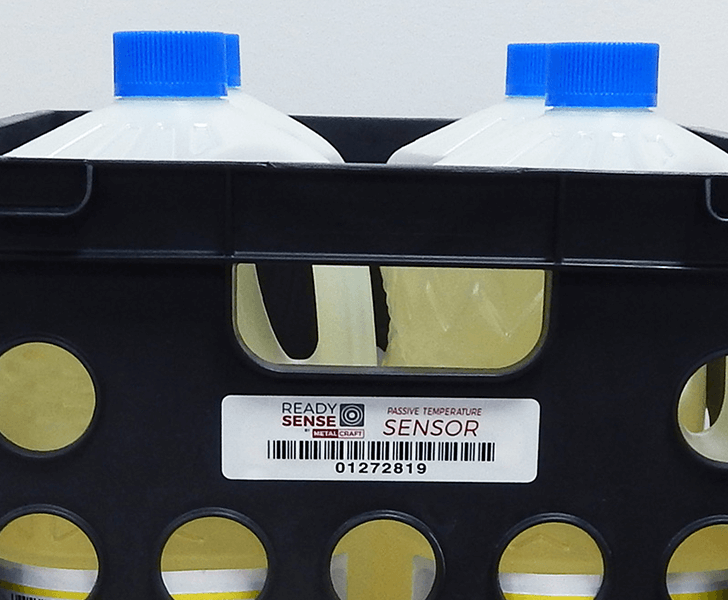
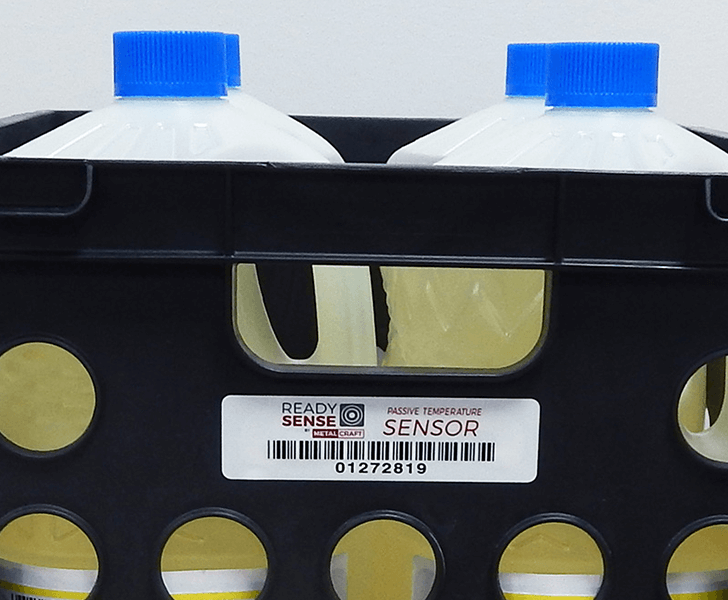
ReadySense Passive RFID Temperature Sensor Tags deliver a powerful solution for organizations that need accurate, reliable, and cost-effective temperature monitoring. Unlike bulky battery-powered devices, these passive RFID sensors are smaller, thinner, and more flexible—making them easy to apply to products, packaging, or equipment in virtually any environment.
Because they require no internal power source, ReadySense RFID labels offer greater affordability and scalability compared to active wireless sensing tags. This allows businesses to deploy temperature monitoring on a much larger scale without sacrificing accuracy or performance.
When scanned with a compatible RFID reader, these tags provide instant access to precise temperature data. That real-time insight helps users track environmental conditions, maintain compliance, reduce spoilage, and make faster, more informed decisions.
Use Cases for Passive RFID Temperature Monitoring
- Cold Chain Logistics – Safeguard food, beverages, and pharmaceuticals by maintaining proper storage and transit temperatures.
- Healthcare & Life Sciences – Protect vaccines, biologics, and laboratory samples with precision temperature tracking.
- IT & Data Centers – Monitor ambient conditions around servers and networking equipment to prevent failures.
- Industrial Manufacturing – Maintain quality in curing, molding, and sensitive production processes.
- Warehousing & Storage – Ensure environmental consistency for large-scale inventory management.
- Agriculture & Horticulture – Monitor greenhouse conditions, seed storage, and produce handling.
- Museums & Archives – Preserve artwork, rare documents, and artifacts in climate-controlled environments.
- Utilities & Energy – Track exposure of equipment like transformers, pipelines, and meters to reduce risks.
| Material | Polyester |
| Serialization | Barcode and human-readable equivalent is digitally printed - providing excellent clarity and easy scanning. Code 39 is the standard symbology with a range of 2.7 to 9.4 CPI (characters per inch). Optional linear and 2D symbologies available. Although this product is primarily marketed as a barcode product, we can produce it with human-readable numbers only or unserialized. |
| Label Copy | The label copy may include block type, stylized type, logos or other designs |
| Colors | Standard colors include black, red, yellow, green or blue. Custom spot colors are also available at no additional charge. Due to contrast needed for the barcode scanner, all barcodes are black. |
| Standard Adhesive | High performance adhesive |
| Sizes | 4.1875" x 1.125" |
| Packaging | Shipped on convenient rolls with scrap matrix removed for ease of removal. Cartons are clearly marked to indicate serial numbers of labels. |
Chemical Testing Summary
The ReadySense temperature tags were attached to a sheet of glass submerged in various chemicals. Observations were made at the following intervals: 2 hours, 24 hours, 48 hours. A Motorola handheld RFID reader as well as a handheld barcode reader were used to test the samples.
Chemical Testing Data
| Length of Immersion | Water | Glass Cleaner | Bathroom Cleaner | Isopropyl Alcohol 99% | Acetone | NaOH pH 12 | HNO3 pH 1 | HCl pH 1 | Brake Fluid |
|---|---|---|---|---|---|---|---|---|---|
| 24 hours | no effect | no effect | no effect | no effect | tag delaminated; tag not read | no effect | no effect | no effect | no effect |
Temperature Testing Summary
High-temperature resistance test: These tags were attached to a sheet of glass at raised temperatures for 15 minutes. Tags were then removed from the oven and tested for readability immediately. Low-temperature resistance test - The tags were attached to a sheet of glass and exposed to -40 °F for 24 hours. Tags were then checked for readability with a handheld RFID reader. All samples were readable while at temperature just prior to removal from the freezer. No tag construction defects were observed and the adhesive still had a strong bond while in the freezer.
Temperature Testing Data
| Temperature | RFID read test (after sample cooled to room temp) | Appearance of tags |
|---|---|---|
| 200°F | Reads well | No change |
| 300°F | Reads well | No change |
| 400°F | Reads well | Tag distorted |
| 500°F | Reads well | Tag destroyed |
Read Range Test Data - ETSI UHF Band (865 - 868 MHz) Data
| Free Air | Cardboard | Wood | Plastic | Glass | Metal (requires .0625" thick foam in tag construction) |
|---|---|---|---|---|---|
| 6.10 | 7.18 | 9.10 | 10.54 | 15.42 | 2.4 |
Read Range Test Data FCC UHF Band (902 - -25 MHz) Data
| Free Air | Cardboard | Wood | Plastic | Glass | Metal (requires .0625" thick foam in tag construction) |
|---|---|---|---|---|---|
| 5.54 | 6.95 | 7.54 | 10.71 | 7.443 | 3.62 |
FAQs
A high-temperature RFID tag is designed to withstand extreme heat—often up to 250°C (482°F) or higher—while maintaining reliable performance. These rugged tags are commonly used in industries like metal processing, automotive manufacturing, and aerospace. In addition, certain RFID tags come with built-in temperature sensors that can track and record real-time temperature data. These RFID temperature sensor tags are widely used in healthcare, pharmaceuticals, and cold chain logistics to ensure temperature-sensitive goods remain safe during storage and transit.
RFID sensor tags are engineered to monitor a wide range of temperatures, typically from -40°C to +85°C, depending on the sensor type and RFID technology. This capability makes them ideal for cold chain monitoring, inventory management, and environmental monitoring. Passive RFID tags are maintenance-free and suitable for long-term deployment in harsh environments. RFID sensor tags provide real-time data through RFID readers, helping businesses track objects and protect product quality. These sensor tags integrate seamlessly with RFID solutions to deliver reliable monitoring for industrial, medical equipment, and supply chain applications, enhancing both compliance and operational efficiency.
RFID sensor tags are essential for cold chain monitoring, offering real-time data on temperature and humidity throughout the supply chain. These sensor tags help ensure product quality and regulatory compliance in industries like pharmaceuticals, food, and biotechnology. Passive RFID tags track perishable goods without the need for batteries, while active RFID tags offer extended range and data logging. RFID readers collect data at key checkpoints, enabling environmental monitoring and efficient inventory management. With RFID technology, businesses gain real-time visibility, reduce spoilage, and automate compliance. RFID sensor tags are a trusted solution for safeguarding sensitive goods in transit.
To achieve the most accurate temperature readings, choose a sensor designed for your specific application. RFID temperature sensor tags provide reliable, real-time monitoring without the need for bulky batteries, making them ideal for logistics, healthcare, and industrial environments. For high precision, ensure the tags are properly calibrated, placed close to the item or environment being measured, and paired with a compatible RFID reader. Using passive RFID sensors also reduces maintenance and improves consistency, giving you dependable data to protect sensitive goods and support smarter decision-making.