
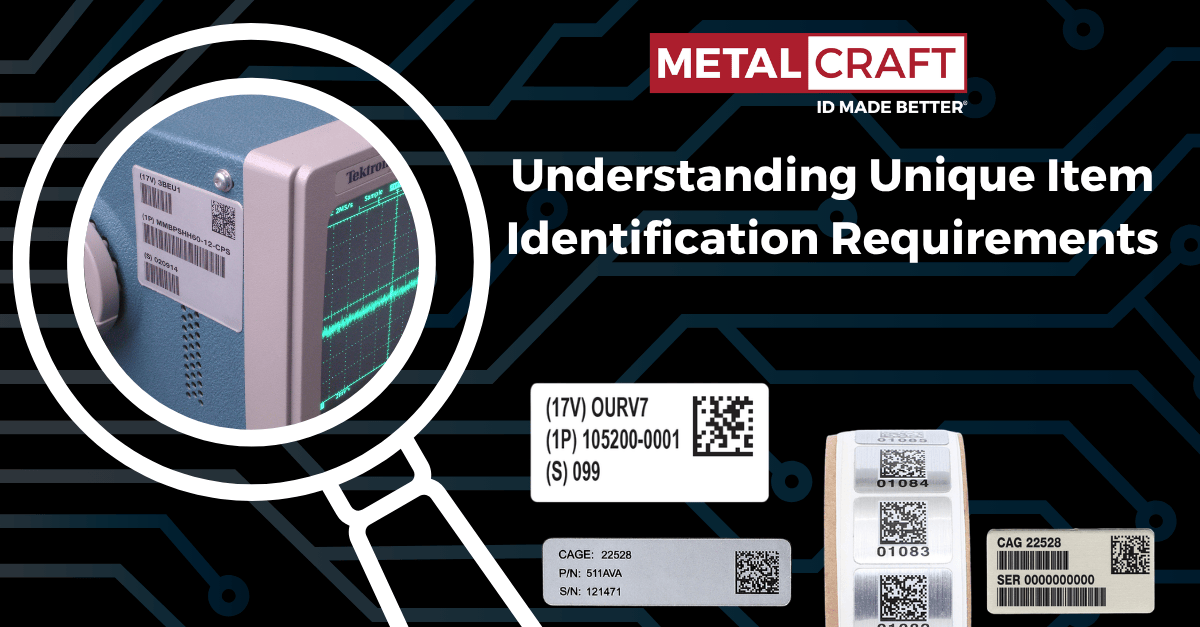
Unique Item Identification (UID) is a system used to assign a globally unique identifier to individual assets, ensuring they can be tracked, managed, and verified throughout their entire item’s lifecycle. Often associated with the Department of Defense (DoD) and other regulated industries, UID plays a critical role in maintaining data integrity, accountability, and compliance across complex supply chains.
UID requirements are especially important for organizations managing tangible personal property, mission essential equipment, and controlled inventory. By enabling precise unique identification of each asset—down to a single hardware article—UID supports lifecycle visibility, maintenance tracking, and audit readiness.
With increasing enforcement of IUID requirements across government, aerospace, and defense sectors, compliance is no longer optional. It is a compliance process mandated for many federal contractors handling military property and high-value assets.
Metalcraft supports this need by providing durable UID labels, nameplates, and asset tags engineered to meet strict MIL-STD-130 marking requirements, helping organizations achieve reliable, long-term permanent identification.
What Are Unique Item Identification Requirements?
Definition of UID (Unique Item Identification)
Item Unique Identification (IUID) is a system for uniquely identifying items using a unique item identifier (UII). Each UII is globally unique and unambiguous, ensuring no two assets share the same identity across systems.
This identifier is typically encoded in a data matrix symbol, a 2D barcode that stores structured data elements such as the enterprise identifier, serial number, and original part number. The result is a reliable method for linking physical assets to digital records in an IUID system.
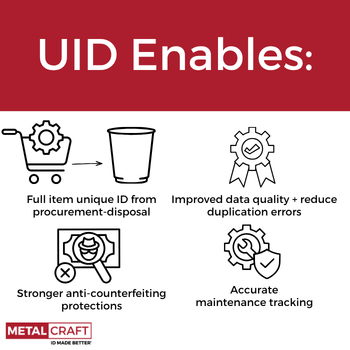
The primary goal of unique item identification is to maintain visibility and accountability across an asset’s lifecycle. UID enables:
Purpose of UID Requirements
- Full item unique identification from procurement through disposal
- Improved data quality and reduced duplication errors
- Stronger anti-counterfeiting protections
- Accurate maintenance tracking for serially managed assets
By ensuring each asset is uniquely assigned a permanent identity, organizations can track even embedded items or embedded subassembly components within larger systems.
Key Standards and Frameworks
UID compliance is governed by several key standards:
- MIL-STD-130: Defines UID marking and identification marking requirements
- DFARS clauses: Outline the compliance process for DoD contractors
- International standards: Support consistent data formats and interoperability
These frameworks ensure that UID data is structured, readable, and compatible with systems like the IUID Registry, where IUID data is stored and managed.
Unique Identifier (UII) Structure
The unique item identifier UII is constructed using standardized formats:
- Construct 1: Combines the enterprise identifier with a serial number
- Construct 2: Includes the enterprise identifier, original part number, and serial number
Additional elements such as the issuing agency code and application identifiers define how data is formatted and interpreted. These structures ensure every single unit is uniquely identifiable—even among unlike items.
Data Matrix Code Requirements
UID relies on a data matrix code in ECC 200 format. This ensures:
- High-density encoding of UII data
- Error correction for reliable scanning
- Compliance with data identifiers and text element identifiers
The data matrix symbol must meet strict readability standards to support automated data capture and integration into multi faceted business applications.
Human-Readable Information (HRI)
In addition to the barcode, UID labels must include human-readable information. This includes:
- The unique identifier
- Relevant data elements
- Clear formatting aligned with marking requirements
HRI ensures that assets can still be identified even if barcode scanning is not possible.
UID Label & Nameplate Requirements
Permanence & Durability Standards
Key Components of UID Marking Requirements
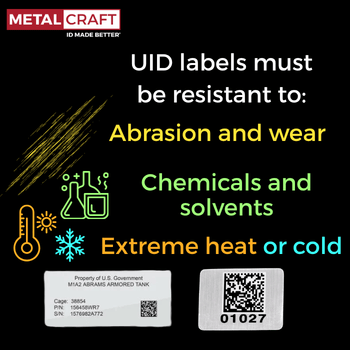
UID labels must use a permanent marking method capable of lasting the entire item’s lifecycle. This includes resistance to:
- Abrasion and wear
- Chemicals and solvents
- Extreme heat or cold
For DoD serially managed assets and medical supplies, durability is essential to maintain data integrity over time.
Material Considerations
Choosing the right material is critical for UID marking success:
- Metal nameplates offer superior durability and long-term performance
- Polyester labels provide flexibility for less demanding environments
Attachment methods—such as adhesive or riveted—must align with the requiring activity determines based on asset use and environment.
Environmental Factors
UID labels must perform in real-world conditions, including:
- Outdoor exposure to UV and weather
- Industrial environments with chemicals or abrasion
- High-temperature processes like thermal spray or laser marking
Proper material selection ensures reliable physical marking across diverse applications.
Common Challenges in Meeting UID Requirements
Ensuring Data Accuracy
Errors in encoding UII data, incorrect serial number assignment, or mismatched data formats can compromise compliance. Maintaining data quality is critical to avoid costly rework or rejection.
Label Durability Failures
Non-compliant materials can lead to fading, peeling, or unreadable marks. This disrupts unique identification and impacts the ability to track delivered items or complete a receiving report.
Verification & Compliance Testing
All UID marks must be verified for readability and compliance. This includes:
- Barcode verification tools
- Scanner compatibility testing
- Validation against IUID requirements
Without proper testing, even correctly encoded labels may fail in real-world use.
Best Practices for UID Compliance
Work with Experienced UID Label Providers
Partnering with experts helps ensure proper formatting, encoding, and material selection. This reduces risk in a compliance process mandated by the Department of Defense and other agencies.
Validate Labels Before Deployment
Testing UID labels in real conditions ensures durability and readability. Verification tools confirm that the data matrix meets required standards.
Standardize UID Processes Across Operations
Consistency is key. Organizations should:
- Document UID workflows
- Train staff on barcode scanning and handling
- Integrate UID into ERP and inventory systems
This ensures seamless tracking of parent item and constituent parts.
Choosing the Right UID Label Solution
Pre-Printed vs Custom UID Labels
Pre-printed labels offer convenience, but custom solutions provide flexibility for specific applications, especially when dealing with batch number, unit acquisition cost, or complex serialization needs.
Direct Part Marking (DPM) vs Labels
Direct part marking methods like laser marking or dot peen create permanent marks directly on the asset. These are ideal for single unit formed components but may not be suitable for all surfaces.
Labels, on the other hand, provide versatility and easier implementation across a wide range of assets.
Integration with Asset Tracking Systems
UID works seamlessly with barcode systems and even radio frequency identification solutions. Integration ensures:
- Efficient data capture
- Compatibility with asset tracking systems
- Improved visibility across the supply chain
Why Metalcraft for UID-Compliant Labels and Nameplates
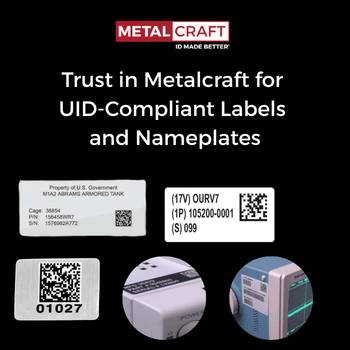
Metalcraft is a trusted provider of UID-compliant labeling solutions, offering:
- Proven expertise in unique item identification and IUID marking methods
- Durable materials engineered for harsh environments
- Custom UID encoding and serialization aligned with MIL-STD-130
- Scalable production for federal contractors and enterprise operations
- Solutions designed to maintain data integrity across the entire item’s lifecycle
Whether you need metal nameplates, polyester labels, or specialized identification marking, Metalcraft delivers reliable solutions built for compliance.
Conclusion: UID Compliance Starts with the Right Labeling Strategy
Meeting unique item identification requirements is not just about applying a barcode—it’s about ensuring long-term traceability, compliance, and asset integrity.
From structuring a unique item identifier UII to selecting the right permanent identification method, every step in the process impacts performance and compliance. Organizations that invest in durable, compliant UID labeling solutions gain better visibility, improved accountability, and stronger alignment with government and industry standards.
With the right strategy—and the right partner—UID becomes more than a requirement. It becomes a powerful tool for managing assets with confidence.
About the Author: John Fitzsimmons

Mobile Phone: 641-423-9460
Office Phone: 641-423-9460
Email: [email protected]
Office: 3360 9th St SW
Subscribe To The Blog
Find More Blogs
Recent Posts
- What Rental Customers Want Right Now: Trends Driving the Modern Rental Industry
- RFID and Rental Software: How Automated Asset Tracking Improves Rental Operations
- RFID vs Barcode for Rental Businesses: Which Tracking Technology Is Right for You?
- Access Control RFID Tags for Secure Identification and Facility Management
- High Temperature Metal Barcodes for Extreme Industrial Environments