
Healthcare organizations depend on thousands of medical devices that move between departments, patient rooms, storage areas, and maintenance facilities every day. Keeping those assets accurately identified and available is critical for inventory management, maintenance, operational efficiency, and patient care.
RFID technology can automate much of that process. But successful RFID medical equipment tracking depends on more than simply attaching an RFID label to every device.
The tag has to work on the equipment.
For biomedical engineering, clinical engineering, and procurement teams, that means evaluating the equipment surface, available mounting space, RFID frequency, required read range, cleaning process, sterilization requirements, attachment method, and expected service life before selecting a product.
Metal equipment creates another challenge. A standard RFID label that performs well in open air may provide poor or inconsistent performance when applied directly to stainless steel or aluminum.
The goal isn’t to find the RFID tag with the longest advertised read range or lowest price. It’s to specify healthcare RFID tags that provide reliable performance on the actual equipment, in the actual healthcare environment, throughout the expected lifecycle of the asset.
Here’s what to evaluate before you buy.
Start With the Medical Equipment Tracking Workflow
One of the easiest ways to choose the wrong RFID tag is to start with a product catalog.
Start with the workflow instead.
Before evaluating tag size, material, or read range, determine exactly what the RFID system needs to accomplish.
Is the goal to:
- Conduct faster medical device inventory counts?
- Locate equipment within a department?
- Automatically identify equipment entering biomedical engineering?
- Verify devices during preventive maintenance?
- Monitor equipment passing through a doorway?
- Improve inventory control across multiple healthcare facilities?
- Identify high-value medical devices leaving a defined area?
- Improve equipment utilization?
- Reduce manual tracking and human error?
The answers determine what kind of medical equipment tracking system—and ultimately what kind of tag—the application requires.
For example, a biomedical technician identifying a device at a maintenance workstation has very different requirements from a hospital conducting bulk inventory rounds with handheld RFID readers.
Define the event the system needs to capture before choosing the RFID tag.
Passive RFID vs. Active RFID for Medical Equipment
RFID tags can generally be passive, active, or semi-passive.
Passive RFID tags do not contain an internal battery. Instead, they receive energy from an RFID reader’s radio signal. Because passive tags require minimal maintenance and can be economical to deploy across large asset populations, they are often a strong option for hospital equipment RFID applications.
Active RFID tags contain their own power source and can transmit over greater distances. They are often used when healthcare providers need continuous or near-real-time visibility into mobile equipment.
Semi-passive tags contain a battery to power certain tag functions but still rely on reader interaction for communication.
Healthcare organizations should therefore determine whether they need identification or continuous location information before purchasing tags. Understanding passive RFID vs RTLS can help teams determine whether checkpoint- or zone-based passive RFID provides enough visibility or whether certain critical equipment requires continuous real time tracking.
For many healthcare assets, passive RFID offers an effective balance between cost, scalability, automated tracking, and maintenance.
Choose the Right RFID Frequency
Once the workflow is defined, the next question is frequency.
There isn’t one RFID frequency that’s best for every medical device.
LF RFID
Low-frequency RFID is generally used for close-range identification and can perform relatively well around certain challenging materials.
Its limited read range makes it less suitable for applications where staff need to quickly identify multiple medical assets throughout a room or storage area.
HF and NFC
High-frequency RFID and NFC support intentional, close-range interactions and may be useful for workflows such as:
- Maintenance verification
- Equipment setup
- Inspection confirmation
- Device authentication
- Access to equipment information
Because the user intentionally brings the reader close to the tag, HF and NFC can provide precise interaction with an individual asset.
Metal still affects performance, so metal-compatible tag construction may be necessary.
UHF RFID
Passive UHF RFID is frequently used for asset tracking because it can provide longer read distances and identify multiple RFID tags during the same read event.
Potential healthcare applications include:
- Medical device inventory
- Equipment audits
- Biomedical engineering rounds
- Receiving and distribution
- Maintenance workflows
- Equipment movement through portals or checkpoints
UHF performance depends heavily on the equipment, tag placement, reader configuration, surrounding materials, and healthcare environment.
That’s why advertised read range should be considered a starting point—not a guaranteed result.
Why Medical Equipment Requires Specialized RFID Tags
Many medical devices create challenging conditions for RFID.
Equipment may contain:
- Stainless steel
- Aluminum
- Plastic
- Glass
- Electronics
- Batteries
- Motors
- Fluids
- Curved housings
- Narrow rails or handles
RFID performance can be affected by nearby metal and liquids. Two identical RFID tags may therefore perform very differently when installed on different pieces of equipment.
Cleaning and sterilization add another variable. A patient monitor receiving routine disinfectant wipes presents a very different application from an instrument repeatedly exposed to high-temperature sterilization.
The tag must be evaluated as part of the equipment and workflow rather than as an isolated component.
How Metal Affects RFID Performance
Metal is one of the most important considerations in RFID asset tracking healthcare applications.
A conventional RFID label placed directly on a conductive surface may experience significantly reduced read performance because metal reflects RF waves and interferes with the tag’s antenna. This interference can weaken or disrupt communication between the RFID tag and reader unless a specialty on-metal RFID tag is used. On-metal tags are specifically engineered to compensate for the effects of metal and provide more consistent, reliable RFID performance when mounted directly to metal equipment.
That’s a major consideration because many hospital assets contain metal, including: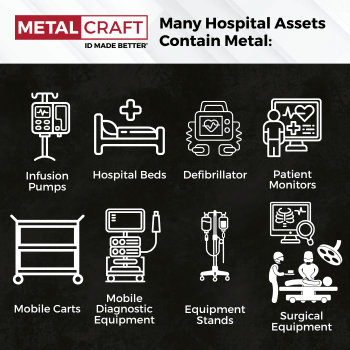
- Infusion pumps
- Hospital beds
- Defibrillators
- Patient monitors
- Mobile carts
- Diagnostic equipment
- Equipment stands and frames
- Surgical equipment
These applications may require RFID tags for metal surfaces that are specifically engineered to operate on conductive equipment.
Depending on the product, an on-metal tag may use an engineered separation layer, ferrite, foam, dielectric material, or antenna design that helps maintain RFID performance when the tag is installed on metal.
For procurement teams, the important distinction is simple:
“RFID compatible” does not necessarily mean “designed for metal.”
Require performance information for the intended mounting surface and test the tag on the actual equipment before approving the specification.
What Makes an On-Metal RFID Tag Different?
Purpose-built on metal RFID tags are designed so the antenna can operate when the tag is installed directly against a conductive surface.
Available constructions range from low-profile flexible tags to rugged encapsulated products designed for more demanding applications.
Healthcare organizations with mixed fleets should also consider whether a surface-independent tag could simplify standardization.
For example, a Universal MC Tag or other Universal RFID Asset Tags may be appropriate when a healthcare organization wants a common tag construction that can perform across different equipment surfaces.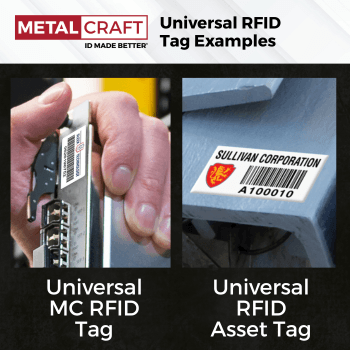
That can reduce the number of tag SKUs procurement needs to manage while creating greater consistency across an asset identification program.
However, “universal” shouldn’t mean “untested.”
The tag still needs to be evaluated on representative medical equipment under actual operating conditions.
Match Tag Size to the Medical Device
Medical devices often provide limited space for an asset label.
Before requesting samples or pricing, measure the actual mounting area and document:
- Maximum tag length
- Maximum tag width
- Maximum thickness
- Surface curvature
- Edge clearance
- Potential abrasion or impact
- Required printed information
Smaller medical device tracking tags may fit equipment more easily, but reducing tag size can affect RFID performance.
Don’t choose the smallest tag first and work backward.
Start with the required read performance, mounting environment, and workflow. Then determine the smallest tag that can reliably meet those requirements.
Tag placement also shouldn’t interfere with controls, vents, warning labels, service panels, handles, or other equipment features.
Standardize RFID Tag Placement
Where the tag is mounted can be just as important as which tag is purchased.
Avoid placing RFID tags:
- Deep inside metal recesses
- Near moving joints
- Where they will experience repeated impact
- Directly beside large batteries or motors without testing
- Where cleaning chemicals can collect around the tag
- Where the label interferes with device operation
- Where printed identification can’t be easily viewed
Once biomedical engineering approves the placement, document it.
Photographs and installation instructions can help ensure the same tag is installed in the same location across identical equipment models.
Without a standardized placement procedure, two identical medical devices using identical RFID tags can deliver different tracking performance simply because the tags were mounted differently.
Specify the Cleaning and Sterilization Environment
One of the biggest mistakes healthcare organizations can make is treating “healthcare grade” as a complete durability specification.
It isn’t.
Biomedical engineering and procurement should document exactly what the tag will experience.
Routine cleaning and disinfection should be evaluated separately from:
- Steam autoclaving
- Washer-disinfector cycles
- Hydrogen peroxide processes
- Ethylene oxide
- Radiation
- Immersion
- Other validated sterilization processes
Sterilizable RFID tags may be designed to withstand demanding environments and high temperatures, but suitability depends on the complete construction and actual processing conditions.
Document:
- Maximum and minimum temperature
- Pressure
- Humidity
- Cleaning chemistry
- Chemical concentration
- Exposure duration
- Sterilization method
- Expected number of cycles
- Water or immersion exposure
A tag surviving one sterilization cycle doesn’t prove it will provide reliable performance after hundreds of cycles.
Evaluate the Entire RFID Tag Construction
The RFID chip continuing to respond doesn’t necessarily mean the identification solution has passed testing.
Repeated cleaning, handling, or sterilization may cause:
- Adhesive edge lift
- Delamination
- Adhesive softening
- Faded printing
- Unreadable barcodes
- Cracked encapsulation
- Moisture intrusion
- Corrosion
- Physical deformation
- Reduced RFID performance
Biomedical teams should evaluate the RFID inlay, adhesive, face material, printing, overlaminate, and encapsulation as one complete system.
For applications requiring sterilization, medical device manufacturers and healthcare organizations may also need specialized tag constructions designed for the specific process.
Define the Read Range You Actually Need
Don’t start by asking:
“How far can this tag read?”
Ask:
“How far does this tag need to read reliably in our workflow?”
A biomedical technician identifying an asset at a workstation may only need close-range identification. A technician conducting a room inventory with a handheld reader may need several feet of dependable performance.
Common workflows include:
- Close-range maintenance verification
- Room inventory
- Storage-area inventory
- Service-bay identification
- Doorway detection
- Equipment movement through portals
Longer read range isn’t automatically better.
Excessive range may create unintended reads from equipment in nearby rooms or adjacent zones, reducing the usefulness of RFID data.
Actual read performance depends on: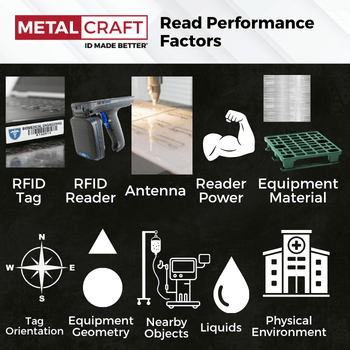
- RFID tag
- RFID reader
- Antenna
- Reader power
- Equipment material
- Tag orientation
- Equipment geometry
- Nearby objects
- Liquids
- Physical environment
Test the complete RFID tracking system—not just the tag.
Decide What Information Belongs on the Tag
For most asset management applications, the RFID chip should start with a unique identifier that connects the physical medical asset to its digital record.
That record may exist within a:
- CMMS
- EAM platform
- ERP system
- Inventory management platform
- Hospital asset management system
- Other RFID-enabled system
Avoid storing unnecessary patient data or frequently changing information directly on the tag when it can be maintained more effectively in the software.
The physical identification can also include:
- Asset number
- Serial number
- Barcode
- QR code
- Human-readable text
- Ownership information
- Department information
- Organization logo
Combining RFID with traditional barcode systems provides useful redundancy. Unlike traditional barcode systems, RFID doesn’t require direct line-of-sight scanning, while a printed barcode remains available when an RFID reader isn’t accessible.
Hospitals should also determine whether tags will arrive preprinted or be generated internally. Onsite printable RFID tags can provide additional flexibility when biomedical or asset management teams need to print and encode identification as new equipment enters the system.
How RFID Supports Medical Equipment Management
The value of RFID extends beyond simply knowing what equipment the hospital owns.
RFID automates data capture and can support asset management processes throughout the equipment lifecycle.
Potential workflows include:
- Conducting faster equipment inventories
- Identifying equipment due for preventive maintenance
- Recording assets entering biomedical engineering
- Improving inventory tracking
- Identifying missing equipment
- Supporting inspection and calibration workflows
- Analyzing equipment utilization
- Improving purchasing decisions
- Supporting more efficient inventory management
The Joint Commission requires applicable organizations to maintain medical equipment inventories and document maintenance activities and frequencies. RFID doesn’t replace those regulatory compliance responsibilities, but accurate identification and better equipment visibility can make the underlying processes easier to manage.
Improved equipment utilization can also help procurement teams understand whether additional medical equipment is truly required before making another purchase.
RFID Beyond the Hospital
Healthcare RFID doesn’t begin and end at the hospital door.
RFID for medical device manufacturers can support work-in-process tracking, production traceability, inventory control, reusable manufacturing assets, and supply chain optimization before equipment reaches healthcare providers.
RFID technology can also support medical device packaging, medical supplies, surgical instruments, blood products, and other healthcare supply chain applications where accurate identification and traceability are important.
Within healthcare facilities, RFID may also support patient identification, patient tracking, medication workflows, and other applications designed to enhance patient care and protect patient safety.
These use cases have different technical and regulatory requirements, so they shouldn’t automatically share the same RFID tag specification.
On-Metal RFID Tag Options From Metalcraft
Metalcraft manufactures passive RFID tags and durable identification solutions for healthcare, industrial, and asset tracking applications.
Rather than starting with a particular product, begin with the equipment and application requirements.
Potential options include:
- On-metal passive RFID tags
- Surface-independent RFID tags
- Standard and mini tag formats
- Low-profile constructions
- Rugged RFID tags for demanding environments
- Preprinted and serialized tags
- Onsite printable RFID tags
- Hybrid RFID, barcode, and human-readable identification
Metalcraft can help evaluate the equipment material, mounting area, required read range, cleaning environment, RFID frequency, and workflow before recommending a tag construction.
The objective is straightforward: application fit first, tag second.
Test RFID Tags on Your Own Medical Equipment
Datasheets are useful for narrowing the options, but they can’t duplicate your equipment, mounting surface, reader configuration, cleaning process, or healthcare environment.
Request sample tags to evaluate mounting fit, adhesion, readability, and RFID performance on the medical equipment you actually intend to track.
When requesting samples, provide the equipment model, substrate, available mounting area, RFID frequency, required read range, and cleaning or sterilization conditions.
Build an RFID Medical Equipment Tag Specification
Before procurement requests pricing, biomedical and clinical engineering teams should document the following requirements:
- Equipment: Device type, manufacturer, model, and ownership.
- Surface: Metal type, coating, plastic, curvature, and available mounting area.
- Workflow: The exact event the RFID system must capture.
- Frequency: LF, HF/NFC, or UHF.
- Read requirements: Required distance, speed, and single- or multiple-tag reads.
- Reader infrastructure: Existing RFID readers, antennas, and regional frequency requirements.
- Tag construction: Standard, on-metal, or surface-independent.
- Physical requirements: Maximum footprint, thickness, and attachment method.
- Environment: Cleaning, chemicals, moisture, temperature, and physical handling.
- Sterilization: Exact process, parameters, and expected lifetime cycle count.
- Identification: RFID, barcode, QR code, human-readable information, serialization, and printing method.
- Integration: CMMS, ERP, EAM, inventory management, RTLS, and other existing systems.
Use these requirements as pass/fail criteria when comparing candidate RFID solutions.
A lower price shouldn’t compensate for inadequate adhesion, poor on-metal performance, insufficient read range, or failure during sterilization.
Test Before You Buy
Sample testing is one of the most important steps in RFID tag selection.
An RFID tag testing checklist for healthcare deployments should evaluate candidate products under realistic conditions, including:
- Read performance on actual medical equipment
- Required read distance
- Multiple reader and equipment orientations
- Tag placement
- Mounting fit
- Adhesive performance
- Exposure to specified cleaners and disinfectants
- Sterilization cycles, when applicable
- Barcode and human-readable print durability
- RFID reader compatibility
- Software and encoding compatibility
- Performance after repeated handling
Test multiple samples rather than relying on a single successful read.
Document the results and use the same acceptance criteria for every candidate. Once a tag is approved, lock the tag model, chip, adhesive, construction, printing, encoding, and mounting location into the purchasing specification.
Six RFID Tag Selection Mistakes to Avoid
- Using a standard RFID label on metal. A tag that works in open air may perform poorly after installation. Specify an on-metal or surface-independent construction when required.
- Choosing the smallest tag first. Smaller isn’t automatically better. Establish performance requirements before selecting tag dimensions.
- Confusing chemical resistance with sterilization resistance. A tag that survives disinfectant wipes may not survive repeated sterilization.
- Treating datasheet read range as guaranteed performance. Test the tag with your equipment, readers, antennas, and environment.
- Allowing tag placement to vary. Standardize installation to improve consistency across identical devices.
- Assuming RFID satisfies regulatory identification requirements. RFID asset tracking and regulatory device identification should be evaluated separately.
Which RFID Medical Equipment Tag Should You Buy?
There isn’t one RFID tag that’s right for every piece of medical equipment.
The right choice depends on the asset, surface, workflow, frequency, read range, mounting space, environment, attachment method, cleaning requirements, and expected service life.
For biomedical engineering, clinical engineering, and procurement teams, the selection process should follow a clear sequence:
- Define the workflow.
- Choose the appropriate RFID frequency.
- Identify the equipment surface.
- Determine whether an on-metal tag is required.
- Measure the mounting area.
- Document cleaning and sterilization requirements.
- Establish the required read range.
- Determine printing and data requirements.
- Test representative samples on actual equipment.
- Lock the approved construction into the purchasing specification.
This approach makes RFID medical equipment tracking less about comparing product specifications and more about finding the tag that reliably solves the application.
The best tag isn’t necessarily the cheapest, smallest, or longest-reading option. It’s the one that stays attached, remains readable, performs reliably, integrates with existing systems, and continues identifying the medical device throughout its expected lifecycle.
Request RFID Samples for Your Medical Equipment Don’t finalize an RFID tag specification based on a datasheet alone. Metalcraft can help evaluate your equipment surface, mounting space, read environment, frequency, cleaning requirements, and workflow to identify passive RFID tag options for testing.
Request sample tags and evaluate performance on the equipment your healthcare organization actually uses.

About the Author: Mark Maliszewski

Mobile Phone: 641-423-9460
Office Phone: 641-428-9156
Email: [email protected]
Office: 3360 9th St SW, Mason City, IA 50401