
A successful RFID demonstration is not the same thing as a successful healthcare RFID implementation.
Reading an RFID tag across a conference table proves that the tag works under one controlled condition. It does not prove that the same tag will remain readable after repeated cleaning, sterilization cycles, exposure to moisture, mounting on metal surfaces, stacking inside surgical trays, movement through crowded hallways, or months of everyday handling.
For sterile processing, biomedical engineering, and RFID project leads, that distinction is critical.
RFID tag testing provides the evidence needed to determine whether a tag, reader configuration, mounting method, and workflow will perform reliably before an organization commits to a larger deployment.
Effective RFID testing evaluates two things: read performance and environmental robustness. The objective isn’t to find the RFID tag with the longest advertised read range. It’s to prove that the selected tag performs consistently on the actual medical equipment, in the actual environment, under the actual conditions where it will be used.
That means testing RFID tags on representative assets, challenging them with real-world conditions, measuring performance before and after environmental exposure, and conducting an RFID pilot with clearly defined pass/fail criteria.
Here’s how to answer the question every healthcare RFID team eventually asks: How do we prove it works before we scale?
Why RFID Tag Testing Is Critical in Healthcare Environments
Healthcare creates unique challenges for RFID technology.
Medical devices and surgical instruments may encounter metal, liquids, disinfectants, high temperatures, pressure, moisture, repeated cleaning, physical impacts, and extreme conditions. At the same time, RFID systems may need to operate around people, carts, cabinets, electronics, and densely packed equipment.
RFID performance can vary significantly based on materials, mounting position, orientation, reader configuration, and the surrounding environment. A tag that performs well on plastic may behave differently on stainless steel. A tag that reads reliably in open space may perform differently when surrounded by surgical tools or positioned near liquids.
That’s why RFID tags must be tested under real-world conditions.
Laboratory specifications are useful for comparing products, but they cannot fully predict performance inside a hospital.
What Tag Failure Can Cost a Hospital
A failed tag isn’t simply an identification problem.
It can create inaccurate inventory records, incomplete location information, missed maintenance events, inefficient sterilization workflows, and additional manual work.
Consider the potential impact on:
- Infusion pumps
- Patient monitors
- Wheelchairs
- Mobile diagnostic equipment
- Surgical trays
- Reusable medical instruments
- Transport carts
- High-value inventory
If the RFID system reports inaccurate data, staff may spend time searching for equipment that isn’t where the system says it is. In sterile processing, an unreadable tag could interfere with traceability through the cleaning and sterilization process.
The ultimate goal of hospital asset tracking isn’t collecting RFID reads. It’s creating accurate, actionable information that improves visibility, operational efficiency, inventory management, and ultimately supports better patient care.
What Your RFID Pilot Needs to Prove
Before scaling, an RFID pilot should establish that the proposed solution can deliver:
- Reliable identification under realistic conditions
- Stable performance across expected workflows and asset locations
- Adequate tag durability over the expected asset lifecycle
- Reliable communication between RFID tags and RFID readers
- Accurate encoding and data association
- Compatibility with software and hospital systems
- Clearly documented pass/fail criteria
RFID pilots validate technology in real operational environments instead of relying solely on specifications or demonstrations.
A focused pilot might run approximately 30 to 90 days and include roughly 100 to 500 representative assets, but these figures should be treated as planning ranges—not requirements. A healthcare pilot should be sized according to workflow complexity, asset risk, environmental exposure, and the amount of evidence required to make a confident rollout decision.
Define the RFID Pilot Before Testing a Single Tag
Successful testing begins with the workflow, not the tag.
Before comparing healthcare RFID tags, define exactly what you’re trying to accomplish.
Identify Your Assets and Workflows
Start by grouping assets into meaningful classes.
Medical equipment
Infusion pumps, beds, monitors, ventilators, workstations, diagnostic devices, and other mobile equipment.
Sterile assets
Surgical instruments, instrument trays, reusable devices, containers, and transport carts.
Inventory
Kits, supplies, implants, pharmaceuticals, and high-value consumables.
Then define how each asset moves.
Does it travel between departments? Is it stored in metal cabinets? Does it leave the facility? Does the workflow require real time tracking, or does the system simply need to confirm that an item passed through a specific doorway or processing point?
These questions affect tag selection, reader placement, read range, and the way success should be measured.
Map Environmental Exposure
For each asset class, document what the RFID tag will experience.
That may include:
- Steam autoclave
- Low-temperature sterilization
- Ethylene oxide
- Chemical disinfection
- Repeated cleaning
- Moisture and washdown
- High heat
- Pressure
- Extreme temperatures
- Blood or saline exposure
- Alcohol-based disinfectants
- Impact and abrasion
- Stacking
- Cart vibration
- Repeated manual handling
Also evaluate the RF environment.
Metal surfaces, liquids, batteries, motors, stainless steel cabinets, surgical trays, people, and nearby medical equipment can all influence performance.
This is especially important when evaluating RFID tags for metal surfaces or selecting a RFID tag for instrument tags applications.
Define Success Before You See the Results
Set program-level objectives such as:
- Inventory accuracy
- Asset search time
- Reduced manual errors
- Reduced equipment loss
- Improved maintenance traceability
- Improved sterilization traceability
- Reduced manual scanning
- Increased equipment availability
RFID has demonstrated significant potential for improving inventory accuracy. Auburn University RFID Lab research frequently cited in the industry found item-level RFID increased retail inventory accuracy from an average of approximately 63% to 95%. That finding comes from retail research, not healthcare, so hospitals should establish and validate their own baseline and improvement targets.
Your tag-level acceptance criteria should be separate.
Those criteria might include minimum read rate, usable read distance, permitted performance degradation after sterilization, and zero-tolerance failures such as detachment or corrupted identification data.
Establish RFID Test Samples, Controls, and Acceptance Criteria
One of the most common mistakes in RFID tag testing is evaluating one tag on one ideal surface.
Test multiple constructions.
Depending on the application, candidates could include:
- On-metal versus general-purpose RFID tags
- Flexible RFID labels versus rigid tags
- UHF, HF, or NFC technology
- Different antenna designs
- Different adhesives
- Different protective materials
- Different tag sizes
RFID tags are also broadly classified as passive, active, and battery-assisted passive (BAP). Passive tags generally offer the shortest range and can be a cost-effective choice for many inventory and asset tracking applications. Depending on frequency, antenna, reader, environment, and tag design, passive UHF tags can provide considerably greater range than LF or HF tags.
Battery-assisted passive tags can extend operational range, while active RFID tags can support much longer distances and are often associated with RTLS and other real-time tracking applications.
The right technology depends on what you’re trying to accomplish—not simply which tag reads farthest.
Test Representative Assets
Don’t test only on ideal panels.
Use actual:
- Stainless steel surgical trays
- Metal medical equipment
- Polymer housings
- Glass
- Curved surfaces
- Equipment with batteries and electronics
- Loaded instrument trays
- New and worn equipment
Testing multiple examples of each asset class can reveal variation that a single test asset might hide.
For teams still deciding between technologies, comparing passive RFID vs RTLS early can prevent testing a tag architecture that doesn’t match the required workflow.
Capture Baseline Performance
Before environmental or durability testing begins, document:
- EPC or identifier
- Initial read range
- Orientation performance
- Reader power
- Tag placement
- Attachment method
- Physical condition
- Barcode readability
- Human-readable information
Photograph the placement.
These baseline measurements give you something to compare against after cleaning, sterilization, abrasion, impact, or aging.
Go Beyond Simple Read/No-Read Testing
Professional RFID tag testing can include several layers.
Functional testing verifies that RFID tags receive and transmit data correctly.
Parametric testing measures electrical and RF properties.
Frequency response testing can identify resonant frequency and operational bandwidth.
Turn-on power testing measures the minimum threshold power needed to activate a tag.
Read and write range verification establishes the operational distance over which stable communication occurs.
Orientation testing helps map radiation patterns and identify potential dead zones.
Data integrity testing verifies that the tag returns the correct information and that the system appropriately handles errors.
Visual and mechanical inspection checks for defects, damage, delamination, cracking, or other physical problems. Automated inspection and automated testing can reduce variation and make regression testing easier when comparing designs or production changes.
ISO/IEC standards also define performance test methods for RFID systems, interrogators, and tags. These standardized methods provide a useful framework, but application-specific testing remains essential because the hospital environment can introduce conditions a generalized laboratory test does not reproduce.
Test Sterilization Resistance Under Real Processing Conditions
For reusable medical instruments and sterile assets, RFID tag durability testing can become one of the most important parts of the pilot.
A tag surviving one autoclave cycle doesn’t establish lifecycle durability.
Testing needs to represent the actual sterilization process.
Match the Test to the Validated Process
Work with sterile processing to document:
- Temperature
- Pressure
- Exposure time
- Drying time
- Cooling
- Cycle frequency
- Pre-vacuum or gravity displacement
- Low-temperature processes where applicable
ISO 17665 addresses requirements for development, validation, and routine control of moist-heat sterilization processes for medical devices. Testing an RFID-tagged device should also remain consistent with the device manufacturer’s applicable reprocessing instructions.
The goal isn’t to create a generic “autoclave test.”
It’s to determine whether the complete tagged assembly is appropriate for your validated process.
Test Over Multiple Sterilization Cycles
For sterilization safe RFID tags and autoclave safe RFID tags, establish checkpoints.
For example:
- Cycle 0: baseline
- Early-cycle checkpoint
- Intermediate checkpoint
- End-of-test checkpoint
After each checkpoint, inspect:
- RFID readability
- Change in read range
- Orientation sensitivity
- EPC and memory integrity
- Cracking
- Blistering
- Warping
- Delamination
- Adhesive lift
- Fluid ingress
- Corrosion
- Printed text
- Barcode readability
Environmental stress testing can also expose RFID tags to accelerated aging conditions, helping teams evaluate how materials and components may respond to extended service.
Environmental testing should evaluate resistance to physical stress as well as temperature and humidity extremes.
Test the Complete Assembly
An RFID inlay isn’t the entire identification solution.
Test:
- RFID component
- Face material
- Adhesive
- Encapsulation
- Printed layer
- Fastener or mounting system
- Asset substrate
A high-temperature RFID component is of little value if its adhesive fails after repeated sterilization cycles.
Likewise, a tag designed to withstand high temperatures still needs to be evaluated for cleaning, moisture, attachment integrity, and RF performance.
No responsible supplier should claim universal autoclave compatibility without understanding the actual process.
Organizations evaluating how durable are Metalcraft RFID tags should begin with the asset, surface, environment, cleaning process, expected lifecycle, and required read range.
For applications involving immersion or significant moisture exposure, an RFID tag submersion test may also be appropriate.
RFID Read Range Testing on Metal, Near Liquids, and Around People
RFID read range testing should measure the usable read zone, not the longest possible laboratory read.
Test Different Materials and Positions
Compare performance on:
- Bare metal
- Painted metal
- Stainless steel
- Polymer
- Glass
- Composite surfaces
Then test placement variables:
- Flat versus curved
- Flush versus offset from metal
- Near corners or seams
- Near batteries
- Near motors
- Near handles or screens
On-metal testing evaluates performance across the surfaces and placements that the tag will actually encounter.
UHF RFID technology can perform effectively on metal when the tag is specifically designed and positioned for that environment. A general-purpose tag, however, may detune or lose significant range when placed directly on metal.
That makes how to choose RFID tags for metal medical equipment an application question, not simply a product specification question.
Create a Repeatable RFID Read Range Test
Keep variables controlled:
- Same reader
- Same antenna
- Same power settings
- Same frequency settings
- Marked distances
- Defined orientations
- Repeated reads at each location
Record:
- First-read distance
- Reliable-read distance
- Failure point
If both handheld and fixed readers will be used, test both.
Challenge the Tag With Liquids and People
Healthcare environments contain large amounts of water—including the human body.
Test tags around:
- Fluid bags
- Reservoirs
- Specimen containers
- Medications
- Cleaning liquids
- People
Then change the conditions.
What happens when a fluid container is full versus empty? What happens when an employee stands between the reader and tag? Does a tag perform differently when equipment is pushed down a crowded corridor?
These tests often reveal why a promising laboratory result doesn’t automatically translate into reliable hospital performance.
Test Dense Metal Environments
Don’t stop after proving the tag works on one metal asset.
Test:
- Equipment parked side by side
- Stacked surgical trays
- Stainless steel shelving
- Wire carts
- Transport racks
- Elevators
- Metal cabinets
Look for tag shadowing, orientation issues, missed reads, and unwanted reads.
The objective of RFID read range testing isn’t maximum distance.
It’s reliable detection where you need it—and avoiding detection where you don’t.
Stress Test RFID Tag Durability
Hospital assets are cleaned, transported, bumped, stacked, scraped, and handled continuously.
RFID tag durability testing should reproduce that reality.
Cleaning and Chemical Resistance
Use facility-approved cleaning agents at realistic concentrations and dwell times.
Conduct repeated wipe cycles.
Inspect:
- Adhesive edges
- Face material
- Enclosure seams
- Surface finish
- RFID performance
A tag that still reads but creates a cleaning concern isn’t necessarily a successful tag.
Mechanical Testing
Depending on the asset, simulate:
- Abrasion
- Impact
- Drops
- Vibration
- Flexing
- Stacking
- Pressure
- Snagging
Environmental stress testing subjects tags to accelerated aging conditions and harsh conditions that may expose weaknesses before deployment.
Testing generally spans design validation through manufacturing quality control. The objective remains consistent: RFID tag testing should demonstrate reliable performance in the intended environment.
Validate RFID in Live Clinical Workflows
Once individual tags have passed controlled testing, move into the actual workflow.
Fixed Reader Testing
Potential test zones include:
- Equipment room exits
- Sterile processing receiving
- Sterile processing dispatch
- Operating room corridors
- Central supply
- Maintenance areas
- Loading docks
- Elevators
Test both missed reads and cross-reads.
A reader that detects everything in a 30-foot radius isn’t necessarily better if the workflow only needs to identify equipment passing through one doorway.
Handheld RFID Reader Testing
For handheld workflows, evaluate:
- Search speed
- Accuracy in cluttered rooms
- Performance near people
- Performance near metal cabinets
- Ability to isolate one asset among many
- Reader battery life
- Connectivity
- Staff usability
This is where the practical benefits of RFID become measurable.
Can a technician find equipment faster? Can sterile processing verify surgical tools or trays more efficiently? Can inventory management teams complete counts with fewer manual errors?
Test Movement Patterns
Test assets:
- Stationary
- Moving slowly
- Moving quickly
- On carts
- Covered
- In crowded hallways
- Inside elevators
Change tag orientation relative to the reader.
Test during busy periods as well as quiet periods.
Movement patterns matter because RFID works through RF interaction, and real-world orientation and interference can significantly change performance.
Validate the Data
An RFID read only creates value if the data is correct.
Test:
- Tag encoding
- Asset/database association
- Duplicate EPC detection
- Middleware transmission
- Timestamps
- Location accuracy
- Offline recovery
- Exception handling
- Integration with CMMS, EAM, ERP, inventory, or other systems
Testing for data integrity ensures RFID tags return correct information and that errors are recognized rather than silently becoming bad inventory data.
For RFID asset tracking for hospitals, system accuracy matters as much as tag performance.
Consider Security, Regulatory Compliance, and UDI Requirements
Healthcare RFID systems should be designed with data governance in mind.
Avoid storing protected health information directly on a tag unless there is a specific, approved reason to do so. Apply appropriate access control, network segmentation, authentication, logging, and security practices.
NIST SP 800-98 provides guidance for understanding RFID security and privacy risks and designing controls for RFID systems.
Healthcare teams should also evaluate applicable regulatory compliance and UDI compliance requirements when RFID is used with regulated medical devices. RFID should complement required identification and traceability processes rather than create ambiguity about the authoritative device identifier.
Medical device manufacturers evaluating RFID for medical device manufacturers should involve quality and regulatory stakeholders early in the project.
Use a Weighted RFID Tag Testing Scorecard
A pilot shouldn’t end with, “It seemed to work.”
Create a documented readiness score.
| Test Category | Weight | Example Evidence |
|---|---|---|
| Baseline performance | 10% | EPC verification, range, orientation |
| Sterilization resistance | 20% | Cycle records, post-cycle reads, inspection |
| Metal/liquid performance | 15% | Reads on representative assets |
| Clinical read-zone accuracy | 15% | Intended, missed and unwanted reads |
| Attachment durability | 10% | Adhesion, movement, edge lift |
| Cleaning/chemical resistance | 10% | Wipe cycles and inspection |
| Handling/abrasion durability | 10% | Impact, transport and stacking results |
| Data/system integration | 5% | Encoding and event-flow tests |
| Security/operational fit | 5% | Risk review and workflow feedback |
Score each category from zero to five, multiply by its assigned weight, and normalize the result to a 100-point scale.
Possible readiness bands:
90–100: Ready for controlled rollout
80–89: Conditionally ready after minor corrective action
65–79: Revise and retest
Below 65: Not ready for deployment
Some failures should override the total score.
Automatic rejection criteria might include:
- Detached tags
- Corrupted identifiers
- Unsafe placement
- Unacceptable contamination risk
- Repeated loss of readability
Weight criteria based on risk rather than convenience. Sterilization resistance should carry more importance for reusable surgical instruments than for an asset that never enters sterile processing.
When a Tag Fails, Find the Root Cause
A failed test doesn’t necessarily mean RFID technology is wrong for the application.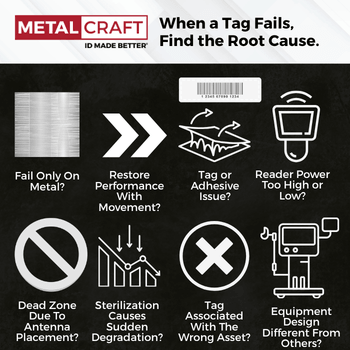
Ask:
- Does the tag fail only on metal?
- Does moving or offsetting it restore performance?
- Is the problem the tag or the adhesive?
- Is reader power too low—or too high?
- Is antenna placement creating a dead zone?
- Did sterilization cause sudden or progressive degradation?
- Is the tag readable but associated with the wrong asset?
- Is one equipment design fundamentally different from the others?
Change one major variable at a time and retest under the same conditions.
That discipline makes it possible to determine whether the solution requires a different tag, mounting location, adhesive, RFID reader configuration, software rule, or workflow.
Turn RFID Pilot Results Into a Rollout Decision
A successful pilot should produce more than a yes/no decision.
It should create a deployment standard.
Document:
- Approved asset classes
- Approved RFID tag SKU
- Approved construction
- Tag placement diagrams
- Surface preparation
- Attachment method
- Reader settings
- Antenna locations
- Encoding standards
- Installation procedures
- Inspection procedures
- Replacement procedures
- Training responsibilities
- Escalation ownership
This documentation becomes especially important when moving from dozens or hundreds of tagged assets to thousands.
RFID can support supply chain management, work-in-process automation, quality control, inventory accuracy, and real-time tracking of shipments and assets. But those benefits of RFID depend on consistent execution.
For hospitals, RFID for hospital inventory management should therefore be treated as an operational system—not simply a tagging project.
Continue Testing After Deployment
RFID readiness isn’t a one-time event.
Monitor:
- Missed-read rates
- False-read rates
- Tag replacement frequency
- Tag damage
- Asset search time
- Inventory accuracy
- Equipment availability
- Sterilization-related failures
- Reader uptime
- Integration uptime
- User-reported problems
Revalidate performance after meaningful changes to:
- RFID tags
- Materials
- Suppliers
- Reader firmware
- Antenna infrastructure
- Software
- Medical equipment
- Cleaning processes
- Sterilization processes
Automated testing can make regression testing easier and reduce variation when designs or system components change.
This ongoing quality process helps ensure the system continues delivering the accuracy, automation, efficiency, and visibility that justified the investment.
Launch Your Healthcare RFID Pilot With Metalcraft
The most important question before a large RFID deployment isn’t:
“Does this RFID tag work?”
It’s:
“Does this RFID tag work on our assets, in our environment, through our processes, at the read range our workflow requires?”
That’s what RFID tag testing should prove.
A successful healthcare RFID implementation begins with the asset, surface, environment, sterilization requirements, cleaning process, workflow, and desired read event.
Metalcraft can help you evaluate tag constructions and prepare samples for a controlled healthcare RFID pilot. Whether you’re evaluating RFID tags for asset tracking, healthcare RFID tags, RFID tags for metal surfaces, or an RFID tag for surgical instruments and trays, testing before scaling can help identify problems while they’re still relatively easy to solve.
Teams planning a broader deployment can also use the healthcare asset tracking sourcebook to evaluate applications and requirements before moving forward.
Instead of ordering production quantities based on a specification sheet, bring us representative information about:
- Your medical devices or instruments
- Asset material and surface
- Sterilization process
- Cleaning chemicals
- Expected service life
- Required read range
- Reader configuration
- Workflow
We’ll help you identify appropriate RFID tag options and develop a sample-based evaluation approach.
| Ready to prove your RFID solution before you scale? |
| Request a consultation with a Metalcraft RFID specialist to discuss your healthcare RFID application, equipment, and performance requirements. Our team can help identify the right RFID tag options, establish testing criteria, and plan a pilot to validate performance before full deployment. |
 |
About the Author: Mark Maliszewski

Mobile Phone: 641-423-9460
Office Phone: 641-428-9156
Email: [email protected]
Office: 3360 9th St SW, Mason City, IA 50401