
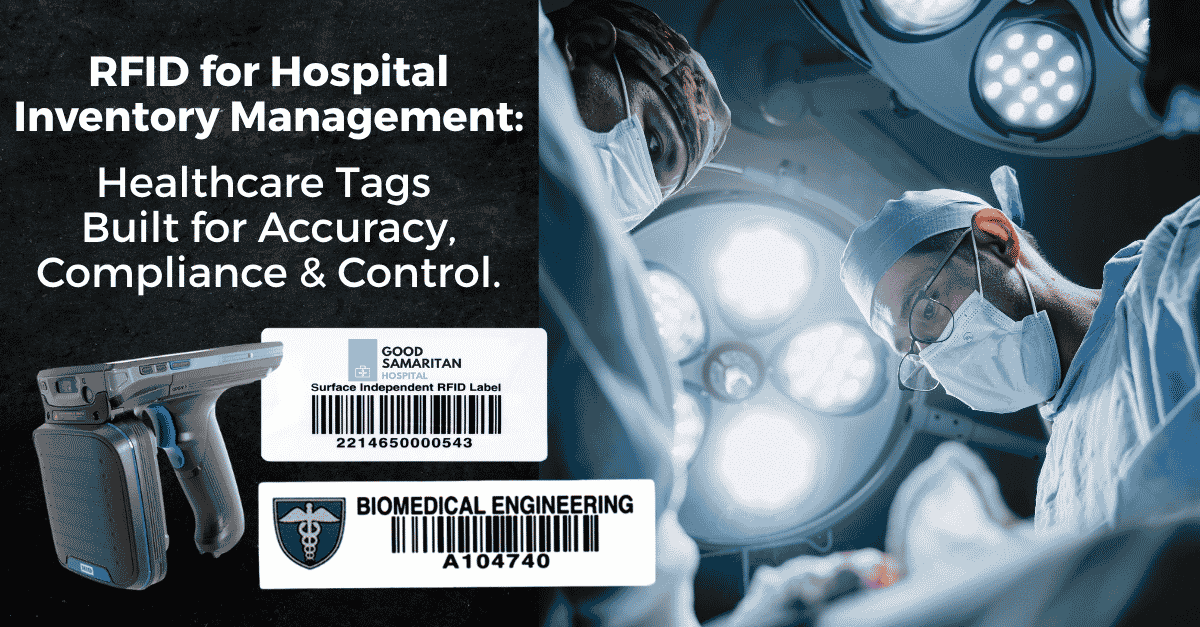
Hospitals depend on having the right supplies and equipment available at the right place and the right time. Yet many healthcare organizations continue to struggle with inventory accuracy. Medical supplies may appear available in an ERP or inventory management software but be missing from the shelf. Critical equipment may be “somewhere in the building,” but no one knows exactly where. At the same time, overstocked supplies consume valuable storage space while other departments experience stockouts.
These challenges affect far more than operational efficiency. Poor inventory management can delay patient care, increase supply chain costs, contribute to medication errors, and make it difficult for healthcare providers to maintain regulatory compliance. As hospitals face growing financial pressures and staffing shortages, improving inventory visibility has become a strategic priority for supply chain, materials management, healthcare IT, and value analysis teams.
RFID for hospital inventory management helps solve these challenges by automating the tracking of medical supplies, critical equipment, and other healthcare assets. Using radio frequency identification (RFID), hospitals can automatically identify inventory, improve stock accuracy, reduce manual data entry, and gain real-time visibility across the healthcare supply chain. As more healthcare organizations adopt RFID, its value continues to become clear. According to the ASHP Foundation, 84% of hospitals and health systems already using RFID rely on it to review inventory content and track trays and boxes throughout their facilities, demonstrating how the technology improves inventory visibility and operational efficiency.
Why Hospital Inventory Accuracy Needs Healthcare-Grade RFID
Hospital inventory rarely stays in one place. Medical supplies move from receiving to central supply, pharmacies, operating rooms, patient floors, and satellite storage locations. Mobile medical equipment travels continuously between departments, while surgical instruments circulate through sterilization and reprocessing. Without accurate inventory tracking, maintaining visibility across hospital operations becomes increasingly difficult.
When Inventory Records Don’t Match Reality
Many hospitals rely on systems that don’t always reflect what’s happening on the floor. Inventory records in ERP systems, computerized maintenance management systems (CMMS), and inventory management software may disagree with actual stock levels because they depend on manual entry, barcode scans, or delayed updates.
Common challenges include:
- Stockouts in one department while excess inventory sits unused elsewhere.
- Medical supplies that appear available in the system but cannot be located.
- Critical equipment stored in temporary locations without updated inventory records.
- Manual inventory counts that consume valuable staff time.
- Human error caused by manual data entry and historically barcode-driven workflows.
Without real-time inventory visibility, healthcare organizations often struggle to make informed purchasing and replenishment decisions.
The Hidden Costs of Limited Inventory Visibility
When inventory cannot be located quickly, hospitals often respond by purchasing additional supplies or renting replacement equipment—even when the original assets are still somewhere within the facility.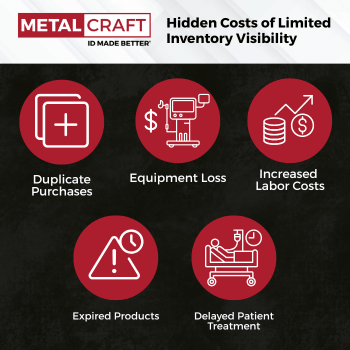
Poor inventory control can lead to:
- Duplicate purchases of medical equipment and supplies.
- Equipment loss and unnecessary rentals.
- Increased labor costs from manual inventory counts.
- Expired products that remain on shelves unnoticed.
- Delays in patient care while staff search for critical resources.
Healthcare organizations implementing RFID technology frequently report improvements in inventory accuracy because RFID systems automate inventory tracking instead of relying on manual processes. RFID can achieve up to 98% stock accuracy, process thousands of tagged items in minutes, and reduce inventory waste by approximately 25%. RFID readers automatically detect tagged items as they move throughout the hospital, creating accurate inventory records without requiring direct line of sight.
For supply chain leaders, better inventory visibility means lower operational costs, fewer rush orders, and improved supply chain efficiency. For clinicians, it means spending less time searching for supplies and more time delivering quality patient care.
What RFID Tracks in Hospital Inventory
One of the biggest misconceptions about RFID is that it only tracks expensive medical equipment. In reality, RFID for hospital inventory management supports a wide range of inventory and asset management applications across healthcare organizations.
Medical Supplies, Consumables, and PAR Areas
Passive RFID tags are well suited for tracking consumable inventory throughout hospitals, including supplies stored in PAR locations, central supply, pharmacies, and procedure rooms.
Common applications include:
- Medical supplies
- PPE and disposable products
- Implantable devices
- Pharmaceutical inventory
- RFID-enabled medication systems
- High-value medications
- Returnable containers
- Supply carts and procedure trays
RFID supports automated inventory tracking by allowing multiple RFID tags to be read simultaneously. Unlike traditional barcode systems that require manual scanning of individual items, RFID readers use radio waves to identify inventory automatically, significantly reducing counting time and improving inventory accuracy.
Hospitals can also program RFID tags with lot numbers, expiration dates, and other critical product data. RFID systems can automatically flag products nearing expiration, support automated stock replenishment alerts when inventory falls below predetermined thresholds, and simplify medication inventory management. While tagging medications often requires a labor-intensive process and close coordination with pharmacy personnel or pharmaceutical manufacturers, the long-term benefits include greater inventory visibility, improved medication safety, and reduced waste.
Durable Assets vs. Consumable Inventory
Hospitals typically manage two very different categories of inventory: durable assets and consumable supplies. Both benefit from RFID—but often in different ways.
Durable assets include:
- Infusion pumps
- Ventilators
- Wheelchairs
- Patient monitors
- Mobile workstations
- Surgical instruments
- Diagnostic equipment
Consumables include:
- Medical supplies
- Pharmaceuticals
- Surgical kits
- Procedure trays
- Sterile inventory
- Returnable containers
The type of RFID tag selected depends on the application. Passive RFID tags, powered by the reader’s signal, provide a cost-effective solution for tracking large volumes of inventory and supplies. Active RFID tags, which contain their own power source, are often used for high-value mobile assets requiring continuous location updates. Semi-passive RFID tags combine features of both technologies, using a battery to power the chip while relying on the reader for communication.
By separating durable assets from consumables and selecting the appropriate RFID technology for each workflow, hospitals can build a scalable inventory management strategy that improves inventory visibility, enhances operational efficiency, and supports better patient outcomes.
Choosing Hospital RFID Tags & Labels That Survive Healthcare
The success of an RFID inventory management program depends on more than selecting the right software—it starts with selecting the right RFID tag. Hospitals present one of the most demanding environments for RFID technology. Medical supplies and equipment are handled constantly, exposed to disinfectants and sterilization processes, and used on a wide variety of surfaces. Choosing a healthcare-grade RFID label that matches the application is essential for long-term performance and inventory accuracy.
Match the RFID Tag to the Surface
There is no one-size-fits-all RFID tag. Different medical assets require different tag designs depending on the material, mounting location, and workflow.
Healthcare organizations should consider RFID tags designed specifically for:
- Metal medical equipment such as infusion pumps, IV poles, hospital beds, monitors, and mobile carts.
- Plastic medical devices including handheld scanners, mobile devices, and diagnostic equipment.
- Curved or irregular surfaces that require flexible RFID labels.
- Hanging or reusable assets such as trays, kits, and returnable containers.
- Specialized environments where temperature monitoring, sterilization, or repeated handling are required.
Because RFID signals can be affected by materials such as metal and liquids, proper tag selection and tag placement are critical. Testing tags on the actual equipment before deployment helps ensure consistent read performance and prevents costly changes later.
Built to Withstand Healthcare Environments
Hospital inventory labels experience far more wear than labels used in many commercial settings. They must remain readable throughout years of daily use while standing up to demanding healthcare environments.
Healthcare-grade RFID labels should withstand:
- Routine cleaning and disinfecting chemicals.
- Frequent handling by hospital staff.
- Abrasion during transport and storage.
- Moisture and humidity.
- Sterilization and reprocessing cycles where applicable.
- Temperature fluctuations in healthcare environments.
For reusable medical devices and surgical instruments, infection prevention teams should be involved in the evaluation process to ensure RFID labels support cleaning protocols without compromising patient safety or device performance.
Why Redundancy Matters
RFID should enhance—not replace—existing identification methods.
Many hospitals choose labels that combine:
- RFID technology.
- Human-readable asset information.
- Barcode identification.
- Internal asset IDs.
- Serial numbers.
This hybrid approach provides flexibility across multiple hospital workflows. Staff can use RFID for automated inventory tracking while continuing to support barcode-driven processes where appropriate. If an RFID reader isn’t available, employees can still identify equipment using the barcode or human-readable information, reducing workflow disruptions.
A Procurement Checklist for Healthcare RFID Labels
When evaluating RFID labels for hospital inventory management, procurement teams should consider more than cost alone.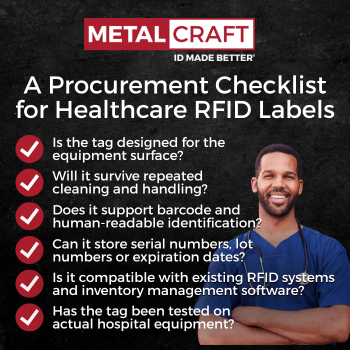
Ask questions such as:
- Is the tag designed for the equipment surface?
- Will it survive repeated cleaning and handling?
- Does it support barcode and human-readable identification?
- Can it store serial numbers, lot numbers, or expiration dates?
- Is it compatible with existing RFID systems and inventory management software?
- Has the tag been tested on actual hospital equipment?
Selecting the right RFID label upfront improves inventory accuracy, extends label life, and helps maximize the return on an RFID investment.
RFID for Compliance Labeling, UDI & Device Traceability
Inventory management isn’t just about knowing where supplies are located—it’s also about maintaining accurate records that support regulatory compliance, patient safety, and efficient hospital operations.
RFID technology helps healthcare organizations create a complete digital history for medical supplies, devices, and equipment throughout their lifecycle.
Managing Multiple Identifiers Without Creating Confusion
Medical devices often require several identifiers to support different operational and regulatory requirements.
An RFID label can incorporate:
- UDI (Unique Device Identification).
- Manufacturer serial numbers.
- Lot numbers.
- Internal asset IDs.
- Barcodes.
- Human-readable information.
Bringing these identifiers together on a single durable label simplifies asset management while reducing confusion between inventory, maintenance, and clinical teams.
Audit-Ready Inventory and Maintenance Records
Because RFID readers automatically capture movement throughout the facility, hospitals gain a more complete record of equipment history without relying on manual entry.
RFID supports:
- Equipment movement history.
- Maintenance schedules.
- Calibration records.
- Inventory transactions.
- Utilization reporting.
- Compliance documentation.
Integrating RFID with existing hospital systems, computerized maintenance management systems (CMMS), and inventory management software creates a centralized database that improves data accuracy while reducing administrative effort.
Faster Product Recalls and Better Traceability
When manufacturers issue recalls, speed is critical.
RFID tags programmed with lot numbers and expiration dates make it easier to identify affected inventory and remove products from circulation before they reach patients. RFID systems can also automatically flag expiring inventory, reducing waste and helping prevent expired products from being used.
For reusable medical devices and surgical instruments, durable RFID labels maintain identification throughout repeated cleaning, sterilization, and repair cycles, providing the traceability needed for regulatory requirements and infection prevention initiatives.
Building the Business Case: Inventory ROI
For supply chain leaders, value analysis committees, and healthcare IT teams, the question isn’t whether RFID works—it’s whether the investment delivers measurable financial and operational value.
The answer increasingly appears to be yes.
Improving Inventory Accuracy While Reducing Labor
Manual inventory counts are time-consuming and susceptible to human error. RFID technology automates inventory management by allowing RFID readers to process thousands of tagged items simultaneously. In fact, RFID technology can read more than 1,800 tagged items in approximately 10 minutes, dramatically reducing the time required for inventory counts while improving data accuracy.
Organizations implementing RFID commonly experience:
- Inventory accuracy approaching 98%.
- Reduced manual inventory counting.
- Automated inventory replenishment.
- Improved inventory visibility.
- Better stock level management.
- Lower operational costs.
The result is less time spent counting inventory and more time focused on strategic supply chain activities.
Better Utilization, Fewer Purchases
RFID doesn’t just tell hospitals what they own—it shows how assets are actually being used.
Real-time inventory visibility helps identify:
- Underutilized equipment that can be redistributed.
- High-value items that require closer monitoring.
- Opportunities to reduce rentals.
- Duplicate purchasing caused by poor visibility.
- Equipment approaching expiration or replacement.
Hospitals also benefit from automated tracking of infusion pumps, ventilators, and other critical equipment, reducing equipment loss while improving asset utilization across departments.
For value analysis teams, this utilization data supports smarter purchasing decisions, stronger inventory control, and a more efficient healthcare supply chain. While RFID implementation requires upfront planning, equipment, and installation costs, the long-term gains in inventory accuracy, labor savings, waste reduction, and operational efficiency often outweigh the initial investment.
Rolling Out RFID Across Hospital Inventory
Implementing RFID for hospital inventory management doesn’t have to be an all-or-nothing initiative. The most successful healthcare organizations begin with a targeted use case, validate results through a pilot program, and expand the system as measurable benefits are realized. This phased approach minimizes disruption, reduces implementation risk, and provides valuable data to support future investment decisions.
Start With the Business Problem
Rather than tagging every item in the hospital, identify the inventory category where RFID can deliver the greatest impact.
Common pilot projects include:
- High-value medical equipment such as infusion pumps and ventilators.
- High-cost pharmaceuticals and RFID-enabled medication systems.
- Surgical instruments and procedure trays.
- Central supply and PAR locations with frequent replenishment.
- Mobile carts, returnable containers, and shared equipment pools.
Establish clear success metrics before deployment, such as improving inventory accuracy, reducing equipment loss, decreasing cycle-count labor, improving medication inventory management, or increasing asset utilization.
Test RFID Tags on Real Healthcare Assets
Hospital environments present unique challenges for RFID. Metal equipment, plastic housings, liquids, disinfectants, sterilization processes, and daily handling all influence RFID performance.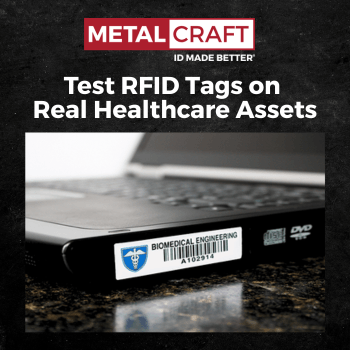
Before selecting an RFID label, test several options on the actual equipment and supplies you’ll be tracking. Evaluating different tag materials, adhesives, and placement locations helps ensure long-term durability and reliable read performance under real operating conditions.
Integrate With Existing Hospital Systems
RFID delivers the greatest value when it complements—not replaces—your existing technology investments.
At a high level, RFID should integrate with:
- Materials management and ERP systems.
- Inventory management software.
- CMMS and biomedical maintenance platforms.
- Hospital information systems.
- Existing hospital workflows and reporting tools.
Equally important is establishing governance around the asset master. Determine who owns inventory records, how new assets are tagged, how exceptions are handled, and how damaged or missing labels will be replaced. Well-defined processes help maintain data accuracy as the program grows.
Successful deployments also include staff training and practical job aids so supply chain teams, clinical staff, and healthcare IT understand how RFID fits into daily workflows. Technology adoption is strongest when employees understand not only how the system works, but how it improves their work.
Why Metalcraft for Hospital Inventory RFID
Hospitals need more than RFID labels—they need identification solutions built for demanding healthcare environments.
Metalcraft’s ID Made Better® approach starts by understanding your application, workflow, and operational goals before recommending a solution. As a technology-agnostic manufacturer, we recommend the right identification method for the job, whether that’s RFID, barcode, or a hybrid solution that combines both.
Healthcare organizations partner with Metalcraft because we provide:
- Healthcare-grade RFID labels engineered for repeated cleaning, disinfecting, and daily handling.
- RFID, barcode, and human-readable identification combined into a single durable label.
- Custom serialization, variable data, and data management expertise to support asset management, inventory control, and regulatory compliance.
- Application-specific recommendations based on equipment type, mounting surface, and workflow.
- Sample testing and due diligence to validate RFID performance before full deployment.
- U.S.-based manufacturing backed by responsive engineering and technical support.
Whether you’re tracking medical equipment, medical supplies, pharmaceuticals, or reusable surgical assets, Metalcraft helps healthcare organizations deploy RFID solutions that improve inventory accuracy, operational efficiency, and supply chain visibility.
Talk to Metalcraft About Your Hospital Inventory RFID Program
Every hospital has unique workflows, equipment, and inventory challenges. That’s why every RFID program should begin with understanding your application—not selecting a tag from a catalog.
Whether you’re looking to improve inventory accuracy, automate inventory tracking, reduce operational costs, strengthen medication management, or gain real-time inventory visibility across your healthcare supply chain, Metalcraft can help you identify the right solution.
Our RFID specialists can help you:
- Evaluate your current inventory management process.
- Recommend RFID labels based on your equipment, supplies, and workflows.
- Provide healthcare-grade sample tags for testing.
- Support pilot programs before full deployment.
- Develop a scalable RFID strategy that integrates with your existing hospital systems.
Ready to improve inventory visibility and control? Contact Metalcraft today to request RFID samples, schedule a consultation, or receive a custom quote for your hospital inventory management program.
About the Author: John Fitzsimmons

Mobile Phone: 641-423-9460
Office Phone: 641-423-9460
Email: [email protected]
Office: 3360 9th St SW