
Medical device manufacturers face increasing pressure to deliver safe, high-quality products while maintaining complete traceability throughout the manufacturing process. Regulatory requirements continue to evolve, global supply chains have become more complex, and customers expect greater visibility into every stage of a product’s lifecycle. At the same time, manufacturers must improve production efficiency, reduce costs, and maintain accurate inventory without sacrificing quality.
Traditional barcode systems remain an important part of medical device identification, particularly for Unique Device Identification (UDI) compliance. However, many manufacturers are expanding beyond barcode-only processes by implementing RFID for medical device manufacturers to automate identification, improve inventory tracking, and gain real-time visibility throughout production and distribution.
Unlike barcode labels, RFID technology does not require direct line-of-sight scanning and can automatically identify multiple items simultaneously. RFID systems, which consist of RFID tags, RFID readers, and software that processes RFID data, help manufacturers automate data capture, reduce manual entry, improve inventory accuracy, and support regulatory compliance across the entire product lifecycle.
As adoption continues to grow across the healthcare industry—with the healthcare RFID market projected to expand from $7.7 billion in 2025 to more than $31 billion by 2034—medical device manufacturers are increasingly recognizing RFID as a strategic investment. Beyond improving operational efficiency, RFID enhances traceability, strengthens quality systems, supports supply chain optimization, and ultimately contributes to improved patient safety by ensuring the right products reach healthcare providers at the right time.
Why Medical Device Manufacturers Are Adopting RFID
For many manufacturers, RFID is no longer viewed simply as an identification technology—it’s becoming an essential part of modern manufacturing and quality management. From raw materials through finished goods, RFID provides greater visibility into products, equipment, and manufacturing operations while reducing manual processes that introduce delays and human error.
Improve Product Traceability Throughout Manufacturing
Medical devices pass through numerous production stages before reaching hospitals and healthcare providers. Maintaining complete traceability throughout this process is critical for quality assurance, regulatory compliance, and product recall readiness.
RFID allows manufacturers to track products through every stage of the manufacturing lifecycle, including: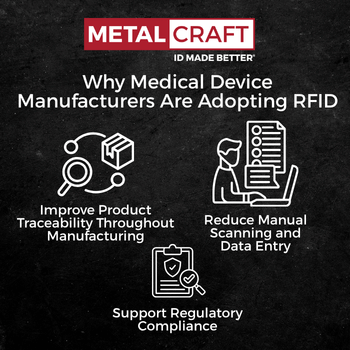
- Raw materials and incoming components.
- Work in progress (WIP).
- Assembly operations.
- Testing and quality inspections.
- Packaging and labeling.
- Finished goods inventory.
- Distribution throughout the healthcare supply chain.
Because RFID tags remain associated with a product throughout production, manufacturers gain a continuous digital record of each device’s history. Inspection results, testing data, production milestones, and movement between workstations can all be linked to individual products, providing the detailed documentation required by regulatory authorities while simplifying investigations and audits.
RFID also enhances quality control by linking inspection results directly to individual medical devices. This level of traceability helps manufacturers ensure regulatory compliance while improving visibility into production workflows and product performance.
Reduce Manual Scanning and Data Entry
Manufacturing efficiency depends on accurate, timely data. Traditional barcode systems often require operators to stop production and manually scan products at each process step. While effective, these workflows increase labor requirements and create opportunities for missed scans and manual entry errors.
RFID automates much of this process.
As products move through production, RFID readers automatically detect RFID tags and capture data without requiring direct line-of-sight scanning. Automated data collection eliminates many manual tasks, allowing employees to focus on higher-value activities while improving production throughput.
Key benefits include:
- Faster product identification throughout manufacturing.
- Automated data capture with fewer manual processes.
- Reduced human error caused by manual entry.
- Improved inventory tracking and inventory accuracy.
- Enhanced operational efficiency across production lines.
- Better visibility into work-in-process inventory.
Because RFID technology automates workflows and captures real-time data, manufacturers can make faster production decisions, identify bottlenecks sooner, and improve overall manufacturing performance.
Support Regulatory Compliance
Regulatory compliance remains one of the primary drivers behind RFID adoption in medical device manufacturing.
Manufacturers must maintain extensive documentation demonstrating product quality, traceability, and process control throughout the device lifecycle. RFID supports these requirements by automatically recording production events and maintaining detailed records that can be integrated with existing quality management systems.
RFID helps support:
- FDA regulatory requirements.
- Unique Device Identification (UDI) initiatives.
- Device History Records (DHR).
- Quality management systems.
- Internal quality audits.
- Distribution traceability.
RFID also supports advanced security capabilities. Modern RFID technology can incorporate cryptographic authentication and tamper-detection features that help reduce counterfeiting risks while protecting product integrity throughout the supply chain.
Although implementing RFID requires careful planning and integration with existing ERP, MES, inventory management, and quality systems, the long-term benefits often outweigh the initial investment. Manufacturers gain more reliable product identification, automated compliance documentation, improved data visibility, and greater confidence in the integrity of their manufacturing processes.
Common Applications for RFID in Medical Device Manufacturing
Medical device manufacturers use RFID across virtually every stage of production—not only to track finished products, but also to improve inventory control, monitor manufacturing assets, and automate warehouse operations.
Work-in-Process (WIP) Tracking
Work-in-process tracking is one of the most valuable RFID applications in medical device manufacturing. RFID provides real-time visibility into products as they move between assembly, inspection, testing, packaging, and shipping.
Instead of relying on manual scans to update production status, RFID readers automatically capture product movement, providing precise tracking throughout manufacturing. This improves scheduling, identifies production bottlenecks earlier, and helps manufacturers maintain accurate production records.
Inventory and Warehouse Management
RFID dramatically improves inventory management by automating inventory tracking throughout warehouses and production facilities. RFID readers can process thousands of tagged items in minutes, providing real-time inventory visibility while reducing manual inventory counts.
The result is:
- Improved inventory accuracy.
- Better inventory control.
- Automated inventory replenishment.
- More accurate stock levels.
- Reduced inventory waste.
- Improved warehouse efficiency.
By improving visibility into inventory and material movement, manufacturers can streamline operations, reduce operational costs, and strengthen overall supply chain performance.
RFID vs. Barcode Labels for Medical Device Manufacturers
For many medical device manufacturers, the question isn’t whether to use RFID or barcode labels—it’s how to use both technologies most effectively. Barcode labels remain the standard for many regulatory identification requirements, while RFID technology provides operational visibility that barcodes alone cannot deliver. Together, they create a comprehensive identification strategy that improves traceability, inventory management, and manufacturing efficiency.
Advantages of Barcode Labels
Barcode labels continue to play a vital role in medical device manufacturing, particularly for product identification and regulatory compliance. They are cost-effective, easy to implement, and compatible with virtually every manufacturing execution system (MES), ERP platform, and warehouse management system.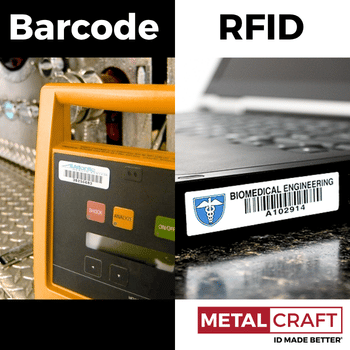
Barcode labels are well suited for:
- Cost-sensitive applications where RFID infrastructure isn’t required.
- Individual product identification and serialization.
- UDI labeling and FDA compliance.
- Manual scanning environments.
- Finished product labeling.
- Medical device packaging.
- Applications requiring human-readable information.
Barcodes provide reliable identification, but they depend on manual scanning and direct line-of-sight. Every scan requires an operator to locate and present the label, making data collection more labor-intensive and increasing the potential for human error.
Advantages of RFID Labels
RFID technology offers significant advantages over traditional barcode systems by automating identification and data capture throughout manufacturing operations.
Unlike traditional barcode systems, RFID:
- Does not require direct line-of-sight scanning.
- Automatically identifies multiple tagged items simultaneously.
- Reduces manual data entry and scanning.
- Provides real-time inventory visibility.
- Enables automated tracking throughout production.
- Supports warehouse automation and inventory control.
- Improves operational efficiency by reducing labor-intensive processes.
RFID tags also store more information than conventional barcodes and, depending on the application, can support writing additional data back to the tag during production. This allows manufacturers to associate inspection results, process status, quality records, and other production information with individual medical devices.
Modern RFID solutions can also incorporate cryptographic security protocols and tamper-detection features that help protect products from counterfeiting while strengthening product identification throughout the healthcare supply chain.
Many Manufacturers Use Both Technologies
Rather than replacing barcode labels, RFID frequently complements them.
Many manufacturers adopt hybrid identification strategies that combine RFID, barcode, QR codes, and human-readable information on a single durable label. This approach allows organizations to satisfy UDI requirements while simultaneously improving inventory tracking, automated data capture, and production visibility.
Hybrid labels support multiple workflows across manufacturing and healthcare settings. RFID automates inventory tracking and warehouse operations, while barcodes continue supporting customer requirements, field service activities, and manual verification when needed.
As products move from manufacturing facilities into hospitals, healthcare providers can continue using barcode systems for patient-facing workflows while leveraging RFID-enabled systems for inventory management, asset tracking, and supply chain optimization.
Choosing the Right RFID Labels for Medical Devices
The effectiveness of an RFID system depends heavily on selecting labels that are engineered for the application. Medical device manufacturing environments expose products to abrasion, cleaning chemicals, sterilization processes, and demanding production conditions that standard labels often cannot withstand.
Choosing the right RFID label helps ensure reliable performance throughout manufacturing, distribution, and the product’s operational lifecycle.
Durability for Manufacturing Environments
Medical device labels must remain functional long after they leave the production floor.
Depending on the application, RFID labels may need to resist:
- Abrasion during manufacturing and shipping.
- Cleaning chemicals and disinfectants.
- Heat generated during production.
- Sterilization processes where applicable.
- Long product lifecycles.
- Frequent handling throughout the supply chain.
Certain medical applications also require RFID tags capable of surviving autoclave sterilization. Autoclave-tolerant RFID tags help manufacturers support sterilization validation while maintaining accurate product identification throughout repeated sterilization cycles.
Durable label construction not only improves reliable performance but also helps ensure traceability throughout the entire medical device lifecycle.
RFID Labels for Challenging Surfaces
Medical devices are manufactured in a wide variety of materials and configurations, making application-specific label selection essential.
RFID labels are available for:
- Plastic housings.
- Metal medical equipment.
- Curved or irregular surfaces.
- Small medical devices with limited label space.
- Medical device packaging.
- Returnable manufacturing containers and fixtures.
Because RFID performance can be affected by metal and liquids, application engineering and testing are critical. Proper tag placement and label construction help minimize signal interference while maximizing read reliability throughout manufacturing and downstream healthcare environments.
Custom RFID Solutions
Every manufacturing process is different, which is why many medical device manufacturers require customized RFID solutions.
Custom RFID labels can include:
- Serialized identification numbers.
- Variable data fields.
- Linear and 2D barcodes.
- QR codes.
- Company logos and branding.
- Custom sizes, materials, and adhesives.
- Multiple RFID frequencies based on application requirements.
These customized identification solutions support automated tracking, inventory management, quality documentation, and regulatory compliance while integrating seamlessly with existing manufacturing and quality systems.
Benefits of RFID for Medical Device Manufacturers
RFID provides measurable benefits throughout manufacturing by improving visibility, automating workflows, and reducing manual processes that slow production and introduce errors.
Increase Manufacturing Efficiency
Automated data capture eliminates many manual scanning steps, allowing products to move more efficiently through manufacturing. RFID automates identification, improves workflow visibility, and helps streamline operations across production, packaging, receiving, and shipping.
Improve Inventory Accuracy
RFID readers can process thousands of tagged items in minutes, providing highly accurate inventory counts while reducing manual inventory checks. Improved inventory accuracy helps maintain accurate stock levels, supports inventory replenishment, and reduces inventory waste by improving visibility across the supply chain.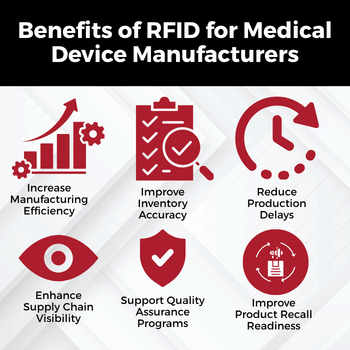
Reduce Production Delays
Real-time tracking provides immediate insight into product location and production status. Manufacturers can quickly identify bottlenecks, locate work-in-process inventory, and prevent production interruptions caused by missing materials or delayed components.
Enhance Supply Chain Visibility
RFID provides end-to-end visibility from raw materials through distribution. Manufacturers gain better control over inventory, shipping, warehouse operations, and product movement while improving communication throughout the healthcare supply chain.
Support Quality Assurance Programs
RFID enhances quality systems by automatically linking manufacturing data, inspection results, testing records, and production history to individual products. This reduces manual documentation while strengthening traceability and ensuring compliance with regulatory requirements.
Improve Product Recall Readiness
When quality issues arise, manufacturers need to identify affected products quickly and accurately. RFID enables swift, targeted product recalls by maintaining detailed production and distribution records for every serialized device. Instead of broad recalls affecting entire production lots, manufacturers can isolate specific products, minimizing disruption, reducing costs, and helping protect patient safety.
How RFID Supports UDI and Medical Device Traceability
Medical device manufacturers are expected to do more than simply identify products—they must maintain complete traceability throughout the product lifecycle. From production and testing to distribution and post-market surveillance, manufacturers need accurate, accessible data that supports regulatory compliance, quality management, and rapid response when issues arise.
RFID technology strengthens medical device traceability by automating product identification and data collection at every stage of manufacturing. Rather than relying solely on manual scanning, RFID captures product movement automatically, providing greater visibility while reducing human error.
Understanding Unique Device Identification (UDI)
The FDA’s Unique Device Identification (UDI) system was established to improve the identification and traceability of medical devices throughout the healthcare supply chain. UDI labels help healthcare providers, distributors, and regulatory authorities accurately identify products while supporting adverse event reporting, recalls, and patient safety initiatives.
A typical UDI includes:
- Device identifier (DI)
- Production identifier (PI)
- Lot or batch number
- Serial number
- Manufacturing information
- Expiration dates where applicable
While barcode labels remain the primary method for meeting UDI labeling requirements, manufacturers increasingly use RFID technology to enhance operational visibility and automate internal manufacturing processes.
RFID as a Complement to UDI Labeling
RFID is not intended to replace UDI barcodes—instead, the two technologies work together to create a more comprehensive identification strategy.
Many medical device manufacturers combine:
- RFID tags
- UDI-compliant barcode labels
- Human-readable information
- QR codes
- Serialized product identification
This hybrid approach allows manufacturers to satisfy regulatory requirements while gaining the operational advantages of RFID. Unlike barcodes, RFID does not require direct line-of-sight scanning, enabling products to be identified automatically as they move through production, packaging, warehousing, and distribution.
RFID tags can also store more information than traditional barcode labels and, in some applications, allow additional data to be written back to the tag during manufacturing. This creates a dynamic identification platform capable of supporting quality assurance, production tracking, and product traceability.
Building a Digital Traceability Strategy
The greatest value of RFID comes from integrating it with existing business systems rather than operating as a standalone technology.
Modern RFID systems integrate with:
- ERP platforms
- Manufacturing execution systems (MES)
- Inventory management software
- Warehouse management systems (WMS)
- Quality management systems (QMS)
- Asset management platforms
By connecting RFID readers, software, and existing systems, manufacturers gain real-time data that improves production visibility, inventory control, and decision-making. Automated data collection eliminates many manual processes while creating a complete digital history for every product manufactured.
This digital traceability strategy not only supports regulatory compliance but also improves inventory management, quality assurance, supply chain optimization, and long-term operational efficiency.
Why Medical Device Manufacturers Choose Metalcraft
Successful RFID programs begin with selecting the right identification partner—not simply purchasing RFID labels.
For more than 75 years, Metalcraft has helped manufacturers develop durable identification solutions for demanding industrial and healthcare applications. Our engineering-first approach focuses on understanding your products, manufacturing environment, and operational goals before recommending the right identification technology.
Medical device manufacturers partner with Metalcraft because we offer:
- Decades of industrial identification expertise supporting highly regulated manufacturing environments.
- Comprehensive RFID and barcode capabilities, including hybrid labels that combine RFID, barcodes, QR codes, and human-readable information.
- Durable RFID labels engineered to withstand abrasion, cleaning chemicals, handling, sterilization processes, and long product lifecycles.
- Custom manufacturing capabilities, including specialized materials, adhesives, sizes, and label constructions.
- Serialization and variable data management to support UDI initiatives, product traceability, and quality systems.
- Application engineering support to help select the appropriate RFID technology, frequency, and label design for your specific application.
- Flexible production volumes, from pilot programs to enterprise-scale manufacturing.
Whether you’re implementing RFID for work-in-process tracking, warehouse automation, inventory management, or end-to-end product traceability, Metalcraft helps you deploy identification solutions built for long-term performance.
Frequently Asked Questions
Can RFID labels withstand sterilization processes?
Yes. RFID labels can be engineered for demanding healthcare and manufacturing environments, including applications that require repeated sterilization. Autoclave-tolerant RFID tags are available for products exposed to high-temperature sterilization processes while maintaining reliable identification and read performance.
Can RFID labels be applied to small medical devices?
Absolutely. RFID labels are available in a variety of sizes and constructions designed specifically for compact medical devices, curved surfaces, plastic housings, and metal components. The appropriate label depends on the available space, operating environment, and required read range.
Can RFID work together with barcode labels?
Yes. Many medical device manufacturers use hybrid labels that combine RFID technology with UDI-compliant barcodes, QR codes, and human-readable information. This approach supports regulatory compliance while adding automated tracking and improved operational visibility.
What RFID frequency is best for medical device manufacturing?
There is no single answer. The best RFID frequency depends on factors such as read range, product materials, manufacturing workflow, and the operating environment. Working with an experienced RFID partner helps ensure the selected technology aligns with your application and performance requirements.
Can RFID improve inventory accuracy in manufacturing facilities?
Yes. RFID automates inventory tracking and data collection, reducing manual inventory checks and improving inventory visibility. Manufacturers can process thousands of tagged items quickly, maintain more accurate stock levels, reduce inventory waste, and improve overall operational efficiency.
Conclusion
Medical device manufacturers face growing pressure to improve traceability, maintain regulatory compliance, and operate more efficiently without compromising quality or patient safety. RFID technology helps meet these demands by automating identification, reducing manual processes, and providing real-time visibility throughout manufacturing and the healthcare supply chain.
When combined with durable, application-specific labels, RFID strengthens quality management systems, improves inventory accuracy, enhances recall readiness, and supports end-to-end product traceability. Rather than replacing barcode identification, RFID complements existing UDI programs by adding automated data capture and operational visibility across the entire product lifecycle.
Build a Smarter Medical Device Identification Strategy
Whether you’re implementing RFID for work-in-process tracking, inventory management, warehouse automation, or end-to-end product traceability, Metalcraft offers custom RFID labels and identification solutions engineered for demanding medical device manufacturing environments.
Our RFID specialists can help you evaluate your application, recommend the appropriate RFID technology, and develop a labeling strategy that supports your manufacturing, quality, and compliance objectives. Contact the Metalcraft team today to discuss your project and receive expert guidance on selecting RFID labels designed to improve traceability, inventory accuracy, and operational performance.
About the Author: John Fitzsimmons

Mobile Phone: 641-423-9460
Office Phone: 641-423-9460
Email: [email protected]
Office: 3360 9th St SW