
Hospitals depend on immediate access to critical medical equipment. Whether clinicians need an infusion pump for a new patient, a wheelchair for discharge, or a crash cart during an emergency, delays in locating equipment can affect patient care, reduce staff productivity, and increase operating costs.
Unfortunately, many healthcare organizations still struggle with limited visibility into their mobile equipment. Medical devices are constantly moving between patient rooms, emergency departments, operating suites, imaging centers, nursing units, and storage areas. Without an effective RFID medical equipment tracking solution, valuable assets can become difficult to locate, leading to unnecessary equipment purchases, higher rental costs, delayed treatments, and increased compliance risks.
As healthcare facilities continue to invest in digital transformation, RFID technology has become one of the most effective tools for improving asset tracking, inventory management, and operational efficiency. By combining durable RFID tags, strategically placed RFID readers, and intelligent software, hospitals can gain real-time visibility into medical equipment without relying on manual scanning or outdated inventory methods.
From infusion pumps and patient monitors to surgical instruments and portable imaging systems, RFID helps healthcare providers quickly locate equipment, automate data capture, and improve asset management processes. The result is better inventory control, enhanced patient safety, and more time for medical staff to focus on delivering quality patient care.
What Is RFID Medical Equipment Tracking?
RFID medical equipment tracking uses radio frequency identification (RFID) to automatically identify, locate, and manage medical equipment throughout a healthcare facility. Instead of manually scanning asset labels or maintaining spreadsheets, RFID systems continuously capture equipment movement and location data, giving hospitals greater visibility into their healthcare assets.
Unlike traditional barcode systems, RFID does not require direct line-of-sight scanning. RFID readers use radio waves to detect RFID tags automatically as equipment moves through hospital workflows, making inventory tracking faster, more accurate, and significantly less labor-intensive.
How RFID Asset Tracking Works
An RFID tracking system consists of three primary components that work together to provide precise and automated tracking of medical equipment: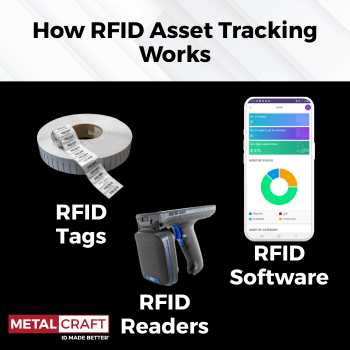
- RFID tags attached to medical equipment such as infusion pumps, wheelchairs, ventilators, patient monitors, crash carts, and other mobile assets.
- RFID readers, including fixed and handheld devices, that automatically detect RFID tags and collect location data as equipment moves throughout the facility.
- RFID software that stores RFID data, tracks equipment status, and integrates with asset management, inventory management, ERP, CMMS, and other hospital systems.
As tagged equipment moves through the hospital, RFID readers automatically identify each asset and transmit data to a centralized database. The software updates equipment location, usage history, and availability in real time, allowing staff to quickly locate equipment without performing manual inventory checks.
Because RFID systems eliminate much of the manual data entry associated with traditional inventory methods, hospitals benefit from greater data accuracy, improved operational efficiency, and reduced human error. Many RFID solutions also integrate with existing systems, electronic health records, inventory management software, and other hospital management platforms, enhancing tracking capabilities without requiring major workflow changes.
Types of Medical Equipment Commonly Tracked
Virtually any mobile medical asset can benefit from RFID tracking, particularly equipment that moves frequently between departments or is shared across multiple clinical areas.
Common examples include:
- Infusion pumps, one of the most frequently tracked assets due to their high utilization and mobility.
- Wheelchairs that are often relocated throughout the facility.
- Crash carts requiring immediate availability during emergencies.
- Defibrillators that must remain readily accessible and properly maintained.
- Ultrasound machines shared among departments.
- Ventilators and other critical respiratory equipment.
- Portable X-ray systems used throughout the hospital.
- IV poles and specialty carts.
- Patient monitors that frequently move between care areas.
- Surgical instruments requiring tracking throughout sterilization and operating room workflows.
Hospitals can use RFID to track tens of thousands of medical devices simultaneously. Some healthcare organizations manage more than 40,000 medical devices using RFID technology, providing real-time visibility into equipment location, status, and availability across multiple departments and campuses.
Why Hospitals Are Replacing Manual Equipment Tracking
Many hospitals still rely on manual inventory checks, spreadsheets, or traditional barcode systems to manage medical equipment. While these methods can work in smaller environments, they often become inefficient as hospitals grow and medical assets move more frequently throughout the organization.
Reduce Time Spent Searching for Equipment
One of the biggest frustrations for clinicians is simply finding the equipment they need.
Medical staff often spend valuable time searching nursing units, hallways, storage rooms, and neighboring departments for critical equipment that should already be available. Industry studies estimate that healthcare professionals may spend 20 to 30 minutes per shift searching for equipment. RFID tracking significantly reduces this time by allowing staff to instantly identify an asset’s last known location.
Rather than interrupting patient care to search for equipment, clinicians can quickly locate infusion pumps, wheelchairs, patient monitors, and other mobile assets through the RFID tracking system. This improves patient flow, reduces staff frustration, and gives healthcare providers more time to focus on patient care.
Improve Equipment Utilization
Limited visibility often causes hospitals to purchase equipment they already own.
When staff cannot locate mobile equipment, departments frequently order replacements or rent additional assets—even though existing equipment is somewhere else in the building. RFID technology improves asset utilization by providing real-time tracking and accurate location data, helping hospitals make better use of existing medical equipment before investing in additional purchases.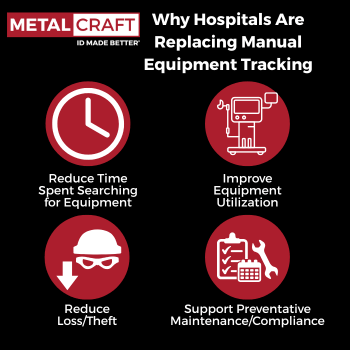
Healthcare organizations implementing RFID commonly report improved equipment utilization, fewer unnecessary equipment purchases, and measurable cost savings through better inventory visibility.
Reduce Equipment Loss and Theft
Hospital equipment is constantly moving, making accountability difficult without automated tracking.
RFID technology improves accountability by recording equipment movement automatically as assets pass RFID readers. Real-time visibility helps reduce equipment loss and theft while making it easier to recover misplaced assets. Considering hospitals can lose approximately $3,000 for every misplaced asset, even modest improvements in visibility can generate a significant return on investment.
Support Preventive Maintenance and Compliance
RFID supports much more than equipment location—it also strengthens regulatory compliance and maintenance management.
Modern RFID systems can automatically flag equipment due for preventive maintenance, inspection, calibration, or testing. Maintenance schedules become easier to manage because biomedical teams can quickly locate equipment instead of creating “unable to locate” work orders.
Automated tracking also supports compliance reporting by maintaining detailed equipment histories, usage data, and maintenance records. Combined with durable RFID labels designed for hospital environments, healthcare organizations can improve accreditation readiness while ensuring critical medical devices remain properly maintained and available for patient care.
RFID vs. Barcode Tracking for Medical Equipment
Both barcode and RFID technologies play an important role in healthcare asset management. The right choice depends on your facility’s size, workflows, budget, and visibility requirements. In fact, many healthcare organizations use both technologies together to maximize operational efficiency while controlling implementation costs.
Benefits of Barcode Asset Labels
Barcode asset labels remain a proven and cost-effective solution for many healthcare facilities. They are well suited for organizations that perform scheduled inventory audits or have fewer mobile assets to manage.
Barcode systems are ideal for:
- Lower-cost asset identification programs with minimal infrastructure requirements.
- Manual inventory audits and periodic equipment verification.
- Smaller hospitals, clinics, surgery centers, and specialty care facilities.
- Organizations with historically barcode-driven workflows.
- Facilities that need simple asset identification without continuous location tracking.
Because barcode systems require manual scanning and direct line-of-sight, they depend on employees updating inventory records as equipment moves. While this approach can provide accurate information, it also increases labor requirements and creates opportunities for human error when assets aren’t scanned consistently.
Benefits of RFID Asset Tracking
Unlike traditional barcode systems, RFID medical equipment tracking automates much of the data collection process. RFID readers detect tagged assets automatically, eliminating the need to manually scan every piece of equipment as it moves throughout the hospital.
Healthcare organizations often choose RFID when they need:
- Automated inventory tracking without line-of-sight scanning.
- Real-time tracking of mobile equipment across departments.
- Faster equipment searches and improved asset visibility.
- Reduced manual inventory checks and data entry.
- Better utilization of high-value medical devices.
- Improved inventory control and asset management.
- Enhanced operational efficiency across large healthcare facilities.
Because RFID technology uses radio waves to communicate with RFID tags, multiple assets can be identified simultaneously. RFID readers automatically collect location data and equipment status as assets move throughout hospital workflows, dramatically improving inventory visibility.
Modern RFID systems also support automated reporting, maintenance scheduling, and compliance documentation. By automating data capture, hospitals gain more accurate usage data while reducing the administrative burden associated with manual inventory management.
When Healthcare Organizations Use Both Technologies
For many hospitals, the best solution isn’t RFID or barcode—it’s both.
Hybrid identification strategies combine RFID and barcode technology on a single durable asset label. This allows healthcare organizations to continue supporting existing barcode workflows while adding RFID capabilities as new infrastructure is deployed.
A hybrid RFID label may include:
- RFID technology for automated tracking.
- A barcode for manual scanning when needed.
- Human-readable asset information.
- Serialized asset IDs.
- QR codes for mobile access to maintenance records or equipment documentation.
This approach provides flexibility during implementation while protecting previous investments in barcode-based asset management processes. It also allows departments without RFID readers to continue using barcode scanners until additional RFID infrastructure is installed.
Choosing the Right RFID Labels for Healthcare Equipment
The effectiveness of any RFID tracking system depends on the quality of the RFID labels attached to the equipment. Healthcare environments are demanding, and standard RFID labels often aren’t designed to withstand years of cleaning, handling, and daily use.
Selecting healthcare-grade RFID labels helps ensure accurate tracking, long service life, and reliable performance.
Durability Matters
Hospital equipment is exposed to conditions that quickly wear out ordinary labels. Durable RFID labels must continue performing throughout the equipment’s lifecycle while maintaining both RFID functionality and readable printed information.
Healthcare RFID labels should withstand:
- Routine exposure to hospital disinfectants and cleaning chemicals.
- Frequent handling by medical staff.
- Abrasion during transport and storage.
- Moisture and humidity.
- Long equipment life cycles.
- Sterilization processes where required.
Certain healthcare applications, such as reusable surgical instruments, may require autoclave-tolerant RFID tags that withstand repeated high-temperature sterilization cycles. These specialized RFID solutions help maintain compliance with sterilization protocols while ensuring equipment remains identifiable after every cleaning cycle.
Tag Materials and Adhesives
Medical equipment comes in many shapes, sizes, and materials, making tag selection just as important as the RFID technology itself.
Healthcare organizations should evaluate:
- On-metal RFID tags designed specifically for metal hospital equipment.
- High-performance adhesives engineered for demanding healthcare environments.
- Flexible RFID labels for curved or irregular surfaces.
- Tamper-resistant options for permanent asset identification.
- Materials designed to withstand cleaning, abrasion, and repeated handling.
Proper tag placement is equally important. Since RFID tracking can be affected by metals and liquids, testing labels on actual medical equipment helps ensure consistent read performance before full deployment.
Custom RFID Label Options
Every healthcare organization manages equipment differently, which is why customization is often essential.
Custom RFID labels can include:
- Serialized asset IDs.
- Linear or 2D barcodes.
- QR codes.
- Hospital logos and branding.
- Human-readable equipment information.
- Multiple RFID frequencies when required.
- Variable data for asset management or inventory control.
These customizations allow RFID labels to support inventory tracking, preventive maintenance, compliance reporting, and equipment identification within a single durable label. Whether hospitals are tracking infusion pumps, surgical instruments, mobile devices, or other healthcare assets, the right RFID label provides a reliable foundation for long-term asset management.
Key Benefits of RFID Medical Equipment Tracking
Healthcare organizations continue adopting RFID because it delivers measurable improvements across clinical, operational, and financial areas.
Improve Patient Care
When clinicians can quickly locate equipment, they spend less time searching and more time caring for patients. Real-time visibility into critical equipment helps support faster treatment decisions, smoother patient flow, and improved patient outcomes.
Increase Staff Productivity
Automated tracking reduces manual inventory checks, manual scanning, and administrative tasks. Medical staff can locate equipment in seconds instead of spending valuable time searching multiple departments.
Reduce Capital Spending
Better asset utilization helps hospitals avoid unnecessary equipment purchases and reduce rentals. Accurate usage data also identifies underutilized equipment that can be redistributed instead of replaced.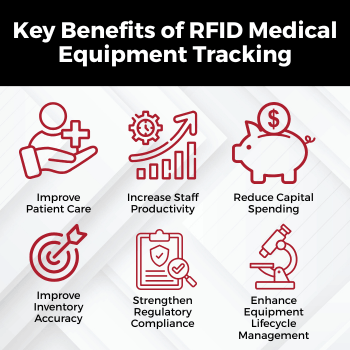
Improve Inventory Accuracy
RFID technology automates data capture, improving inventory accuracy while reducing manual entry and human error. Real-time visibility provides a more complete picture of medical device inventory across the organization.
Strengthen Regulatory Compliance
RFID supports compliance by maintaining accurate maintenance records, equipment histories, inspection schedules, and usage documentation. Automated tracking also helps ensure critical equipment remains properly maintained and available when needed.
Enhance Equipment Lifecycle Management
RFID provides continuous visibility throughout an asset’s lifecycle—from initial deployment through maintenance, repair, relocation, and eventual replacement. Better lifecycle management extends equipment value while improving planning, budgeting, and long-term asset management.
Industries and Healthcare Facilities That Benefit
While large hospitals are often the first organizations to adopt RFID medical equipment tracking, healthcare providers of all sizes can benefit from greater visibility into medical assets, improved inventory management, and more efficient workflows.
Hospitals
Acute care hospitals rely on RFID to manage thousands of mobile assets across multiple departments. Real-time tracking helps staff quickly locate equipment, improve asset utilization, reduce equipment loss, and streamline patient care.
Surgery Centers
Ambulatory surgery centers use RFID to track surgical instruments, procedure carts, and critical medical devices. Automated tracking supports sterilization protocols, reduces errors, and helps ensure equipment is available for every procedure.
Clinics
Clinics and outpatient facilities use RFID to manage shared medical equipment, improve inventory control, and reduce the time employees spend locating devices between patient appointments.
Long-Term Care Facilities
Long-term care and rehabilitation facilities benefit from RFID by tracking wheelchairs, lifts, infusion pumps, and other frequently shared equipment. Improved equipment visibility supports better patient care while reducing replacement costs.
Medical Laboratories
Laboratories use RFID to manage testing equipment, mobile assets, sample containers, and specialized medical devices. Automated tracking improves inventory accuracy while supporting regulatory compliance and audit readiness.
Research Institutions
Universities, research hospitals, and pharmaceutical organizations use RFID to monitor laboratory equipment, track valuable research assets, and improve utilization of specialized medical devices across multiple departments.
Why Choose Metalcraft for RFID Medical Equipment Labels?
Selecting the right RFID technology is only part of a successful asset tracking program. Equally important is choosing an identification partner that understands healthcare environments and can recommend labels engineered for your specific application.
For more than 75 years, Metalcraft has helped organizations identify and track critical assets in some of the world’s most demanding environments. Our consultative approach ensures you receive the right identification solution—not simply an off-the-shelf RFID label.
Healthcare organizations choose Metalcraft because we offer:
- Decades of identification expertise supporting hospitals, healthcare systems, laboratories, and medical device manufacturers.
- Durable RFID solutions engineered to withstand cleaning chemicals, hospital disinfectants, abrasion, and years of daily handling.
- Custom-engineered RFID labels designed for metal equipment, plastic devices, curved surfaces, and other challenging applications.
- Barcode, QR code, and RFID capabilities combined into a single durable label to support multiple hospital workflows.
- Custom sizes, materials, adhesives, and serialization options tailored to your equipment and asset management requirements.
- Application engineering support to help determine the right RFID technology, tag placement, and label construction for your environment.
- U.S.-based manufacturing with responsive technical support and consistent product quality.
Whether you’re implementing a new RFID tracking system or expanding an existing asset management program, Metalcraft helps ensure your labels perform reliably throughout the life of your medical equipment.
Frequently Asked Questions
Can RFID tags be attached to metal medical equipment?
Yes. Standard RFID labels may experience signal interference when applied directly to metal surfaces, but on-metal RFID tags are specifically designed to overcome this challenge. These tags deliver reliable read performance on infusion pumps, hospital beds, crash carts, patient monitors, and other metal medical equipment.
How long do RFID asset labels last?
The lifespan of an RFID label depends on the application and environment. Healthcare-grade RFID labels are designed to withstand years of cleaning, disinfecting, frequent handling, and daily use. Selecting the appropriate materials and adhesives helps maximize durability and long-term performance.
Can RFID work alongside barcode asset labels?
Absolutely. Many healthcare organizations adopt hybrid identification strategies that combine RFID, barcode, QR codes, and human-readable information on a single label. This allows hospitals to leverage automated RFID tracking while continuing to support existing barcode workflows.
What types of RFID frequencies are commonly used in hospitals?
Healthcare facilities use several RFID technologies depending on the application. Passive RFID is commonly used for medical equipment and inventory tracking, while active RFID may be selected for continuous location monitoring of high-value mobile assets. The best choice depends on the required read range, equipment type, and operational workflow.
Can RFID help with Joint Commission compliance?
RFID can support Joint Commission readiness by improving equipment visibility, documenting maintenance activities, maintaining accurate asset records, and helping organizations quickly locate equipment due for inspection, calibration, or preventive maintenance. While RFID does not ensure compliance by itself, it provides accurate, automated data that supports accreditation and regulatory requirements.
Conclusion
Healthcare organizations can’t afford to lose track of the equipment that supports patient care. As medical devices become more mobile and hospital operations grow more complex, manual inventory methods are no longer enough to maintain accurate visibility into critical assets.
RFID medical equipment tracking helps healthcare providers improve patient safety, reduce equipment loss, strengthen regulatory compliance, and streamline inventory management through automated data capture and real-time visibility. When paired with durable RFID labels designed specifically for healthcare environments, RFID provides a strong foundation for building an efficient, scalable asset tracking program.
Whether you’re tracking infusion pumps, surgical instruments, patient monitors, or thousands of mobile medical assets, selecting the right RFID label is just as important as selecting the right tracking system.
Ready to Improve Medical Equipment Visibility?
Whether you’re implementing a new RFID asset tracking system or upgrading existing barcode labels, Metalcraft offers durable RFID labels and asset identification solutions built for demanding healthcare environments.
Our RFID specialists can help you select the right RFID technology, label construction, and identification strategy based on your equipment, workflows, and asset management goals. Contact us today to discuss your medical equipment tracking requirements and receive recommendations designed to improve inventory accuracy, equipment utilization, operational efficiency, and patient care.
About the Author: John Fitzsimmons

Mobile Phone: 641-423-9460
Office Phone: 641-423-9460
Email: [email protected]
Office: 3360 9th St SW