Save Thousands with This RFID Reader Tip
Reading this article can save you thousands of dollars. Did that get your attention? It should. RFID technology is powerful, but making one common mistake when purchasing your RFID reader can cost you significant time and money.
Here’s the issue: RFID reader performance is directly influenced by antenna polarization. Yet many buyers focus on frequency, brand, or price without fully understanding how polarization impacts RFID system performance, read accuracy, and overall reliability. The wrong reader selection can result in missed reads, reduced efficiency, and unnecessary hardware upgrades.
We’ve seen many companies fall into this trap, purchasing the wrong equipment for their environment and then spending additional budget trying to “fix” performance issues that were preventable from the start. In many cases, the reader itself isn’t the problem—the antenna polarization simply doesn’t match the application.
So, what’s the money-saving tip? It’s understanding the concept of polarization—specifically, the type of polarization in the antenna used in RFID readers. Many people overlook this crucial detail, yet it’s one of the most important factors in determining the success of your RFID system.
Before buying an RFID reader, you need to understand the two primary types of antenna polarization: linear polarization and circular polarization. Each affects how well your system performs in different environments and for different types of assets.
Let’s break it down and see why RFID polarization matters so much.
What is Linear RFID Polarization?
A linear polarized antenna transmits RFID signals in a single, fixed plane—either horizontal or vertical. In a linear polarization setup, the electromagnetic field does not rotate. Instead, it travels in one consistent direction, which means the RFID reader and the RFID tag must be aligned within that same plane for optimal performance.
This creates a very clear performance requirement: reader and tag alignment matters.
For a linear polarized antenna to achieve maximum read accuracy and range, the tag antenna must share the same polarization orientation as the reader antenna. When both are aligned correctly, the signal transfer is highly efficient. Energy is concentrated in one direction, which often results in stronger signal strength and longer read distances compared to circular polarization.
However, this efficiency depends on environmental control.
If a tagged asset rotates, tilts, or changes position—even by 90 degrees—the signal coupling between the reader and tag can drop significantly. In extreme cases, the tag may not be read at all. This is why linear polarization is best suited for applications where tag orientation is fixed and predictable.
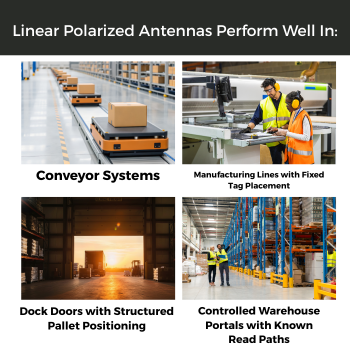
Linear polarized antennas perform especially well in:
-
Conveyor systems where items pass in a consistent orientation
-
Manufacturing lines with fixed tag placement
-
Dock doors with structured pallet positioning
-
Controlled warehouse portals with known read paths
-
Line-of-sight read zones where assets move through a defined plane
The key factors are fixed orientation and line-of-sight predictability. If your environment allows you to control how tags are mounted and how assets pass the reader, a linear polarized antenna can deliver excellent range, strong read performance, and high system efficiency.
But if your environment involves unpredictable movement, shifting containers, or variable tag placement, linear polarization may introduce risk.
In decision terms:
Choose a linear polarized antenna when your process guarantees consistent reader-to-tag alignment and environmental stability. It rewards controlled conditions with greater range and focused performance.
What is Circular RFID Polarization?
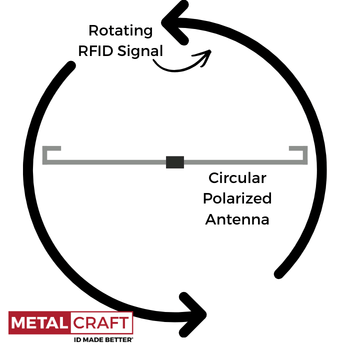
In contrast to linear polarization, a circular polarized antenna transmits RFID signals in a rotating field. Instead of traveling in one fixed plane, the electromagnetic wave continuously rotates—either clockwise (right-hand circular polarization) or counterclockwise (left-hand circular polarization)—as it propagates outward from the reader.
This rotation is the key difference.
Because the signal is constantly changing orientation, a circular polarized antenna does not require strict alignment between the RFID reader and the RFID tag. Unlike a linear polarized antenna—where reader-to-tag alignment must match precisely—circular polarization is designed to accommodate movement, rotation, and inconsistent tag positioning.
That makes it especially effective in dynamic or uncontrolled environments.
In many real-world RFID applications, tags do not remain in a fixed orientation. Containers rotate in transit. Pallets shift on forklifts. Assets tilt, turn, and move through portals at varying angles. In retail, supply chain operations, and asset tracking systems, maintaining consistent tag alignment is often unrealistic.
A circular polarized antenna increases the probability of capturing a read because the rotating signal can couple with the tag antenna across multiple orientations. Even if a tag enters the read zone at an unexpected angle, the system still has a strong chance of successfully reading it.
However, this flexibility comes with a tradeoff.
Because the signal energy is distributed across a rotating field rather than concentrated in a single plane, circular polarization typically offers a shorter effective read range than a linear polarized antenna. The broader signal pattern can also introduce slightly more susceptibility to environmental interference in certain conditions.
In decision terms:
-
If your environment involves movement, rotation, or unpredictable tag orientation, a circular polarized antenna improves read reliability.
-
If maximum read distance in a tightly controlled, fixed-orientation environment is the priority, linear may outperform circular.
Circular polarization sacrifices some range in exchange for versatility. In many dynamic RFID deployments, that tradeoff results in more consistent read accuracy and better overall system performance.
Why RFID Polarization Matters
RFID polarization is not a minor technical setting—it is a system design decision that directly impacts read accuracy, operational efficiency, and total deployment cost.
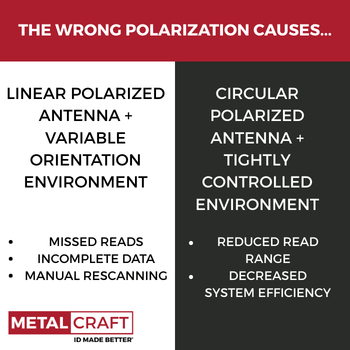
Selecting the wrong polarization creates predictable problems:
-
A linear polarized antenna in a variable-orientation environment leads to missed reads, incomplete data, and manual re-scanning.
-
A circular polarized antenna in a tightly controlled, fixed-orientation environment may reduce achievable read range and system efficiency unnecessarily.
Both mistakes affect performance. Both introduce avoidable costs.
To make the correct reader selection, use polarization as a decision framework based on environmental realities—not assumptions.
Step 1: Evaluate Tag Orientation
Ask:
-
Are tags mounted in a fixed, repeatable orientation?
-
Do assets pass the reader in a controlled, line-of-sight path?
-
Is alignment between reader and tag consistent?
If the answer is yes, a linear polarized antenna typically provides stronger signal concentration and longer read range.
If tags rotate, tilt, shift, or move unpredictably, circular polarization increases read reliability by accommodating those orientation changes.
Step 2: Evaluate Movement and Process Control
Consider:
-
Do assets move through structured portals or controlled conveyors?
-
Or do they travel through open dock doors, yards, or dynamic workflows?
-
Is tag placement standardized across all items?
Highly controlled environments favor linear polarization. Dynamic supply chain environments—with forklifts, stacked pallets, and shifting containers—often favor circular polarization.
Step 3: Evaluate Performance Priorities
Determine what matters most:
-
Maximum read distance?
-
Consistent read accuracy across movement?
-
Reduced manual intervention?
-
Data reliability for downstream systems?
Polarization affects all of these outcomes.
Missed reads reduce system reliability. Inconsistent data impacts inventory accuracy. Manual rescanning slows operations. Over time, these inefficiencies increase labor costs, delay workflows, and reduce confidence in the RFID system.
When polarization matches the environment, RFID system performance improves. Read accuracy increases. Exceptions decrease. Operational efficiency rises. Most importantly, the system behaves predictably.
In practical terms:
-
Controlled, fixed-orientation environment → Linear polarization
-
Dynamic, variable-orientation environment → Circular polarization
Making this decision deliberately—based on environmental factors—protects both system reliability and long-term ROI.
Polarization is not just about signal physics. It is about designing an RFID system that performs consistently, reduces errors, and operates efficiently in the real world.
The Bottom Line
When purchasing your next RFID reader, take the time to understand how polarization will affect your system’s performance. Matching the right antenna polarization to your environment will not only improve efficiency but also save you from unnecessary expenses on equipment and time. Knowing whether linear or circular polarization is right for your application could be the difference between a highly efficient RFID system and one that costs you in missed reads and misaligned equipment.
By selecting the correct type of RFID reader with the appropriate polarization, you can optimize your asset tracking, inventory management, or supply chain processes, ensuring better ROI for your investment. Don’t make the costly mistake of ignoring polarization—this small detail can save you thousands in the long run.