
 Why RFID Technology Is Reshaping Industries
In 2025, RFID (Radio Frequency Identification) technology is transforming industries by enabling faster tracking, real-time inventory insights, and automation across supply chains. As the global RFID market grows beyond $25 billion, businesses across manufacturing, logistics, healthcare, retail, and outdoor asset management are leveraging RFID solutions to improve efficiency and accuracy.
With so many providers on the market, it’s useful to understand the leading players and what they offer. Below, we examine 10 of the top RFID companies making an impact this year. While each company brings unique strengths, we’re especially proud of how Metalcraft distinguishes itself in the area of durable, custom solutions.
What We Considered When Reviewing These RFID Companies
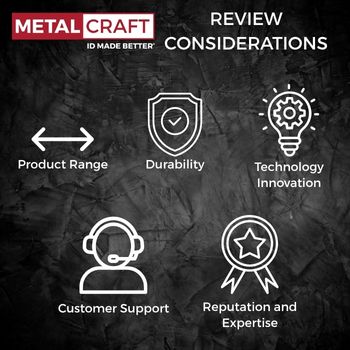
Selecting the right RFID partner goes beyond comparing product lists. We evaluated each company using several key factors to highlight their strengths and focus areas:
- Product Range – We looked at whether the company offers a diverse portfolio — including passive and active tags, on-metal options, labels, readers, and software — serving industries like retail, healthcare, logistics, and outdoor tracking.
- Durability – We considered if products are designed to handle chemicals, extreme temperatures, weather, and abrasion. Vendors offering rugged metal tags or specialized materials stood out for demanding environments.
- Technology Innovation – We assessed companies advancing the field through R&D, improved designs, and the use of technologies like NFC or IoT. Innovation ensures customers get modern, future-ready solutions.
- Customer Support – Good support can save time and prevent costly mistakes. We looked at companies providing clear communication, custom solutions, and reliable after-sales service.
- Reputation and Expertise – We considered market reputation, industry presence, and customer success stories. Vendors with strong expertise tend to deliver more reliable solutions, especially for complex projects.
Why These Factors Matter
These factors help identify vendors offering not just strong products but strong partnership potential. Innovation keeps your system current, and a broad product range means you can scale without switching providers. Strong support ensures smooth implementation and long-term success.
How to Apply This Evaluation to Your Business
To apply these criteria, first assess your needs — define your environment, asset types, and goals. Request product demos or samples to test real-world performance. Engage with vendor teams to gauge responsiveness and expertise. Finally, review case studies or references to see how similar customers succeeded.
Disclaimer
Durability references in this article are generalized from public sources — not formal lab ratings. Performance varies by product and use case. We recommend contacting each vendor for detailed specifications and application-specific advice.
10 of the Top RFID Companies in 2025
Metalcraft
Key Highlights: Specializes in rugged on metal RFID tags, windshield RFID tags, and RFID tags for custom applications
Best Fit: Industrial environments, IT assets, outdoor equipment, chemical facilities, and warehouse/logistics asset management
Strengths: Custom-engineered products, known for durability, and strong customer support
Metalcraft has built a reputation over decades for providing reliable, long-lasting RFID and barcode solutions. For companies that need durable labels capable of withstanding abrasion, chemicals, and harsh weather, Metalcraft remains a trusted partner. Among its most popular products are the Universal RFID Asset Tag, known for its versatility across surfaces; the RFID Flex Hard Tag, designed for rugged environments requiring flexibility and strength; the RFID Windshield Tag, perfect for vehicle access control and tracking; and the DuraDestruct RFID Tag, which offers tamper-evident security for high-value or sensitive assets.
Zebra Technologies
Key Highlights: Offers a wide range of RFID hardware, printers, readers, and software
Best Fit: Retail, healthcare, logistics, supply chains
Strengths: Integrated solutions combining hardware and software, strong global brand
Avery Dennison
Key Highlights: Sustainable RFID tags, apparel and packaging solutions
Best Fit: Fashion, retail, sustainability-focused businesses
Strengths: Innovation in eco-friendly materials and global supply capabilities
Impinj
Key Highlights: High-performance RFID readers, chips, and IoT integrations
Best Fit: Large-scale supply chains, smart shelves, connected devices
Strengths: Advanced technology and strong industry partnerships
Alien Technology
Key Highlights: UHF RFID tags, readers, and antennas for scalable deployments
Best Fit: Warehouse logistics, general inventory tracking
Strengths: Reliable UHF solutions for various industries
Confidex
Key Highlights: Specialty hard tags, on-metal solutions, automotive and transit applications
Best Fit: Automotive, industrial, public transport
Strengths: Innovative design and excellent durability in demanding conditions
Smartrac (A Division of Avery Dennison)
Key Highlights: RFID inlays, NFC solutions, embedded technologies
Best Fit: Packaging, authentication, smart card applications
Strengths: Focus on innovation, sustainability, and embedded systems
HID Global
Key Highlights: Secure RFID products for access control and identity management
Best Fit: Government, healthcare, secure enterprise environments
Strengths: Strong security features, encryption, and multi-application capabilities
GAO RFID
Key Highlights: Broad RFID product catalog including readers, tags, and software
Best Fit: General business, retail, healthcare applications
Strengths: Wide selection of products and solutions
Omni-ID
Key Highlights: Rugged on-metal RFID tags, high-temperature and heavy-industry solutions
Best Fit: Oil and gas, heavy industry, outdoor asset management
Strengths: Specialized products designed for extreme environments
Comparison Table: 2025 RFID Company Snapshot
| Company | Best Use Case | Specialty Focus |
|---|---|---|
| Metalcraft | Industrial, outdoor | Metal, polyester, QR tags |
| Zebra | Retail, healthcare | Integrated hardware/software |
| Avery Dennison | Fashion, sustainability | Eco-friendly labels |
| Impinj | Supply chain, IoT | RFID readers, chips |
| Alien Tech | Logistics, warehouse | UHF tags and antennas |
| Confidex | Automotive, transport | Hard tags, on-metal designs |
| Smartrac | Packaging, NFC, smart cards | Embedded, NFC solutions |
| HID Global | Security, access control | Secure RFID, encryption |
| GAO RFID | General business healthcare | Wide product range |
| Omni-ID | Heavy industry, outdoor | Rugged, high-temp tags |
RFID Buying Guide: What to Consider
Key Considerations
- Application Needs – Think carefully about what you need the RFID system to do. Are you tracking inventory in a controlled indoor warehouse? Tagging assets exposed to outdoor weather, heat, or chemicals? Managing returnable containers, high-value tools, or sensitive product data? Different use cases require different tag types (e.g., on-metal, embedded, passive, active) and different read ranges.
- Durability Requirements – Look at the environment your RFID tags will face: Will they need to survive abrasion, exposure to water, dust, or extreme temperatures? Select materials (like anodized aluminum or specialized polymers) that can hold up under your specific conditions. A tag that works perfectly in a retail store may fail in an industrial yard or oilfield.
- Read Range and Performance – Consider how far away the reader will be from the tag — is a short-range (near-field) or long-range (UHF) system more appropriate? Do you need one-at-a-time scans or the ability to read multiple tags simultaneously? Understanding your system’s scan needs will help you pick the right technology.
- Integration with Existing Systems – It’s critical to ensure that your RFID solution integrates smoothly with your current software, ERP, or inventory management systems. Check compatibility with hardware, middleware, and software platforms to avoid costly system mismatches or the need for custom development.
- Scalability and Future Needs – Will your operations grow or change significantly in the next few years? Choose vendors and solutions that can scale with you — whether that means adding more tags, expanding to multiple locations, or integrating with new digital systems.
- Vendor Support and Service – Reliable vendors provide more than just tags — they offer design consultation, technical troubleshooting, and after-sales support. Make sure your supplier can help tailor solutions to your needs, provide timely support, and offer customization where necessary.
- Total Cost of Ownership – Look beyond the initial price of labels, readers, and infrastructure. Factor in installation, maintenance, software licenses, employee training, and long-term replacement costs to get a full picture of what your RFID investment will require over time.
Common Pitfalls to Avoid
- Underestimating Enviro
 nmental Factors – A common mistake is choosing tags without considering the operating environment — for example, using standard tags in high-temperature or chemical environments where they’ll quickly degrade. Always match the materials and construction to your specific application.
 - Ignoring Readability and Orientation – Some RFID systems are sensitive to the angle or placement of the tag relative to the reader. Improper positioning can lead to missed reads or slower scanning. Work with vendors to understand optimal tag placement for reliable performance.
- Neglecting System Integration – Businesses sometimes invest in RFID hardware without checking if it integrates with their existing software systems. This can lead to data silos, duplication of effort, or additional costs for custom integrations.
- Failing to Test Before Full Rollout – Jumping into a full system deployment without first testing in a small pilot is risky. Testing allows you to uncover performance issues, identify configuration needs, and ensure the system works as intended under real-world conditions.
- Assuming One Size Fits All – Not all RFID tags or systems are interchangeable. What works in one industry or application may not work in another. Always tailor your solution — including tag type, reader configuration, and software setup — to your specific use case.
- Overlooking Training Needs – Even the best RFID system can fall short if staff aren’t trained on how to use it properly. Ensure your team understands how to install, operate, maintain, and troubleshoot the system to maximize its value.
Conclusion: Exploring Trusted RFID Partners
The companies featured here represent some of the strongest players in the RFID market today, each with unique expertise across industries and applications. Metalcraft, for example, offers a strong mix of durable labels and custom solutions for rugged environments, while companies like Zebra, Impinj, and Avery Dennison excel in large-scale integration, supply chain, and sustainability applications.
Contact us today at [email protected] to start the conversation. We’d love to help you find a solution that improves your tracking, boosts your efficiency, and delivers lasting value.
Let’s explore how RFID can work better for you — reach out anytime!
About the Author: John Fitzsimmons

Mobile Phone: 641-423-9460
Office Phone: 641-423-9460
Email: [email protected]
Office: 3360 9th St SW