
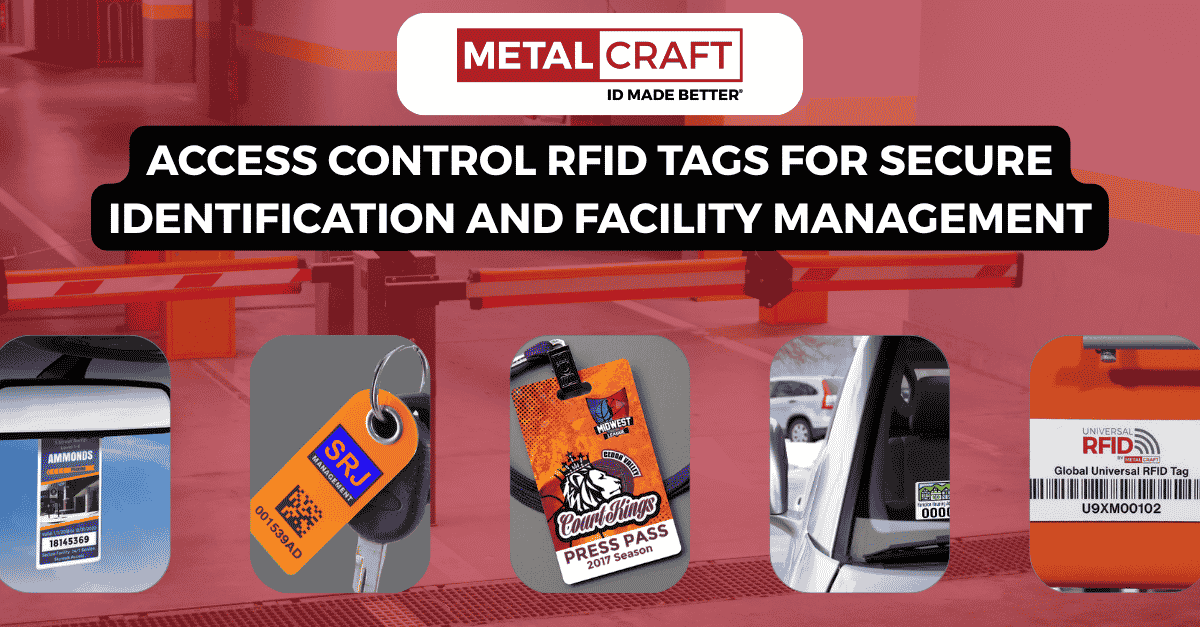
Modern organizations face increasing pressure to secure facilities, protect assets, manage visitor access, and streamline entry for employees and authorized personnel. Traditional keys, magnetic stripe cards, and manual visitor logs often create administrative burdens while introducing potential security vulnerabilities.
As a result, businesses, healthcare facilities, logistics facilities, office buildings, and industrial operations are increasingly adopting access control RFID tags as part of their broader security infrastructure. Using RFID technology and radio frequency identification, these solutions provide secure, contactless authentication that helps organizations manage access permissions, monitor activity, and improve operational efficiency.
From employee credentials and vehicle access control to visitor management and asset tracking, RFID access control systems have become a cornerstone of modern access control strategies.
What Are Access Control RFID Tags?
Access control RFID tags are electronic credentials used to identify authorized users, vehicles, or assets within access control systems. Each RFID tag contains a unique identifier that communicates with an RFID reader using radio waves. When presented at a door, gate, or access point, the system verifies the credential and determines whether to grant access or deny access.
How RFID Technology Works in Access Control Systems
RFID access control systems operate using a three-part process:
- Tag Activation
- Data Transmission
- Verification
When an RFID credential enters the read zone, the RFID reader emits radio signals that activate the RFID tag. The tag then transmits stored information to the reader.
The RFID reader verifies user credentials against an authorized database within the access control software. The system verifies access permissions and either activates an electronic locking mechanism to grant access or restrict access when credentials are invalid.
The entire process typically occurs in less than a second, making RFID access control ideal for high-traffic environments.
Types of RFID Tags Used for Access Management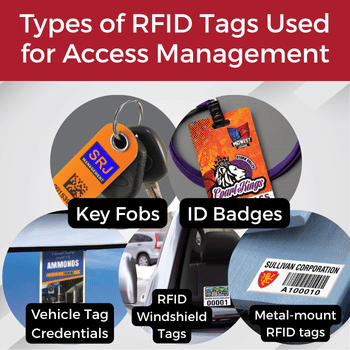
Common RFID tag formats include:
- RFID cards
- Key fobs
- ID badges
- Vehicle tag credentials
- RFID Windshield tags
- Metal-mount RFID tags
These RFID devices provide flexible options for different access systems and security requirements.
Differences Between RFID, Barcode, and Magnetic Stripe Systems
Unlike barcode systems, RFID access control does not require direct line-of-sight scanning or physical interaction with the credential. RFID credentials communicate wirelessly with readers using radio waves, allowing authorized users to gain access quickly and conveniently. This contactless functionality helps reduce delays at entry points, improve user convenience, and support faster movement through doors, gates, and secured areas. RFID access control systems are especially beneficial in high-traffic environments where speed and efficiency are important.
Magnetic stripe cards, by comparison, require physical contact with a reader and are more susceptible to wear, damage, and read failures over time. As cards become scratched or degraded, reliability can decline and replacement costs may increase. Modern access control systems increasingly favor RFID credentials because they provide greater durability, faster operation, and enhanced security capabilities. RFID credentials can also support advanced features such as encrypted authentication, automated access logging, and centralized credential management, making them a more effective solution for today’s security-conscious organizations.
Why Businesses Use RFID Tags for Access Control
Enhancing Facility Security and Accountability
RFID technology enhances security by helping organizations control personnel flow, secure entry points, and verify that only authorized personnel can access restricted areas. Every RFID credential contains a unique identifier that is linked to an individual user, vehicle, or asset, allowing security teams to accurately monitor and manage facility access. This level of visibility helps reduce unauthorized access risks while improving accountability across the organization.
RFID access control systems automatically log entry events whenever a credential is presented at a reader. These detailed access logs provide valuable information for investigations, compliance reporting, security audits, and incident response activities. Administrators can review historical records to determine who accessed specific areas, when access occurred, and whether any unusual activity took place.
In addition, real-time monitoring of access points provides greater visibility into facility activity as it happens. Security teams can track movement throughout the facility, identify potential security concerns more quickly, and respond to incidents with greater confidence. By combining automated authentication, detailed audit trails, and real-time monitoring capabilities, RFID access control systems help organizations strengthen security while maintaining efficient access management processes.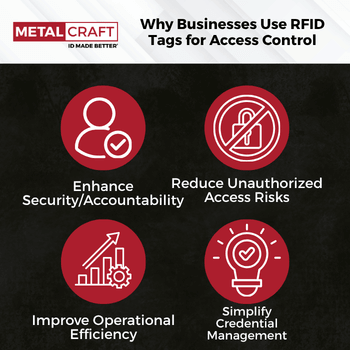
Reducing Unauthorized Access Risks
One of the primary goals of any access control system is ensuring only authorized personnel can enter secured areas. RFID access control systems provide a reliable and scalable way to manage access permissions while reducing the risks associated with traditional keys, shared credentials, and manual access management processes. By linking each RFID credential to a specific user, organizations gain greater control over who can access particular locations and when.
RFID access control helps:
- Prevent unauthorized entry by verifying credentials before granting access to secured areas.
- Restrict access to sensitive locations such as data centers, laboratories, equipment rooms, and executive offices.
- Manage visitor access through temporary credentials and controlled access permissions.
- Control contractor access by limiting access rights based on project requirements, schedules, or designated work areas.
- Improve accountability by creating detailed records of who accessed specific locations and when.
If an RFID credential is lost, stolen, or no longer needed, administrators can instantly revoke access privileges through the access control software without replacing locks or reissuing physical keys. This capability significantly improves security while reducing administrative costs and helping organizations respond quickly to changing security requirements.
Improving Operational Efficiency With Contactless Entry
RFID access control systems operate without physical contact, reducing bottlenecks at entry points and creating a smoother experience for employees, visitors, and authorized personnel. Unlike traditional keys or magnetic stripe cards that require physical interaction, RFID credentials can be read quickly and automatically as users approach a reader. This contactless process helps minimize delays, improve user convenience, and support faster movement through secured areas.
RFID systems streamline high-volume traffic through rapid contactless verification and can grant access in under a second. Because the RFID reader can instantly verify credentials and communicate with the access controller, users spend less time waiting at doors, gates, and checkpoints. This efficiency is especially valuable during shift changes, employee arrivals, visitor check-ins, and other peak traffic periods. RFID door systems are particularly beneficial for office buildings, manufacturing facilities, logistics facilities, healthcare facilities, and other environments where large numbers of people require fast, secure access. By reducing congestion and improving traffic flow, RFID technology helps organizations enhance both security and operational efficiency.
Simplifying Credential Management Across Multiple Locations
Organizations operating across multiple facilities benefit from centralized access management.
RFID technology allows administrators to:
- Issue credentials remotely
- Update access permissions
- Monitor access logs
- Manage visitor access
- Coordinate security policies across locations
This scalability makes RFID solutions ideal for growing organizations.
Common Applications for Access Control RFID Tags
Employee and Contractor Identification Badges
Employee ID cards and RFID credentials help organizations manage door entry systems and control facility access. Access credentials can be customized for departments, job functions, and security clearance levels.
Vehicle Gate and Parking Access Systems
Vehicle access control systems often use windshield RFID tags and vehicle tag credentials to support automatic vehicle identification, allowing authorized vehicles to enter secured areas quickly and efficiently without requiring drivers to stop, lower windows, or present physical credentials. By using RFID technology, organizations can automate vehicle access, improve traffic flow, and enhance security at gates, parking entrances, and restricted vehicle access points.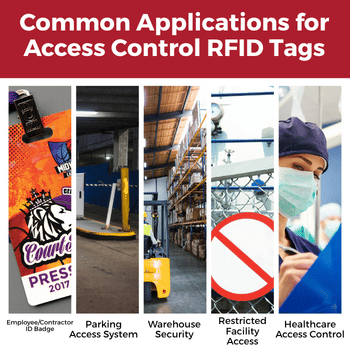
These systems are commonly used in:
- Corporate campuses to manage employee and visitor vehicle access.
- Parking management facilities that require efficient entry and exit tracking.
- Apartment complexes seeking secure, convenient access for residents and approved guests.
- Gated communities that want to improve security while maintaining resident convenience.
- Logistics facilities where trucks, delivery vehicles, and fleet assets require controlled access.
RFID-based vehicle access systems can also generate access logs, support visitor management programs, and integrate with broader security infrastructure to provide greater visibility into vehicle movement. Industry reports estimate that approximately 47% of U.S. apartment buildings utilize RFID door systems or similar RFID-based access technologies, highlighting the growing adoption of RFID solutions for both pedestrian and vehicle access management. By reducing manual intervention and streamlining entry processes, RFID vehicle access control systems help organizations improve security, operational efficiency, and user convenience.
Warehouse and Distribution Center Security
Warehouses rely on RFID access control to protect inventory, loading docks, equipment storage areas, and restricted operational spaces. By ensuring only authorized personnel can enter sensitive areas, organizations can improve security, reduce theft, and increase accountability.
RFID access control often complements broader asset tracking initiatives, allowing facilities to monitor both personnel access and asset movement. This combination improves operational visibility, supports compliance efforts, and helps warehouses maintain more secure and efficient operations.
Data Centers and Restricted Facility Access
High security environments such as data centers require strict access management controls because they house sensitive data, critical infrastructure, networking equipment, and mission-critical systems. RFID credentials provide secure authentication while supporting detailed access logs, audit reporting, and real-time monitoring of entry activity. By limiting access to authorized personnel and maintaining a complete record of access events, RFID access control systems help organizations strengthen security, support compliance requirements, and reduce the risk of unauthorized access to critical facilities.
Healthcare and Pharmaceutical Facility Access Control
Healthcare facilities use RFID systems to secure laboratories, pharmacies, medication storage areas, clean rooms, and sensitive patient-care environments. By ensuring that only authorized personnel can access restricted areas, RFID access control helps improve safety, protect valuable assets, and support regulatory compliance. Detailed access logs and automated credential management also provide greater accountability, helping healthcare organizations maintain secure operations while protecting patients, staff, medications, and sensitive information.
Types of RFID Tags Used in Access Control Systems
Passive RFID Tags
Passive RFID technology remains the most common option for access control applications because it offers a cost-effective, reliable, and low-maintenance solution for everyday credential management. These RFID tags do not require an internal power source, making them durable and well-suited for high-volume deployments across commercial and industrial facilities.
Passive RFID tags:
- Have no battery, reducing maintenance requirements and replacement costs.
- Draw power from the reader’s electromagnetic field when presented near an RFID reader.
- Typically operate within 10 cm to 1 meter, depending on the frequency and system design.
- Provide low-maintenance operation with no batteries to monitor or replace.
- Support long service life, often lasting for many years under normal operating conditions.
Passive systems are widely used in key fobs, smart cards, employee badges, and other RFID credentials commonly found in access control systems.
Active RFID Tags
Active RFID tags contain an internal battery that allows longer read ranges and additional functionality than passive RFID tags. These credentials are often used in specialized access control applications where users, vehicles, or assets must be identified from greater distances.
Active RFID devices can:
- Transmit signals up to 100 meters, supporting long-range identification.
- Support real-time monitoring of vehicles, assets, or personnel movement.
- Enable long-range vehicle access at gates, parking facilities, and secured perimeters.
- Provide enhanced tracking capabilities for large facilities and complex security environments.
Because active tags offer extended read ranges and advanced features, they are commonly used for vehicle access control, fleet management, and large-scale industrial security applications.
Semi-Active RFID Tags
Semi-active RFID tags combine features of both passive and active RFID technology. These tags contain an internal battery but still rely on reader activation to initiate communication. Semi-active tags can offer improved performance and reliability while consuming less power than fully active RFID devices. They are often used in specialized applications that require greater read performance than passive tags but do not require the full capabilities of active RFID systems.
RFID Key Fobs and Smart Cards
Key fobs and RFID cards remain among the most popular RFID credentials due to their durability, convenience, and compatibility with modern access control systems. These credentials are easy to carry, simple to issue, and widely supported by existing access control infrastructure. RFID key fobs and smart cards are commonly used for employee access, visitor management, apartment access, office buildings, healthcare facilities, and educational campuses.
Windshield RFID Tags for Vehicle Access
UHF RFID tags operating around 900 MHz are commonly used for vehicle identification and automatic vehicle identification systems. Their longer read ranges allow vehicles to be identified quickly without requiring drivers to stop and present a credential manually.
These tags support:
- Parking management systems that automate vehicle entry and exit.
- Fleet access programs for commercial and industrial operations.
- Logistics facilities that manage truck and delivery vehicle traffic.
- Gated communities seeking secure and convenient resident access.
Windshield RFID tags help improve traffic flow, reduce gate congestion, and enhance overall security.
Metal-Mount RFID Tags for Industrial Environments
Industrial environments often require RFID credentials designed specifically for metal surfaces and harsh operating conditions. Standard RFID tags may experience performance challenges when mounted directly on metal equipment, machinery, or infrastructure. Metal-mount RFID tags are engineered to overcome these limitations, providing reliable read performance while withstanding vibration, moisture, temperature fluctuations, and demanding industrial environments. These tags are commonly used for access control, equipment identification, and asset tracking applications in manufacturing facilities, warehouses, utilities, and other industrial settings.
Key Features to Look for in Access Control RFID Tags
Conclusion: Modernize Security With Reliable RFID Access Control Tags
Access control RFID tags have become a critical component of modern security infrastructure. By combining secure authentication, contactless entry, automated auditing, and centralized credential management, RFID access control systems help organizations improve security, streamline facility operations, and enhance operational visibility.
Whether managing employee access, visitor access, vehicle identification, or restricted-area security, selecting durable and customizable RFID credentials designed for your environment is essential for long-term success.
About the Author: John Fitzsimmons

Mobile Phone: 641-423-9460
Office Phone: 641-423-9460
Email: [email protected]
Office: 3360 9th St SW