
There are many benefits of barcode as outlined in this article. Even beyond data redundancy, a barcode can still be a powerful tool in the pursuit of better asset management. While they lack many of the more industrious and attractive qualities of RFID, their tried-and-true nature still has benefits for many applications, sometimes even in place of RFID.
What is barcoding? How does a barcode work?
Barcodes are a series of black and white stripes that are used to represent information. These stripes comprise alternating thick and thin likes that form a series of “bars” on the affixed label. Each letter or number can represent different products, and the code is unique to each product. Barcodes can be scanned by a reader which then uploads the information into a computer.
What kinds of barcodes are there?
There are two types of barcodes: linear (or one-dimensional) and two-dimensional. Linear barcodes are the most common type and are found on most products. A linear barcode is made up of series of thin black bars and spaces that are arranged in a particular pattern. When scanned, this pattern is turned into digital information that can be read by computers.
Two-dimensional barcodes, also known as stacked codes, are more complex than linear barcodes, provide more information, hold more data and are easier to read when printed on small objects. Unlike linear barcodes, stacked codes are read by a laser rather than an optical scanner.
Choosing the Right Barcode Material for Your Application
Barcodes can be produced using a variety of materials, and the best choice depends on the environment, longevity, and performance requirements of your specific application. From durable metal asset tags to flexible plastic labels and cost-effective paper options, each material offers unique advantages in terms of durability, scanability, and resistance to environmental stressors.
Plastic Barcode Labels
Plastic barcode labels are widely used across industries due to their combination of durability, flexibility, and cost-effectiveness. Common types of plastic materials include:
Polyester
Polyester labels are known for their excellent resistance to chemicals, moisture, and UV exposure. They are ideal for indoor and light industrial environments, offering a balance between toughness and print clarity. Polyester is commonly used in asset tracking, inventory labeling, and equipment identification.
Polypropylene
Polypropylene labels are slightly less rigid than polyester and offer good moisture resistance and tear strength. They are often used in logistics, packaging, and retail, where moderate durability and low cost are important.
Polycarbonate
Polycarbonate barcode labels offer enhanced toughness and clarity. They are often used when high-impact resistance is required, such as in automotive and outdoor applications. Polycarbonate also provides excellent dimensional stability, making it suitable for long-term labeling.
These plastic materials are well-suited for surfaces that may encounter light chemicals or abrasion, and they pair well with thermal transfer printing and lamination for added protection.
Metal Asset Tags
When durability and resilience are essential, metal asset tags stand out as the superior choice. Engineered for extreme environments, these tags are ideal for long-term identification, particularly in industrial, outdoor, and high-temperature applications. Common material options for metal asset tags include:
Anodized Aluminum
Anodized aluminum is lightweight, corrosion-resistant, and highly durable. When paired with sub-surface image processing (like Metalphoto®), the barcode remains legible even after years of exposure to UV rays, moisture, chemicals, and abrasion. These tags are perfect for outdoor asset management and military-grade tracking.
Stainless Steel
Stainless steel metal asset tags provide exceptional durability in harsh, high-temperature, or chemically aggressive environments. Their resistance to corrosion and physical wear makes them ideal for oil and gas, power generation, aerospace, and marine applications. They are the go-to choice when the label absolutely must endure.
Metalphoto®
Metalphoto® tags use a photographic process to embed the barcode image beneath the surface of anodized aluminum. These tags are trusted in defense, transportation, and manufacturing for their 20+ year lifespan and resistance to UV light, abrasion, and harsh chemicals. When long-lasting readability is critical, Metalphoto® metal barcode tags are unmatched.
What are the benefits of barcode?
- Less expensive – barcodes are more affordable than RFID tags. when a a company uses both barcodes and RFID tags. when a company uses both barcodes and RFID tags, it can provide value where and when it’s needed by using both solutions, as needed, without breaking the budget. Barcodes and RFID tags work well with existing technology, so companies with existing warehouse management systems can use this technology without having to re-enter information or purchase new software.
- Flexibility of surface composition – unlike RFID, barcodes can be affixed to most surfaces without affecting their performance. Metal, plastic, glass, etc. doesn’t affect the barcode read. In addition, the surface can either be flat or curved.
- Durability – barcode tags can be made out of a variety of different materials to withstand whatever environmental conditions the barcode tag needs to resist.
What are the benefits of barcode with RFID?
- Time savings – RFID readers can also scan barcodes. This means that if you’re already using barcodes, you don’t have to purchase new scanners. If you already have new barcode readers, you can still incorporate both technologies into one tag; however, it’s critical that you keep the assets’ location information in sync; some enterprise software systems can help address this issue.
- A more complete view of the supply chain – many companies currently use a mix of both technologies, and the coexistence of barcodes and RFID can provide the best of both worlds. To achieve this, you need to understand the characteristics of barcodes and RFID, how they work and what they can do. By understanding how each technology works, companies can make informed decisions about which technology to use in specific locations or processes.When products are scanned using both technologies in the tag, for example, the system can more efficiently track and monitor their products as they move through the supply chain, from beginning to end. This can improve visibility and efficiency throughout the supply chain.
- Flexibility – using a joint RFID-barcode solution allows for either data redundancy by programming the same information into the RFID tag as what the barcode reads or increasing the data capacity by programming different information into the RFID tag as what the barcode reads.
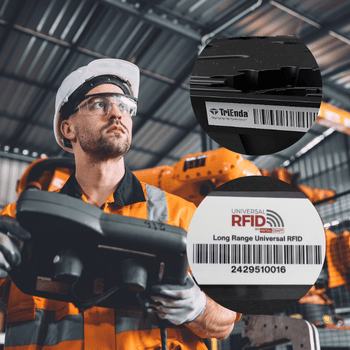
- Security – using both barcodes and RFID tags can provide higher levels of security. RFID tags are more difficult to copy and are more secure than barcodes; therefore, when a company uses both barcodes and RFID tags, it can provide a higher level of security with RFID tags, where required, without having to completely convert its entire system.
- Less disruption to operations and the supply chain – a joint RFID-barcode system can help create a more seamless process for companies that are automating their processes for product identification, shipping and tracking. For example, if a company uses barcode tags in addition to RFID tags, then the company can easily transition to using only RFID tags when the time is right, instead of trying to implement a huge process change all at once. For example, adding the printed barcodes to RFID tags on products can enable the transition to RFID and avoid unnecessary supply chain disruption.
- Easier transitions to RFID – if you need to transition to RFID more slowly due to financial considerations, gradually implementing and RFID solution alongside a barcoding system can save money and prevent disruption.
About the Author: Marianne Alvarado

Mobile Phone: 641-529-9492
Office Phone: 641-423-9460
Email: [email protected]
Office: 3360 9th St. SW, Mason City, IA 50401