

Returnable vs Disposable Containers: Key Differences and When to Use Each
Choosing between returnable and non-returnable containers is one of the most important packaging decisions many businesses make. The debate around returnable vs non-returnable containers, returnable vs disposable containers, and returnable vs single use containers goes far beyond sustainability buzzwords. The right choice depends on workflow, shipment frequency, product value, loss risk, and how your supply chain actually operates.
Returnable packaging can deliver long-term savings, reduce waste generation, and support environmental sustainability—but only when it fits the logistics model. Disposable or expendable packaging, on the other hand, often offers lower upfront costs and simplicity for one-way shipments. Understanding the tradeoffs helps companies select the best solution for their business, not just the most popular one.
What Are Returnable Containers?
Returnable containers are reusable packaging assets designed for repeated use across multiple cycles. They are commonly used in closed loop systems where containers move between suppliers, manufacturers, distribution centers, and customers before being returned empty for reuse.
Typical examples include reusable totes, plastic bins, racks, pallets, roll cages, and reusable plastic containers (RPCs). Many returnable systems operate through ownership models or rental and pooling programs, where logistics partners manage container fleets on behalf of many businesses.
Industries such as automotive manufacturing, food processing, consumer packaged goods, and industrial manufacturing rely heavily on returnable packaging. These reusable systems prioritize durability, product protection, and long-term efficiency. Although returnable containers require a higher initial investment, they are built for continuous reuse, often lasting dozens or even hundreds of cycles.
When managed properly, returnable systems reduce transportation costs, minimize packaging waste, and lower the overall carbon footprint across the supply chain.

What Are Disposable / Non-Returnable Containers?
Disposable, non-returnable, or expendable containers are designed for single trip use. Once the shipment reaches its destination, the packaging is discarded, recycled, or occasionally downcycled.
Common examples include cardboard boxes, corrugate, foam padding, shrink wrap, and other single use packaging materials. Expendable packaging is widely used for export shipments, e-commerce fulfillment, and low-value goods where returning containers is impractical.
The primary advantage of disposable packaging is lower upfront costs and simple logistics. There is no need to manage reverse logistics, track empty containers, or coordinate returns with suppliers or customers. However, single use options generate ongoing waste, contribute to landfills, and often increase waste generation over time—even when materials are technically recyclable.
When to Choose Returnable vs Non-Returnable
There is no one-size-fits-all answer to the returnable vs expendable containers question. The right choice depends on how products move through your operation.
| Shipment or Environment | Recommended Container Type and Rationale |
|---|---|
| Frequent Cycles | Returnable Containers When shipments move between the same locations repeatedly, returnable packaging delivers the greatest value. Multiple cycles allow businesses to spread the initial investment across repeated use, driving long-term savings and improved operational efficiency. |
| One-Way Shipments | Non-Returnable Containers For export shipments, long distances or customer deliveries with no practical return path, disposable packaging remains the most suitable option. The cost and complexity of returning containers often outweigh the benefits. |
| Harsh Environments | Durable Plastics In environments with rough handling, moisture, chemicals or washing requirements, reusable containers made from durable plastics or metal outperform cardboard and single-use materials. |
| High-Loss Environments | RFID-Tracked Returnables Facilities with frequent container loss benefit from RFID-enabled returnable systems. Tracking returning containers improves visibility, reduces shrinkage and supports accountability across suppliers and logistics partners. |
| Low-Value Goods | Expendables For short-term shipments of low-value goods, expendable packaging minimizes cost and avoids unnecessary tracking or asset-management overhead. |
Use Cases for Each
Automotive Supplier Loop
Automotive supply chains operate on tightly synchronized production schedules, with components moving between OEMs, tier suppliers, and sub-assembly plants multiple times per week—or even daily. These closed loop systems depend on consistent container availability to prevent line stoppages and production delays.
Returnable containers such as totes, racks, and dunnage are ideal for this environment because they are engineered for repeated use and rough handling. They reduce product damage compared to expendable packaging and maintain part orientation throughout transport. Just as importantly, reusable packaging systems allow manufacturers to track containers as assets. By applying durable labels or RFID tags, automotive operations can monitor container location, utilization, and movement across many facilities. This visibility reduces shortages, supports better planning, and lowers long-term packaging costs by minimizing loss and emergency replacements.
Food Processing RPCs
Food manufacturers and processors rely heavily on reusable plastic containers (RPCs) to move ingredients and finished goods through production, storage, and distribution. These containers must meet strict hygiene and contamination controls while maintaining efficiency at scale.
Returnable RPCs are designed to withstand repeated washing cycles, exposure to sanitizing chemicals, moisture, and temperature fluctuations. Unlike single use packaging, reusable containers maintain structural integrity and consistent dimensions over multiple cycles, enabling automated handling and stacking. When paired with durable labeling or RFID identification, food processors gain accurate visibility into container status and movement without compromising sanitation. These returnable systems support sustainability goals by reducing waste generation while maintaining food safety, operational efficiency, and regulatory compliance.
Export Shipments
Export shipments introduce challenges that often make returnable packaging impractical. Long distances, cross-border regulations, customs inspections, and unpredictable return paths increase the cost and complexity of returning empty containers. In many cases, the probability of recovery is low.
As a result, non-returnable or expendable packaging is frequently the best solution for export logistics. Single use containers, corrugate, and protective materials provide flexibility without requiring reverse logistics or tracking infrastructure. While these options generate more waste, they reduce risk and administrative overhead for one-way shipments. Many businesses adopt a hybrid approach—using returnable containers for domestic closed loop systems and disposable packaging for export routes where recovery is unlikely.
Label Failure Comparison
| Failure Point | Cheap Labels | Durable Labels (Metalcraft) |
|---|---|---|
| Washing cycle | Peel off | Stay readable |
| Friction / stacking | Scratch easily | Subsurface printing protects barcode |
| Outdoor exposure | Fade | UV- and heat-resistant |
| RFID read range | Weak performance | Tuned for plastic and metal surfaces |
| Adhesion on textured bins | Fall off | Engineered adhesives |
Cost Considerations
Returnables: Higher Upfront Cost, Lower Lifetime Cost
Returnable containers typically require a higher initial investment compared to disposable packaging. However, when returnables are tracked effectively, that upfront cost is spread across dozens or even hundreds of reuse cycles—dramatically lowering the cost per trip over time.
Tracking returnable containers using barcodes or RFID is critical to realizing these savings. Without visibility, containers are easily misplaced, underutilized, or written off as lost. With a returnable container tracking system in place, companies gain accurate data on container location, movement, and utilization. This visibility reduces shrinkage, prevents shortages, and eliminates unnecessary replacement purchases. Over time, businesses benefit from reduced packaging spend, lower transportation costs tied to emergency shipments, and improved planning across the supply chain. The result is long-term savings, reduced waste, and a more sustainable future.
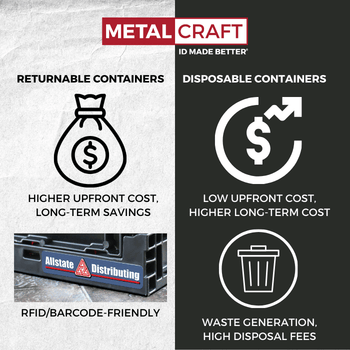
Non-Returnables: Low Upfront Cost, Higher Long-Term Impact
Non-returnable or disposable packaging offers lower upfront costs and minimal operational complexity. There is no need to track assets, manage reverse logistics, or recover empty containers. For one-way shipments, this simplicity can be an advantage.
However, because expendable packaging is used once and discarded, costs repeat with every shipment. Continuous purchasing, higher disposal fees, and ongoing waste generation increase total cost over time. Without tracking or reuse, organizations absorb higher material costs and a greater environmental impact, making disposable packaging less cost-effective for high-volume or repetitive shipping lanes.
The Breakdown
Returnable vs disposable containers is ultimately a workflow decision. Returnable packaging works best in closed loop systems with frequent reuse and strong control. Non-returnable packaging remains the best solution for one-way, short term, or export shipments.
Many businesses adopt a hybrid approach, combining reusable solutions where possible with single use options where necessary. The key is aligning packaging choices with logistics realities, sustainability goals, and long-term cost considerations.
See our Container Tracking Products and choose which options are best for your workflow.
About the Author: John Fitzsimmons

Mobile Phone: 641-423-9460
Office Phone: 641-423-9460
Email: [email protected]
Office: 3360 9th St SW