
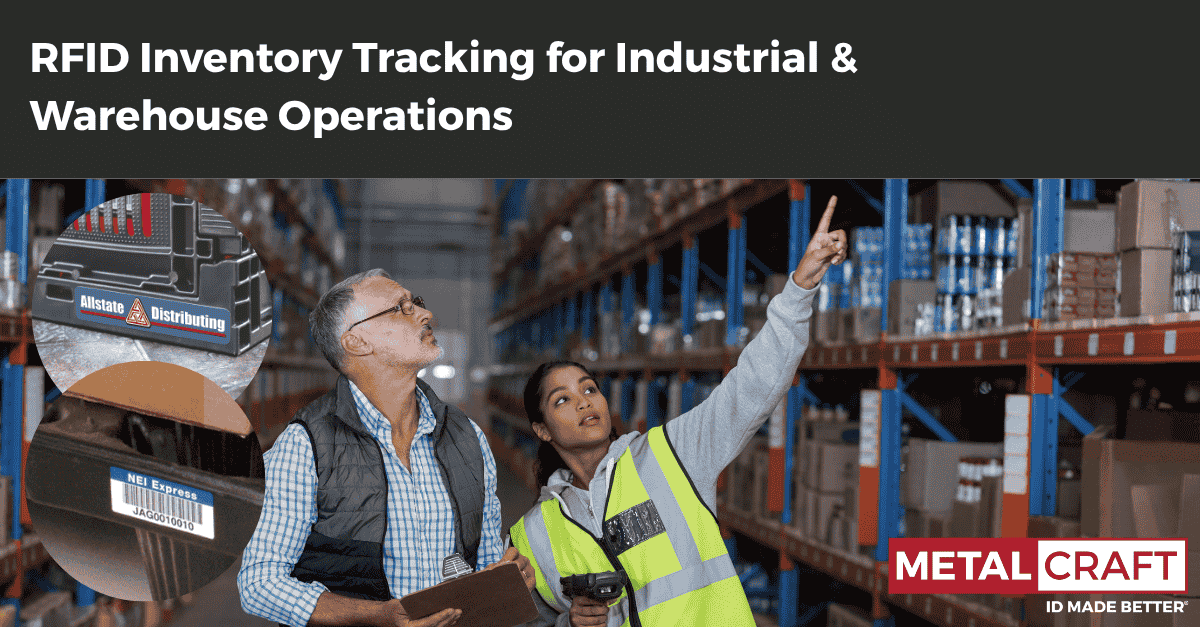
Inventory accuracy remains a major challenge across manufacturing, warehousing, utilities, and field operations. Organizations managing large volumes of tools, equipment, and individual assets often struggle with miscounts, misplaced items, and inconsistent records. These issues impact everything from production timelines to customer satisfaction.
Traditional barcode-based inventory management systems have improved tracking, but they still rely on manual scanning and line-of-sight processes. This creates gaps in data quality, increases labor requirements, and limits real-time visibility.
That’s why more operations leaders are adopting radio frequency identification (RFID). RFID inventory tracking enables organizations to uniquely identify and track assets automatically—without manual scanning—delivering faster, more accurate results.
At Metalcraft, we provide rugged RFID labels engineered for industrial environments, ensuring reliable performance across the entire useful life of your assets.
What Is RFID Inventory Tracking?
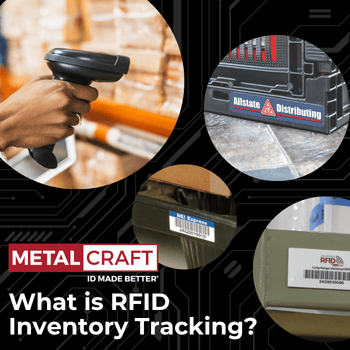
RFID inventory tracking uses radio frequency identification technology to automatically track and manage inventory. Each item is assigned a unique identifier, typically a numeric or alphanumeric string, that acts as a globally unique identifier within a given system.
This identifier functions similarly to a vehicle identification number (VIN) or MAC address, allowing organizations to distinguish one item from millions of unlike items.
In many cases, RFID aligns with item unique identification (IUID) principles, where each individual item receives a unique identifier UID that remains with it throughout its lifecycle. These identifiers are stored in a centralized database, supporting strong data integrity and traceability.
How RFID Inventory Systems Work
RFID systems combine both hardware and software components to enable automated, efficient tracking of inventory and assets. At the core of these systems are passive UHF RFID labels, which store a unique item identifier along with key data elements such as a serial number or original part number. Each tag is uniquely assigned to a single unit or discrete entity, ensuring precise identification.
RFID readers—both fixed and handheld—capture this data using radio waves. Fixed readers are typically installed at key transition points to track items as they move through a facility, while handheld readers allow users to quickly scan large areas without manual, line-by-line effort. The captured data integrates seamlessly with ERP or WMS platforms, providing real-time updates and eliminating duplicate reports. Unlike barcodes or QR codes, RFID does not require line-of-sight scanning, meaning multiple tags can be read simultaneously—even when items are stacked, enclosed, or not directly visible.
RFID vs. Barcode Inventory Tracking
RFID offers several advantages over barcode systems:
- Bulk reading vs. line-of-sight: Scan hundreds of items at once
- Labor efficiency: Reduce manual scanning tasks
- Higher accuracy: Achieve 98–99%+ accuracy
- Long-term ROI: Lower labor costs and fewer errors
Why Operations Leaders Are Moving to RFID
Increase Inventory Accuracy to 99%+
RFID allows organizations to uniquely identify every asset, reducing errors and improving fulfillment accuracy. This leads to better customer satisfaction and more reliable operations.
Reduce Manual Labor & Cycle Count Disruptions
RFID enables inventory counts without shutting down operations. Employees can scan entire areas quickly, reducing labor and improving efficiency.
Gain Real-Time Inventory Visibility
RFID provides real-time updates on asset location, status, and movement. This eliminates spreadsheets and improves planning, forecasting, and decision-making.
Reduce Asset Loss and Shrinkage
By assigning each item a unique identifier UID, organizations can track high-value equipment, monitor movement, and improve accountability—reducing loss and shrinkage.
RFID Labels Designed for Harsh Environments
Industrial environments demand more than standard labeling—they require RFID solutions built for durability and consistent performance. RFID labels designed for harsh environments are engineered to withstand the challenges commonly found in manufacturing, warehousing, and field operations. For metal surfaces, where signal interference is a common issue, specialized on-metal RFID tags are designed to maintain strong read performance and reliable tracking. In more extreme conditions, Metalcraft RFID labels are built to endure high heat, chemical exposure, and outdoor elements without compromising functionality. This level of durability ensures that each tag continues to perform accurately throughout the asset’s useful life, supporting long-term tracking and operational efficiency.
Custom-Printed & Encoded RFID Labels
Custom RFID labels can include:
- Serialized numeric or alphanumeric string identifiers
- Pre-encoded EPC data
- Variable data printing
- Onsite printable RFID labels
These labels support compliance with item unique identification standards and integration with systems like the IUID registry.
Industries That Benefit from RFID Inventory Tracking
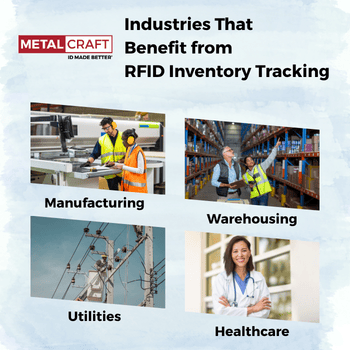
RFID delivers measurable value across a wide range of industries by improving accuracy, visibility, and operational efficiency. By enabling organizations to uniquely identify and track assets in real time, RFID supports better decision-making and reduces manual effort across complex environments.
- Manufacturing & Production
RFID enables real-time tracking of work-in-progress, tools, and constituent parts throughout the production lifecycle. This allows teams to monitor each stage of manufacturing, reduce bottlenecks, and ensure that every component is accounted for. With improved traceability, manufacturers can enhance quality control, streamline workflows, and maintain accurate records for every single unit produced. - Warehousing & Distribution
In warehouse environments, RFID significantly improves receiving accuracy and outbound validation by automatically capturing inventory data as items move through key checkpoints. This reduces errors during picking and shipping while providing real-time inventory visibility across locations. The result is faster operations, fewer discrepancies, and a more efficient supply chain. - Utilities & Field Operations
RFID helps organizations track equipment and assets across multiple locations, even in remote or rugged environments. By monitoring asset location, status, and usage, teams can better manage lifecycle performance, schedule maintenance, and ensure compliance with regulatory requirements. This improves asset utilization and reduces the risk of loss or downtime. - Healthcare
RFID enables healthcare providers to track medical devices and medical supplies with greater accuracy and accountability. This ensures critical equipment is always available when needed, supports compliance with strict regulations, and helps protect patient privacy. By improving visibility into asset usage and location, healthcare organizations can enhance patient care while reducing operational inefficiencies.
How to Evaluate an RFID Inventory Tracking Provider
Choosing the right RFID inventory tracking provider is critical to long-term success. Beyond the technology itself, you need a partner that can deliver reliable performance, integrate with your existing systems, and scale with your operations.
Tag Performance & Read Accuracy
Start by evaluating how well the RFID tags will perform in your specific environment. Factors like metal surfaces, liquids, and required read range can significantly impact accuracy. High-quality tags should deliver consistent read performance and support reliable data capture across all operating conditions.
Integration with ERP & WMS Systems
A strong RFID solution should integrate seamlessly with your existing ERP or warehouse management system. This ensures that data flows smoothly across platforms, eliminates data silos, and provides real-time visibility without requiring complex workarounds or manual updates.
Scalability & Multi-Site Rollout
Look for a provider that can support both initial pilot programs and full-scale deployment. Whether you’re starting with a single facility or planning a multi-site rollout, the solution should scale easily as your needs grow, without requiring major system changes.
Long-Term Durability & Total Cost of Ownership
Durability plays a major role in overall ROI. High-quality RFID tags that withstand harsh environments reduce the need for frequent replacements, lowering long-term costs. Evaluating total cost of ownership—not just upfront pricing—will help ensure you’re investing in a solution that delivers sustained value over time.
Frequently Asked Questions About RFID Inventory Tracking
Is RFID expensive compared to barcode systems?
RFID has higher upfront costs but delivers long-term savings through reduced labor and improved accuracy.
Will RFID work in metal-heavy environments?
Yes, with on-metal RFID tags designed for these conditions.
How quickly can we see ROI?
Most organizations see ROI within months due to improved efficiency and reduced errors.
Conclusion: Achieve Real-Time Inventory Accuracy Without Adding Labor
RFID inventory tracking is no longer a future upgrade—it’s a competitive advantage.
By assigning each asset a globally unique identifier, organizations can improve data integrity, increase visibility, and reduce labor costs. RFID enables accurate, real-time tracking across complex operations—something barcode systems alone cannot achieve.
With rugged RFID labels designed for industrial environments, Metalcraft helps organizations modernize their inventory management systems with confidence.
Ready to improve inventory accuracy and reduce manual workload?
Request a consultation today to explore RFID solutions built for your environment.
👉 Contact Metalcraft today to start your RFID pilot program.
About the Author: John Fitzsimmons

Mobile Phone: 641-423-9460
Office Phone: 641-423-9460
Email: [email protected]
Office: 3360 9th St SW
Subscribe To The Blog
Find More Blogs
Recent Posts
- Chemical-Resistant RFID Tags: How to Choose Tags for Cleaning, Disinfectants and Harsh Environments
- Medical Supply Recall Tracking: How RFID Closes Traceability Gaps
- RFID vs. Barcodes for Laboratory Sample and Specimen Tracking: Which Is Right for Your Lab?
- What is ITAR? – The Complete Guide to ITAR Compliance for 2026
- Top RFID Companies to Know in 2026