

An RFID tag that reads perfectly on an empty test tube can perform very differently when that same tube is filled with blood, placed beside 49 other tubes in a rack, and moved into refrigerated or frozen storage.
That is why choosing RFID tags for test tubes should begin with the specimen container and laboratory workflow—not a nominal read-range number on a product datasheet.
For clinical and research laboratory managers, biobank operations leaders, laboratory procurement teams, and LIMS administrators, the practical question is straightforward: Which tag configuration will actually read on our containers, in our racks, and at our temperatures?
The answer depends on several variables working together. Container material, curvature, fill level, rack density, RFID frequency, antenna design, adhesive, storage temperature, reader placement, and the required identification event can all influence performance.
RFID technology can provide continuous and automated tracking, improve specimen identification, accelerate inventory processes, and create a digital record as samples pass between collection, accessioning, processing, testing, storage, and disposal. Unlike barcode-only workflows, radio frequency identification can also identify multiple tagged items without requiring direct line of sight.
But those benefits depend on choosing the right physical tag.
Metalcraft takes a technology-agnostic, application-first approach to RFID. If barcode is the better identification technology for a workflow, that should be part of the discussion. If RFID provides a meaningful advantage, the tag construction should be matched to the actual container, environment, read point, and system requirements before a production order is placed.
For laboratories evaluating RFID, that makes sample testing urgent—not optional. The earlier you determine what works on the actual specimen container, the less likely you are to discover a problem after readers, software, labels, and workflows have already been deployed.
Choose RFID Specimen Tags by Container, Workflow and Read Point
Start With the Physical Container, Not the RFID Specification
Start with the object carrying the tag.
Is the container polypropylene, polyethylene, glass, metal, or another material? Is the RFID label going directly on the primary specimen container, or will it be mounted to a cardboard sleeve, cassette, rack, box, or secondary carrier?
Then measure the usable space.
A blood collection tube, cryovial, culture tube, microtube, specimen cup, and large storage container present very different antenna-design constraints. Curvature matters because an antenna designed to operate flat may behave differently when wrapped around a narrow cylindrical surface.
Document:
- Container material and manufacturer
- Diameter and circumference
- Usable label height and width
- Surface curvature
- Existing barcode or specimen label
- Fill and inspection windows
- Graduation marks
- Cap design
- Disposable or reusable lifecycle
- Required human-readable information
The tag cannot interfere with how laboratory personnel use the container. It should not cover critical markings, obstruct visual inspection of the specimen, interfere with cap access, or compromise existing identification.
For polymer tubes, begin by reviewing RFID tags for plastic surfaces and RFID labels for polymer containers, then narrow the available constructions based on the actual plastic, curvature, environment, and read requirement.
Define the Identification Event the Tag Must Support
Next, define exactly what must happen when the specimen reaches an RFID read point.
A laboratory may need to:
- Confirm one container at specimen collection
- Automatically identify a specimen during laboratory accessioning
- Read multiple tubes inside a rack
- Inventory samples inside a refrigerator or freezer
- Confirm movement between collection and pathology
- Track chain-of-custody events
- Detect samples entering or leaving a storage area
- Locate archived specimens in a biobank
- Reconcile a rack or freezer box with the LIMS
- Generate alerts when an expected specimen does not arrive
These are not interchangeable requirements.
A tag designed for intentional close-range identification may be appropriate at accessioning but inefficient for bulk freezer inventory. Conversely, a configuration optimized for reading many samples simultaneously may create unnecessary complexity if technicians only need deliberate one-at-a-time confirmation.
The best tag is the one that supports the required read event reliably.
Use a Three-Stage Specimen Tag Selection Framework
Metalcraft’s application-first approach can be reduced to three stages.
Stage one: container. Identify the material, diameter, curvature, available tag area, cap configuration, and whether the RFID tag will be attached directly to the specimen or a secondary carrier.
Stage two: workflow and environment. Define read distance, read density, orientation, temperature, liquid exposure, chemicals, storage conditions, and whether specimens will be read individually or in groups.
Stage three: tag construction. Select the RFID frequency, antenna format, facestock, adhesive, printing, encoding, and attachment method that best supports stages one and two.
The sequence matters.
Starting with a catalog SKU and attempting to make the workflow accommodate it reverses the process.
Match RFID Tags to Test Tube, Vial and Container Materials
RFID Tags for Plastic Test Tubes and Specimen Containers
Polypropylene and polyethylene are common in laboratory containers, but they can present adhesion challenges because many plastics have relatively low surface energy.
An adhesive that performs reliably on one polymer formulation may not provide the same bond on another.
Curvature creates an additional challenge. On a narrow test tube, the label constantly wants to return to its flat state. If the adhesive and facestock are not appropriate for the diameter, the edges can lift.
That can lead to:
- Lost labels
- Snagging
- Poor barcode readability
- Changed RFID antenna geometry
- Contamination concerns
- Failed identification events
For some small tubes, a compact RFID label may be preferable to a conventional wrap construction. In other workflows, moving the RFID antenna to a secondary carrier can provide better performance.
There is no substitute for applying candidate RFID tags to the actual polymer container and evaluating them through the expected lifecycle.
RFID Tags for Glass Specimen Vials and Laboratory Tubes
Glass generally provides a smooth mounting surface, but laboratories still need to account for curvature, condensation, temperature, handling, and chemical exposure.
The tag should preserve any visual inspection area required by the workflow. Avoid covering fill lines, manufacturer markings, or other critical information.
Cold storage deserves particular attention. A label applied to clean, dry glass at room temperature may bond very differently from one applied after the vial is already cold or covered with condensation.
Testing should therefore reflect when and how the label will actually be applied—not merely the final storage temperature.
RFID Tags for Metal-Capped or Foil-Sealed Containers
Metal caps and foil seals can affect RFID performance, particularly when the antenna is positioned close to the closure.
Distance from the metal, tag orientation, container spacing, and antenna design should all be evaluated.
For a deeper explanation of the underlying issue, see how metal surfaces affect RFID tag performance.
In specimen applications, the practical requirement is to test the proposed tag with the actual cap or seal installed and with containers positioned as they will be during normal laboratory handling.
Direct Container Tagging Versus Tagging a Secondary Carrier
Not every workflow requires an RFID tag directly on the tube.
If the individual specimen needs a permanent identity throughout collection, testing, storage, and retrieval, item-level tagging may be appropriate.
Other applications may be better served by tagging:
- Racks
- Cassettes
- Sleeves
- Boxes
- Transport pouches
- Reusable carriers
Carrier-level tracking can reduce tag costs and simplify attachment, but it introduces an important assumption: a tagged rack does not prove every expected tube is actually present.
For high-value or irreplaceable specimens, laboratories may choose a hybrid architecture in which both the specimen and its current carrier have independent identities.
That creates greater traceability but also requires the LIMS to maintain accurate parent-child relationships.
Decide Between HF, NFC and UHF RFID for Specimen Tracking
HF RFID for Controlled, Short-Range Specimen Identification
HF RFID can be useful when deliberate, close-proximity identification matters more than long-range inventory.
Potential workflows include:
- Accessioning
- Benchtop identification
- Tray-based processing
- Controlled handoffs
- Individual specimen verification
HF can also be attractive in applications involving liquid-filled containers and dense populations, although actual performance still depends on the tag, specimen, reader, and physical configuration.
Its shorter practical read zone may help reduce unintended reads from nearby specimens.
Procurement should also evaluate applicable standards, reader compatibility, memory requirements, and whether the selected tags can be sourced consistently over the expected program lifecycle.
NFC for Phone-Accessible or Tap-Based Workflows
NFC is part of the HF RFID family and is designed for intentional close-range interaction.
It can be useful when laboratory or field personnel need to interact with an individual tagged object using a compatible mobile device.
Potential applications include:
- Field collection
- Exception handling
- Sample verification
- Maintenance records
- Controlled user interactions
NFC should not automatically be selected simply because smartphones can read it. If the goal is inventorying hundreds of tubes in racks, a one-at-a-time tap workflow may eliminate many of the efficiency benefits RFID was intended to provide.
Security and device-management policies also matter when phones or tablets become part of the identification infrastructure.
UHF RFID for Longer Read Range and High-Volume Inventory
UHF RFID is particularly attractive when laboratories need high throughput.
Properly designed UHF RFID systems can identify multiple tagged samples without direct line of sight, making them useful for:
- Rack inventory
- Freezer management
- Storage cabinets
- Movement detection
- Transport workflows
- High-volume accessioning
- Archive management
UHF, however, is sensitive to liquids, antenna orientation, tag spacing, and surrounding materials. That makes physical testing particularly important for liquid-filled test tubes.
Global laboratories should also account for regional operating frequencies and reader requirements. Interoperability specifications such as ISO/IEC 18000-63 and EPC Gen2 should be evaluated as part of procurement rather than after tags have been ordered.
Is HF or UHF RFID Better for Specimen Tracking?
Neither is universally better.
Choose based on the read event.
HF or NFC may be a strong fit when the laboratory needs deliberate, controlled, short-range identification. UHF may be more appropriate when throughput, bulk scanning, automated inventory, or movement detection is the primary goal.
Some laboratory environments may benefit from both.
For example, specimen collection could use a controlled close-range identification workflow while long-term storage uses UHF for automated inventory.
That architecture can provide significant benefits, but supporting multiple technologies adds reader, software, validation, training, and procurement considerations. The operational benefit should justify the additional complexity.
Account for Liquid, Tube Geometry and Rack Density
Does Liquid Interfere With RFID Tags?
Yes. Water-rich biological samples and reagents can absorb or redirect RF energy, and the impact can be significant depending on frequency and tag design.
That is why an empty-tube demonstration is not enough.
A tag should be evaluated with the container: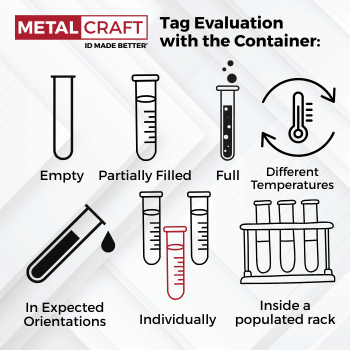
- Empty
- Partially filled
- Fully filled
- At different temperatures
- In expected orientations
- Individually
- Inside a populated rack
Blood, tissue suspensions, buffers, aqueous reagents, and other materials may not behave identically.
Fill level also changes the relationship among the fluid, air gap, antenna, and reader.
This is one reason broad read-range claims are less useful for specimen tracking than application-specific testing. A tag advertised with an impressive range in a controlled environment may not deliver the same performance on a liquid-filled tube in a dense rack.
Understand Antenna Orientation on Cylindrical Containers
Test tubes rotate.
That simple fact can undermine a laboratory RFID implementation if testing only measures the best tag orientation.
A cylindrical tube may present its antenna directly toward the reader during one read and rotate 90 or 180 degrees during the next.
Evaluate:
- Horizontal tubes
- Vertical tubes
- Multiple rotational positions
- Tubes in racks
- Tubes carried individually
- Tubes moving through automation
Compact antenna designs can help fit constrained spaces, but small size may reduce performance. Flag-style constructions can move more of the antenna away from the tube, but they introduce other workflow considerations.
Define acceptable performance across realistic orientations rather than testing only the ideal position.
Plan for Densely Packed Tubes and Vials
Reading one tube is not the same as reading 50.
When tubes are densely packed, neighboring specimens, tags, fluids, and rack materials can affect the RF environment.
Test:
- One tube
- Partially populated racks
- Fully populated racks
- Different rack materials
- Multiple slot spacings
- Empty versus filled containers
- Adjacent racks or boxes
The goal is not simply to prove that every tag can eventually be read.
The system should achieve the required inventory accuracy within an operationally useful period while controlling duplicate or unintended reads.
RFID technology can provide major time savings here because multiple tags can be captured during a single inventory process instead of requiring technicians to orient and scan every barcode individually.
Design a Controlled Read Zone
More read range is not always better.
A laboratory workstation intended to identify specimens in one tray should not automatically capture samples sitting on the bench three feet away.
Define:
- What must be read
- What must not be read
- Minimum acceptable read rate
- Maximum acceptable stray-read rate
- Reader location
- Antenna angle
- Reader power
- Physical shielding, if necessary
A controlled read zone produces more useful RFID data than a system designed simply to maximize distance.
This is especially important in high-density laboratory environments where many specimens may pass close to one another.
Compare RFID Tag Formats for Tubes, Vials and Specimen Containers
Standard Pressure-Sensitive RFID Labels
Standard RFID labels can work well when the container provides enough mounting area for the antenna and printed identification.
They may be appropriate for:
- Larger specimen cups
- Bottles
- Boxes
- Wide tubes
- Secondary packaging
Consider whether labels will be preprinted or printed on demand.
The available surface must accommodate the RFID antenna along with any required barcode, accession number, human-readable text, warnings, and other identification.
Watch for edge lift, wrinkles, overlap, and excessive antenna bending.
Compact and Micro RFID Labels
Small vials and microtubes may require a compact antenna.
Smaller tags can provide access to applications where a conventional RFID label simply will not fit, but the tradeoff is typically less antenna area and potentially reduced read performance.
Application precision becomes more important as the tag gets smaller.
Metalcraft’s Universal Micro RFID Tag is useful here as an example of what small-footprint antenna engineering can look like. It should not be interpreted as a blanket recommendation for specimen containers; laboratories shopping for tube and vial solutions should evaluate it alongside the appropriate RFID tags for plastic surfaces and other constructions designed around the actual substrate and workflow.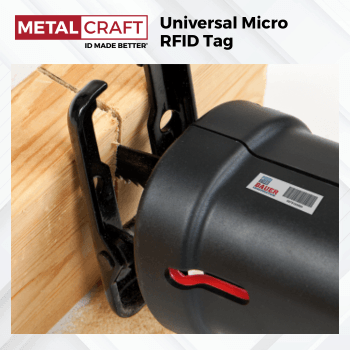
Also consider printer and encoder capabilities. Extremely small RFID labels may require specialized printing or encoding processes.
To compare form factors before narrowing the specification, browse RFID tag constructions or use the Metalcraft product selector as a starting point.
Flag-Style RFID Tags
Flag tags place part of the antenna away from the container surface.
That can be advantageous on narrow, curved, or liquid-filled containers because more of the antenna is exposed to the RF field.
But the physical flag can create operational issues.
Evaluate whether it could:
- Snag during handling
- Interfere with centrifugation
- Contact adjacent specimens
- Prevent a tube from fitting in a rack
- Interfere with robotic grippers
- Fold or crease during transport
A tag can perform well electrically and still fail operationally.
Wraparound and Self-Laminating Tag Constructions
Wraparound and self-laminating constructions can combine specimen identification with additional protection for printed information.
They can be useful when moisture, chemicals, handling, or abrasion threaten barcode and human-readable data.
On narrow tubes, however, there may not be enough circumference to accommodate every design element without overlap.
The RFID antenna should not be folded or overlapped in a way that changes performance unless the tag was specifically designed for that installation method.
Hard Tags and Carrier-Mounted RFID Tags
Hard tags may be appropriate for reusable laboratory assets rather than disposable specimen containers.
Potential applications include:
- Tube racks
- Freezer boxes
- Transport containers
- Cassettes
- Reusable specialty carriers
Mechanical attachment can provide an alternative when adhesive bonding is unreliable.
However, reusable RFID identities require strong process controls. A tag previously assigned to one specimen or carrier cannot accidentally retain an identity when reassigned.
Cleaning, contamination control, added bulk, and compatibility with laboratory automation should also be evaluated.
RFID Specimen Tag Selection Table by Container Type
| Consideration | Passive RFID | Healthcare RTLS |
|---|---|---|
| Primary purpose | Identification and checkpoint tracking | Continuous location tracking |
| Tag power | No internal battery | Often battery-powered |
| Location information | Read-point or zone based | Continuous or near-real-time |
| Tracking accuracy | Depends on reader placement and configuration | Depends on RTLS technology and infrastructure |
| Infrastructure | Readers and antennas | Location infrastructure plus software |
| Tag cost | Generally lower | Generally higher |
| Large asset populations | Highly scalable | Often more selective due to cost |
| Battery maintenance | None for passive tags | Often required |
| Best applications | Inventory, audits, identification, checkpoints | Real-time equipment location |
| Implementation complexity | Generally lower | Generally higher |
Select Adhesives and Mounting Methods for Laboratory Conditions
Match Adhesive Chemistry to the Container Surface
The RFID inlay can be perfect and the application can still fail because the label falls off.
Adhesive selection should account for the actual substrate, including polypropylene, polyethylene, glass, coated paper, and metal.
Also document the condition of the surface when the label is applied.
Is it:
- Clean?
- Dry?
- Textured?
- Treated?
- Contaminated?
- Already cold?
- Covered in condensation?
Some adhesives need dwell time before reaching their expected bond strength. Applying tags before the specimen is filled or cooled may therefore improve reliability when the workflow allows it.
Choose Adhesives for Refrigeration and Freezer Storage
Application temperature and service temperature are not the same specification.
An adhesive capable of surviving freezer storage may still require application at room temperature.
A technician applying a label to a frozen, frost-covered vial creates a very different bond than one applying the same label to a clean tube before it enters storage.
Account for:
- Application temperature
- Long-term service temperature
- Condensation
- Frost
- Thermal contraction
- Freeze-thaw cycling
For laboratories purchasing thousands or millions of tags, overlooking this distinction can create a significant replacement problem.
Evaluate Cryogenic RFID Tag Requirements Separately
Ultra-low-temperature and cryogenic storage should be treated as specialized applications.
Do not assume a label designed for standard refrigeration or freezer conditions will automatically survive cryogenic use.
Potential failure modes include:
- Facestock brittleness
- Cracking
- Delamination
- Adhesive failure
- RFID inlay damage
- Print degradation
The environment also includes how the specimens are handled.
Frost, gloves, rack extraction, abrasion, immersion, and vapor-phase storage can all affect the finished identification system.
For applications requiring environmental monitoring in addition to identification, RFID temperature sensor tags may also be worth evaluating. Sensor requirements should be specified separately from basic specimen identity and tested under the intended storage conditions.
Consider Chemical Exposure, Cleaning and Sterilization
Laboratory labels can encounter alcohols, disinfectants, solvents, reagents, cleaning agents, and other chemicals.
Some specialized RFID constructions can withstand substantial chemical exposure, high or low temperatures, and sterilization processes. Durable materials can also help printed information resist smudging and smearing.
But resistance is specific to the construction and exposure.
Specify:
- Chemical
- Concentration
- Contact duration
- Exposure frequency
- Temperature
- Sterilization process
- Required cycle count
Evaluate printed data and barcode readability along with RFID functionality.
A tag that continues transmitting but has lost its visible specimen identification may not meet the laboratory’s requirements.
Know When Mechanical Mounting Is the Safer Option
Mechanical attachment is generally more relevant to reusable carriers than disposable tubes.
Potential attachment methods include:
- Screws
- Rivets
- Slots
- Clips
- Cable ties
- Molded holders
- Recessed mounting
This can be useful for freezer boxes, racks, cases, and reusable transport equipment.
Evaluate cleanability, contamination control, automation clearance, and the risk of the tag moving during use.
Total installed cost matters too. A more expensive mechanically mounted tag that lasts for years can be more cost effective than repeatedly replacing failed adhesive tags on a reusable carrier.
Connect RFID Specimen Tracking to LIMS and Laboratory Workflows
Define What Data Belongs on the RFID Tag
More memory does not automatically create a better RFID system.
For many specimen tracking applications, a stable unique identifier is the most important data stored on the tag. That ID can link the physical specimen to the detailed record maintained by the LIMS.
Avoid placing unnecessary patient or sensitive research information directly on RFID memory.
Instead, define:
- Unique identifier structure
- EPC requirements
- User-memory requirements
- Passwords
- Lock state
- Re-encoding rules
- Retention requirements
Laboratories evaluating how to program RFID tags should establish these data rules before encoding begins.
RFID tags can support rewritable memory, but dynamic data should only be written to the physical tag when there is a clear workflow reason to do so.
Preserve Barcode and Human-Readable Identification
RFID should not necessarily replace every existing identification method.
A hybrid label can provide:
- RFID
- Barcode
- Human-readable accession number
- Short identifier
- Warnings or handling information
Barcode remains useful for exceptions, downtime, external partners, and workflows where an RFID reader is unavailable.
Visible identification also provides an immediate human check.
The objective is not RFID for RFID’s sake. It is improved specimen tracking and identification.
Map Each RFID Read to a Workflow Event
RFID becomes more valuable when each meaningful read represents an operational event.
Those events may include:
- Specimen collection
- Initial identification
- Receipt
- Laboratory accessioning
- Aliquoting
- Movement into testing
- Refrigerated storage
- Freezer storage
- Transfer between laboratories
- Chain-of-custody handoff
- Disposal
The system should also manage exceptions.
What happens when a specimen is:
- Missing?
- Unexpected?
- Duplicated?
- Unreadable?
- In the wrong rack?
- At the wrong location?
RFID can provide automated end-to-end traceability, but only if the system understands what each read means.
Integrate Readers Without Creating Duplicate Records
RFID readers can generate substantial amounts of data.
A specimen sitting in a reader field for 30 seconds might be detected repeatedly. The LIMS does not need 300 separate arrival transactions.
Middleware or application logic should filter raw RFID data into meaningful events.
Integration should define:
- Tag-to-accession mapping
- Reader location
- Timestamp
- User
- Workflow status
- Duplicate-read suppression
- Exception handling
- Downtime procedures
- Audit-trail requirements
Well-designed integration with lab inventory management systems can automate tracking without overwhelming users with raw reads.
Automated data capture also reduces manual entry, which can help decrease specimen identification and transcription errors.
Protect Privacy, Security and Data Integrity
RFID data requires governance.
Store the minimum necessary information on the physical tag and protect the detailed record within the LIMS or other secured system.
Consider:
- User access controls
- Tag passwords
- Locking
- Authentication
- Kill functionality, where supported
- Unauthorized reads
- Tag cloning
- Replacement procedures
- Ownership of identifier ranges
Security should be part of the initial system architecture, not an add-on after implementation.
Explore Metalcraft RFID for Laboratory and Specimen Tracking
Match the Tag Construction to the Laboratory Application
Once you understand the container, workflow, environment, and read requirement, you can begin narrowing the physical tag.
Metalcraft’s role is to help connect those application requirements with an appropriate construction rather than forcing every laboratory into the same product.
Depending on the application, that evaluation may include:
- RFID labels for plastic containers
- Compact RFID constructions
- Durable labels for challenging environments
- Cold-storage-compatible materials
- Carrier-mounted tags
- Custom dimensions
- Specialized adhesives
- Preprinted or variable identification
- RFID plus barcode and human-readable information
A healthcare RFID tagging solution should be designed around what the laboratory actually needs to identify—not around the product a supplier happens to have in stock.
That is also why the small-footprint engineering represented by the Universal Micro RFID Tag can be useful as a form-factor reference without implying that it is automatically the correct tag for a test tube or specimen vial.
Laboratories should compare it with the appropriate plastic-surface and specimen-container options, then validate the best candidates physically.
Metalcraft’s technology-agnostic approach also means RFID should earn its place in the workflow. In some processes, barcode remains the most practical solution. In others, a hybrid barcode/RFID label may deliver the best combination of visible identification and automated data capture.
Validate RFID Specimen Tags Before Facility-Wide Deployment
Build a Representative Test Matrix
A laboratory RFID pilot should reproduce the conditions that make the application difficult.
Include representative:
- Container manufacturers
- Materials
- Diameters
- Caps
- Surface treatments
- Fill levels
- Specimen types or safe surrogate fluids
- Rack configurations
- Storage temperatures
- Handling conditions
Test empty, partially filled, and fully filled containers.
Test tubes individually and inside fully populated racks.
Test room-temperature, refrigerated, frozen, thawed, wet, and frost-exposed specimens when applicable.
New tags should also be compared with tags that have experienced the expected handling and environmental cycles.
Measure More Than Maximum Read Range
Maximum range is only one measurement—and often not the most useful one.
Record:
- First-pass read rate
- Read accuracy
- Orientation sensitivity
- Full-rack inventory time
- Stray-read frequency
- Post-environment performance
- Adhesive failures
- Label movement
- Print degradation
- Operator time
- Exception frequency
The purpose is to determine whether the tag supports the actual process.
For a more complete validation framework, use an RFID tag testing checklist for healthcare deployments rather than creating acceptance criteria after the pilot has already begun.
Test the Complete Reader Environment
Do not test the tag independently of the system that will read it.
Evaluate the actual or representative:
- Handheld reader
- Benchtop reader
- Portal
- Cabinet
- Shelf
- Tunnel
- Reader power
- Antenna placement
Laboratory surroundings matter too.
Metal benches, freezer walls, racks, shielding, nearby instruments, liquids, and other tagged objects can influence performance.
Test at real workflow speed. A stationary demonstration in an empty conference room does not represent specimens moving through a clinical laboratory.
Start With One Specimen Class Before Scaling
Begin with a defined problem.
That could be one:
- Specimen type
- Department
- Storage area
- Accessioning workflow
- Research study
- Freezer bank
Measure the current baseline before RFID implementation.
Then define acceptance thresholds for tracking accuracy, read performance, processing time, specimen loss events, and workflow exceptions.
Include accessioning, laboratory operations, IT, LIMS, quality, and procurement in the pilot.
Keep a barcode fallback and rollback process until RFID performance is proven.
The value of this approach is supported by real laboratory experience. Mayo Clinic’s earlier specimen-identification initiative combined RFID with a paperless requisition process and two-provider confirmation. The initiative reduced mislabeled or unlabeled specimens from 765 to 47 during the compared three-month periods—a roughly 93% decrease. Because several process changes occurred together, that result should not be attributed to the RFID tag alone.
Mayo Clinic’s Department of Laboratory Medicine and Pathology later upgraded to UHF RFID and published two peer-reviewed studies analyzing the implementation. In the six months after deployment, six mislabeling events occurred versus 24 in the preceding six months, a 75% decrease, while the system also enabled timely recovery of three missing specimens.
Those results illustrate the larger point: RFID is most valuable when the tag, readers, software, and laboratory process are designed together.
Compare RFID Specimen Tag Suppliers and Total Installed Cost
Ask Suppliers Application-Specific Questions
A supplier should be able to discuss the application, not simply email a datasheet.
Ask:
- Has this tag been evaluated on our container material?
- Has it been evaluated on this diameter?
- Was quoted read range measured on an empty or filled object?
- What liquid was present during testing?
- What reader and antenna were used?
- What reader power was used?
- What tag orientation produced the result?
- Which adhesives are available?
- Which facestocks are available?
- What temperature data is available?
- What chemical-resistance data is available?
- Can the tag be customized?
If the answer to every application is the same tag, ask more questions.
Evaluate Manufacturing and Quality Controls
Laboratory procurement should look beyond initial RFID performance.
Ask suppliers about:
- Encoding verification
- Unique ID controls
- Print inspection
- Barcode verification
- RFID inlay placement tolerance
- Lot traceability
- Change notification
- Sample approval
- Defective-tag procedures
Small construction changes can matter in tightly constrained RFID applications. Procurement therefore needs visibility into changes that could affect validated performance.
Compare Preprinted and Onsite-Printable RFID Specimen Tags
Preprinted and encoded tags can simplify high-volume programs where identifiers are centrally managed.
Onsite printable RFID tags can offer greater flexibility when specimen or asset identities must be generated at the point of use.
The decision should account for:
- Printer compatibility
- Encoder compatibility
- Calibration
- Operator training
- Failed encoding
- Verification
- Label inventory
- Identifier management
A printer that can physically accept a label does not automatically mean it can encode a very small RFID inlay reliably.
Include the printer in validation when onsite encoding is required.
Calculate Total Installed Cost, Not Unit Price
A low-cost RFID tag is expensive if it fails in the freezer.
Calculate the complete cost of the solution, including:
- Tag price
- Custom tooling
- Printing
- Encoding
- Design
- RFID printers
- Readers
- Antennas
- Middleware
- LIMS integration
- Installation labor
- Validation
- Training
- Replacement rates
- System support
- Ongoing maintenance
Then compare those costs with the problem being addressed.
Potential benefits can include:
- Faster sample tracking
- Reduced manual scanning
- Automated inventory
- Faster specimen retrieval
- Fewer data-entry errors
- Improved traceability
- Better chain-of-custody documentation
- Reduced searching
- Earlier detection of missing samples
In anatomic pathology and other clinical workflows, specimen identification errors can carry consequences far beyond the cost of a replacement label. AHRQ notes that pre-analytical errors are an important source of medical-testing error and that some specimen loss or mislabeling events can lead to serious delays or inappropriate treatment.
That is why the most cost-effective tag is the one that reliably performs the required job—not necessarily the one with the lowest unit price.
Build a Reliable RFID Specimen Tracking System With Metalcraft
Follow the Selection Sequence in Order
A reliable RFID sample tracking program comes back to the same three-stage sequence: container first, workflow and environment second, tag construction third.
Don’t choose an RFID tag based on nominal read range alone.
Start with the container material and geometry. Then define the read event, rack density, temperature, fluids, and storage environment. Only then select the RFID frequency, antenna design, adhesive, facestock, printing, and encoding.
That approach is especially important for RFID tags for test tubes, where a small change in curvature, fill level, orientation, or rack spacing can influence performance.
RFID technology can improve identification and tracking, provide real-time or near-real-time workflow data, automate readings, and create an electronic audit trail as samples pass through the laboratory.
But the physical tag remains the foundation.
If the tag does not stay attached or cannot be read consistently, software cannot fix the problem.
Send Suppliers a Complete Specification Sheet
Before requesting a production quote, document:
- Container manufacturer
- Container material
- Surface treatment
- Diameter
- Curvature
- Usable mounting area
- Cap material
- Foil seals
- Nearby metal
- Disposable or reusable lifecycle
- Existing markings that must remain visible
- Individual or bulk-reading requirement
- Minimum desired read distance
- Maximum desired read distance
- Permitted read zone
- Container orientation
- Rack density
- Reader type
- Operating frequency
- Application temperature
- Service temperature
- Freeze-thaw cycle count
- Moisture
- Condensation
- Frost
- Immersion
- Chemical exposure
- Cleaning processes
- Abrasion
- Centrifugation
- Sterilization
- Identifier structure
- LIMS mapping
- Barcode requirements
- Human-readable requirements
- Encoding requirements
- Sample-testing requirements
- Custom size requirements
- Adhesive requirements
- Printing requirements
- Minimum order quantity
- Lead time
- Quality documentation
- Change-control expectations
The more complete the application information, the faster Metalcraft can narrow the options and recommend samples worth testing.
That matters when a laboratory is working against a system implementation, LIMS upgrade, freezer migration, research-program launch, or quality-improvement deadline. Sending only a tube diameter and desired read range usually creates another round of questions. Sending the actual container, environmental conditions, reader information, and workflow can move the evaluation forward faster.
Metalcraft’s role is to help make that process easier: identify what needs to work, determine which constructions are worth evaluating, and get physical samples into the application before a production specification is locked.
| Request Pricing for RFID Specimen Tags |
|
Ask Metalcraft to review your container, environment, read point, rack configuration, and tag-format requirements together. Sample testing or prototype evaluation should come before a production order so the proposed RFID tag can be evaluated on the actual container and in representative laboratory conditions. Custom materials, adhesives, dimensions, printing, and encoding can be considered as part of the application evaluation—not treated as an afterthought once a standard tag has already been selected. Request an RFID specimen tag quote |
 |
About the Author: Mark Maliszewski

Mobile Phone: 641-423-9460
Office Phone: 641-428-9156
Email: [email protected]
Office: 3360 9th St SW, Mason City, IA 50401
Subscribe To The Blog
Find More Blogs
Recent Posts
- Chemical-Resistant RFID Tags: How to Choose Tags for Cleaning, Disinfectants and Harsh Environments
- Medical Supply Recall Tracking: How RFID Closes Traceability Gaps
- RFID vs. Barcodes for Laboratory Sample and Specimen Tracking: Which Is Right for Your Lab?
- What is ITAR? – The Complete Guide to ITAR Compliance for 2026
- Top RFID Companies to Know in 2026