

What Is a Semi-Passive RFID Tag (and How It Works)
Radio frequency identification (RFID) has become one of the most widely used technologies for tracking, monitoring, and automating processes across the supply chain, manufacturing, logistics, retail, and countless other industries. Most people recognize passive RFID tags and active RFID tags, but fewer understand the category in between: semi-passive RFID tags.
Semi-passive tags—sometimes called battery-assisted passive tags or semi-active tags—bridge the gap between low-cost passive tags and high-power active tags. They deliver longer read range, support environmental sensors, and improve reliability, all while avoiding the higher cost and infrastructure needs of fully active systems.
In this article, you’ll learn exactly what semi-passive RFID tags are, how they work, when to use them, and how they compare to passive and active tag types. You’ll also get a clear table to help distinguish the three technologies at a glance.
What Is a Semi-Passive RFID Tag?
A semi passive RFID tag (often written as semi-passive RFID, semi passive tags, or battery-assisted passive tags) is an RFID tag with an integrated battery—but unlike active RFID tags, the battery does not broadcast a signal. Instead, it powers the internal tag components such as environmental sensors, memory, or the tag IC.
The reader still energizes the tag during communication. That makes semi-passive RFID ideal when you need sensor data, improved read range, and better performance in harsh environments, without committing to the higher cost of an active RFID system.
How It Differs from Other Tags
The biggest difference among passive, semi-passive, and active RFID tags is the power source and how the tag uses it. This determines how far the tag can communicate, its battery life, and the types of additional functionalities it supports.
Comparison Table: Active vs Passive vs Semi-Passive
| Tag Type | Power Source | How Tags Operate | Primary Advantage |
|---|---|---|---|
| Active RFID Tags | Self-powered battery | Continuously broadcast using their own power | Longest read range & real-time tracking |
| Passive RFID Tags | Reader-powered (no battery) | Reader energizes the tag using radio waves | Low cost & small form factor |
| Semi-Passive RFID Tags | Battery-powered internal components only | Sensors and IC powered by battery; communication initiated by reader | Improved read range & support for sensors |
Semi passive RFID tags land directly between active and passive tags—offering a smart balance of range, power, data, and cost.
How Semi-Passive RFID Tags Work
Semi-passive RFID tags use a combination of internal battery power and reader-initiated activation, which enables both improved sensing capabilities and longer communication range than standard passive RFID tags.
Power and Activation
The integrated battery in a semi-passive tag does not broadcast radio waves by itself. Instead, it powers:
-
the tag IC
-
onboard sensors (temperature, humidity, motion)
-
memory
-
advanced wake/sleep logic
Because internal electronics are powered, the tag avoids the limited energy constraints that passive tags face. Many semi passive RFID tags also include a sleep mode, preserving battery life until the RFID reader activates them.
Compared with passive RFID:
-
Passive tags rely solely on harvested energy.
-
Semi-passive tags have their own power source to run electronics.
-
This results in reliable performance in harsh environments or on sensitive assets needing continuous sensing.
Communication
During communication:
-
The reader antenna emits radio waves.
-
The tag detects the signal through the forward link.
-
Instead of powering internal circuits from the reader, the tag uses its battery to operate.
-
The tag modulates and backscatters the signal back to the reader to transmit data.
Because the electronics are pre-powered, semi-passive tags achieve:
-
longer read range (often 20–30% greater than passive RFID tags)
-
improved communication range consistency
-
better performance around liquids, metals, and outdoor applications
This “hybrid” mode is why semi-passive RFID is sometimes described as battery assisted passive.
Reader Compatibility
A major advantage of semi-passive tags is that they work with standard UHF RFID readers, making them easier to deploy. Organizations typically do not need:
-
new reader infrastructure
-
special antennas
-
major system upgrades
Semi-passive RFID is fully compatible with UHF RFID technology, ultra high frequency systems, and standard industry-grade RFID technology.
Key Features and Benefits
Semi-passive RFID tags deliver a longer read range than passive RFID tags—often 20–30% farther—making them easier to capture in busy or spread-out environments.

They also support environmental sensors such as temperature, humidity, or motion. This makes them ideal for applications where monitoring conditions is just as important as tracking location.
Because they work with standard RFID readers, these tags require no new infrastructure, allowing organizations to upgrade performance without major changes to existing systems.
Semi-passive tags excel in supply chain monitoring, especially for sensitive goods that need reliable condition tracking. Their internally powered electronics also help them perform better in harsh environments or areas with interference.
These tags are valuable for high-value or sensitive assets, offering durable construction that withstands challenging conditions better than most passive tags. The powered IC also reduces communication errors for more dependable data capture.
Overall, semi-passive RFID provides strong capabilities at a balanced cost, offering enhanced range and sensing without the higher price of active RFID systems.
Semi-Passive vs Active vs Passive RFID
Semi-passive RFID tags sit in the middle of the RFID spectrum. Here’s how they compare across the criteria that matter most.
Power Source and Signal Type
-
Passive RFID tags rely entirely on the RFID reader for energy.
-
Active RFID uses a strong battery to broadcast signals continuously.
-
Semi passive RFID uses a battery for internal systems, but the reader energizes communication.
This makes semi-passive a hybrid: partial battery-powered operation without a broadcasting transmitter.
Range and Reliability
-
Passive RFID read range: short to moderate, depending on the antenna and environment.
-
Active RFID read range: longest, designed for real-time locating.
-
Semi-passive RFID read range: ~20–30% longer than passive and significantly more reliable around interference.
Semi-passive tags are ideal when range matters but you don’t need constant broadcasting.
Battery Life and Maintenance
Semi-passive tags have:
-
longer battery life than active tags
-
lower power consumption because they don’t constantly broadcast
-
occasional replacement needs depending on usage patterns
Tags with a replaceable battery are available for long-term deployments.
Cost and Scalability
-
Passive tags remain the most low cost and scalable options.
-
Active RFID tags come with a higher cost due to their transmitter and battery.
-
Semi-passive tags fall in between and provide strong cost effectiveness for condition-monitoring applications.
When budget and performance must be balanced, semi-passive RFID is often the sweet spot.
Common Environments
Passive RFID:
Retail, high-volume supply chain labeling, inventory counts, access control, disposable labeling.
Active RFID:
Real-time tracking of vehicles, personnel, and large equipment across wide areas.
Semi-passive RFID:
Sensitive goods, pharmaceuticals, cold chain, environmental monitoring, food safety, outdoor applications, industrial sensing, and high-value asset tracking.
When to Use Semi-Passive RFID Tags
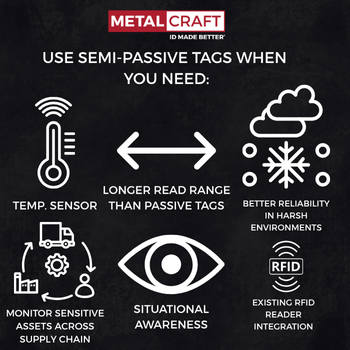
Choose semi-passive RFID tags when you need:
-
Temperature sensor, humidity, motion, or shock monitoring
-
Longer read range than passive tags without active-system cost
-
Better reliability in harsh environments
-
Monitoring of sensitive assets across the supply chain
-
Situational awareness rather than real-time tracking
Industries that commonly benefit:
-
Pharmaceuticals & cold chain
-
Electronics manufacturing
-
Food storage and transport
-
Industrial and outdoor equipment
-
Aerospace and defense
-
High-value inventory and tooling
Because semi-passive tags transmit data only when triggered, they strike an ideal balance between performance, lifespan, and affordability.
Limitations to Consider
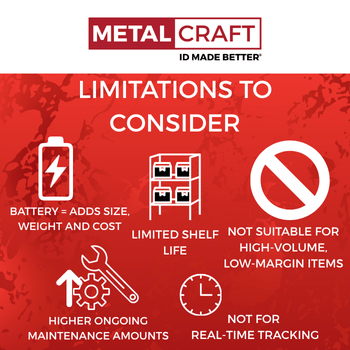
Even though semi-passive tags offer significant advantages, they aren’t perfect. Key potential downsides include:
-
Battery adds size, weight, and cost.
-
Shelf life is limited by battery life.
-
Not suitable for extremely high-volume, low-margin items where passive RFID is preferred.
-
Slightly higher ongoing maintenance than purely passive RFID.
-
Not ideal when real-time tracking is required (active RFID is better).
The limiting factor for many organizations is simply whether the improved sensing and range justify the added cost.
Choosing the Right Tag Type for Your Application
To select the right tag—passive, semi-passive, or active—evaluate:
-
Intended applications (inventory, sensing, tracking, real-time locating)
-
Required read range
-
Need for sensors or environmental monitoring
-
Budget and cost constraints
-
Conditions and harsh environments
-
Whether the tag must remain for months or years
-
Whether additional features or additional functionalities are required
If you need a balance of range, reliability, and sensor support, semi-passive RFID almost always delivers the best result.
Frequently Asked Questions
Are semi-passive RFID tags the same as battery-assisted passive tags?
Yes. Semi-passive, battery-assisted passive, and semi-active tags are different terms for the same technology. All rely on an integrated battery for sensors and internal circuitry but still require a reader to activate communication.
Do semi-passive tags work with UHF RFID readers?
Absolutely. They’re designed for standard UHF RFID systems and compatible with UHF RFID technology using ultra high frequency bands.
How long does a semi-passive RFID tag’s battery last?
Depending on the duty cycle, sensing interval, and environment, battery life typically ranges from one to several years. Sleep mode helps extend the lifespan significantly.
What types of sensors can be integrated?
Common environmental sensors include temperature, humidity, motion, shock, and tamper detection. The tag IC manages measurement, logging, and communication.
Are semi-passive tags more expensive?
They cost more than passive tags but far less than active RFID tags. Their cost effectiveness shines when monitoring conditions or high-value goods in the supply chain.
Can semi-passive RFID withstand harsh environments?
Yes. Many are housed in rugged hard tags designed to withstand harsh environments such as temperature swings, vibration, dirt, and moisture.
What is the greater communication range advantage?
Because the internal electronics run on the tag’s battery, semi-passive tags often reach longer read ranges and offer more stable communication range than passive solutions.
Final Thoughts
Semi-passive RFID tags fill one of the most important gaps in modern RFID technology. They’re powerful enough to monitor temperature, humidity, and motion; flexible enough to operate with existing infrastructure; and efficient enough to support long-term deployments across complex supply chain environments.
If your application requires tracking, data, environmental sensing, or extended range, a semi-passive tag may be the ideal middle ground—giving you the performance of active systems at a more accessible cost.
Whether for cold chain monitoring, industrial operations, or protecting sensitive assets, semi-passive RFID offers a compelling combination of reliability, intelligence, and efficiency.
About the Author: John Fitzsimmons

Mobile Phone: 641-423-9460
Office Phone: 641-423-9460
Email: [email protected]
Office: 3360 9th St SW