
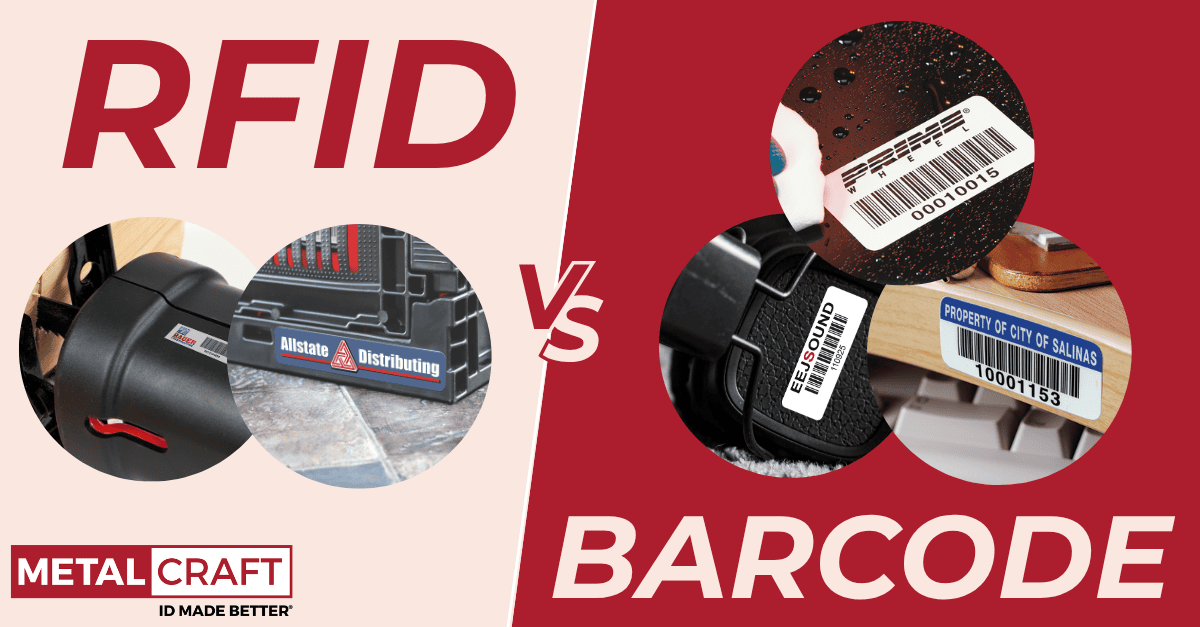
Choosing between RFID vs barcode asset tracking is one of the most important decisions organizations face when improving asset tracking, inventory management, and overall business processes. Both technologies are widely used, both are proven, and both can dramatically improve inventory accuracy and reduce asset loss. But the way they operate—and the value they deliver—differs in critical ways.
This guide breaks down the key differences, benefits, and use cases of RFID vs barcode systems so you can confidently choose the right asset tracking technology for your operation.
Understanding RFID vs Barcode Technology
At a fundamental level, radio frequency identification (RFID) and barcode technology work very differently.
RFID technology uses radio waves to transmit data from RFID tags to RFID readers without requiring a direct line of sight. In contrast, barcode systems rely on barcode scanners or barcode readers to optically scan barcode labels, meaning each item must be visible and scanned individually.
This distinction is the core of the RFID vs barcode asset tracking debate: automation vs manual scanning.
Scanning Speed and Efficiency
One of the biggest advantages of RFID tracking is speed. RFID systems can read multiple tags simultaneously, often scanning dozens—or even hundreds—of items in seconds. This enables true automated data collection and dramatically reduces labor time.
Barcode tracking, on the other hand, requires barcode scanning one item at a time. Each label must be aligned with a scanner, increasing the risk of human error and slowing down workflows.
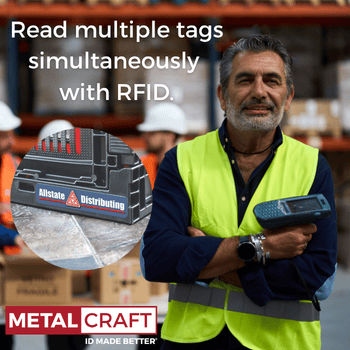
For operations that need to track assets quickly—such as warehouses or supply chain management environments—RFID provides a clear efficiency advantage.
Read Range and Line-of-Sight Requirements
Another major difference in RFID vs barcode systems is scanning distance.
RFID operates without a direct line or visibility requirement. Depending on the type of RFID scanner and tag, the tracking range can extend from a few inches to hundreds of feet. This makes RFID ideal for scanning items in bulk, even when they are inside boxes or behind barriers.
Barcode systems require a direct line of sight and close proximity. Labels must be clean and visible to be read. This limitation can slow down workflows, especially when dealing with mobile assets or large inventories.
Data Storage and Asset Intelligence
When comparing RFID data to barcode data, storage capacity is a major differentiator.
Barcodes, including QR codes, have limited data capacity. While they can encode basic identifiers, most detailed information must be pulled from external databases. Once printed, barcode data cannot be changed.
For organizations tracking high value assets, medical equipment, or sensitive assets, RFID’s higher data storage capacity provides significant advantages.
Durability in Harsh Environments
Durability is often misunderstood in the RFID vs barcode conversation, especially when comparing modern solutions.
RFID tags are designed for performance in harsh environments, with many options built to withstand extreme temperatures, moisture, chemicals, and physical impact. This makes RFID a strong fit for industrial applications like manufacturing, construction, and even animal tracking.
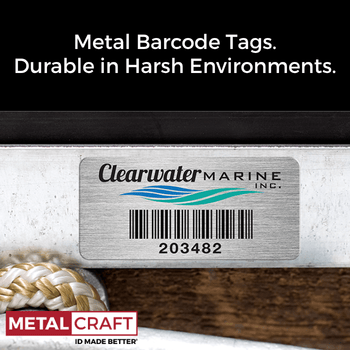
However, it’s not accurate to assume that all barcode labels are fragile. While standard paper labels can fade or tear, metal barcode tags and industrial-grade barcode labels are engineered for durability and, in many cases, can be just as durable—or even more durable—than RFID tags. These tags are often made from materials like anodized aluminum or stainless steel, allowing them to resist abrasion, corrosion, UV exposure, and chemicals.
In environments where long-term readability is critical, durable barcode solutions can provide highly reliable barcode tracking without
RFID tags, especially passive RFID tags, can store data such as asset data, maintenance records, and even maintenance history. Some RFID systems also allow data to be updated in real time, supporting advanced asset management strategies. The key difference is not durability alone, but how the data is captured. Unlike RFID, barcode systems still require a direct line of sight to capture data, so while the tag itself may last for years, scanning conditions must still be maintained for consistent performance.
Ultimately, both RFID and barcode technologies can perform well in tough conditions—the best choice depends on your scanning needs as much as the environment itself.
Cost and Implementation Considerations
Despite its advantages, RFID is not always the default choice.
Implementing RFID typically involves higher upfront costs, including RFID readers, infrastructure, and software integration. RFID systems may also require more planning to integrate with existing systems.
In contrast, barcode asset tracking is known for its low cost and simplicity. Barcode scanners are affordable, easy to deploy, and widely supported. For smaller operations or those with tight budgets, barcode systems remain a cost effective solution.
This is why, even today, barcode remains one of the most widely used tracking methods across industries.
Real-Time Tracking and Automation
RFID excels when it comes to real time tracking.
With fixed readers and automated checkpoints, RFID systems can continuously monitor asset movement and provide real time location data. This is particularly valuable for high value or frequently moving assets.
Barcode systems, by contrast, rely on manual scans. Without active scanning, no new data is recorded. This limits their ability to provide real-time visibility.
For companies needing full visibility across tracking systems, RFID offers a clear operational advantage.
Use Cases: When to Choose RFID vs Barcode
RFID is ideal for:
- Large facilities managing multiple tags
- Tracking high value assets or sensitive assets
- Environments requiring automated data collection
- Healthcare systems tracking medical equipment
- Operations needing real time tracking and reduced labor
Barcode systems are ideal for:
- Smaller businesses with limited budgets
- Simple inventory tracking needs
- Applications requiring precise, item-level control
- Retail environments using barcode barcodes at checkout
Hybrid Systems: The Best of Both Worlds
In many cases, the choice isn’t strictly RFID vs barcode—it’s both.
Modern RFID and barcode systems can work together in hybrid systems, allowing businesses to balance cost and performance. For example:
- Use RFID for high value assets
- Use barcodes for low-cost or static inventory
This approach maximizes cost effectiveness while still enabling advanced RFID asset tracking where it matters most.
RFID vs Barcode vs GPS Asset Tracking
It’s also worth noting that GPS asset tracking plays a role in certain use cases.
While RFID is excellent for indoor tracking and automation, GPS trackers are better suited for outdoor or long-distance tracking of vehicles and shipments. Many organizations combine RFID and GPS for complete visibility across indoor and outdoor environments.
Final Thoughts: Choosing the Right Asset Tracking System
The decision between RFID vs barcode asset tracking ultimately comes down to your operational needs.
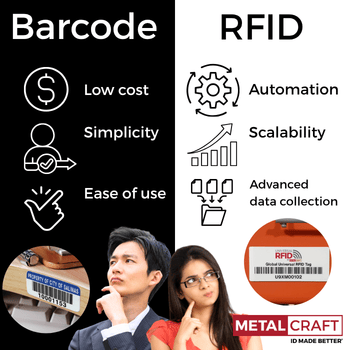
If your priority is low cost, simplicity, and ease of use, barcode technology remains a strong choice. But if you need automation, scalability, and advanced data collection, RFID delivers powerful key advantages.
As businesses continue to scale and demand better accuracy, many are asking: will RFID replace barcodes? The reality is more nuanced. While RFID is growing rapidly, RFID and barcode technologies will likely continue to coexist.
The best strategy is not choosing one over the other—but selecting the right tool for each part of your operation.
That’s where working with the right partner matters. Metalcraft offers both durable barcode asset tracking solutions—including long-lasting metal barcode tags—and advanced RFID solutions built for a wide range of environments and applications. Their team works closely with you to evaluate your facility, assets, and workflows to recommend the right asset tracking system and the right product for your specific needs.
By aligning your asset tracking technology with your goals—and leveraging expert guidance—you can improve efficiency, reduce asset loss, and build smarter, more resilient inventory management processes.
About the Author: Marianne Alvarado

Mobile Phone: 641-529-9492
Office Phone: 641-423-9460
Email: [email protected]
Office: 3360 9th St. SW, Mason City, IA 50401