

A pharmaceutical RFID tag can read perfectly during development and still fail when it reaches the packaging line.
That does not necessarily mean the RFID tag is defective or that the RFID reader needs more power. In many cases, the package itself has changed the RF environment. A tag tested in free air or on an empty container is not operating under the same conditions once it is attached to a liquid-filled vial, positioned beside a foil seal, packed into a dense tray, or moving past a reader at production speed.
Liquids absorb and detune. Foil reflects and shields. Both can change the performance of RFID tags after they are applied.
For pharmaceutical packaging engineers, packaging development and validation teams, quality managers, and pharmacy inventory professionals, the important question is not simply, Does this RFID tag work?
It is: Will this tag read reliably on this finished pharmaceutical package, at the required orientation, density, fill level, and line speed?
Getting that answer early matters. RFID technology can support faster inventory counts, medication inventory management, expiration monitoring, recall processes, supply chain visibility, and automated identification. But inconsistent reads create the opposite result: manual recounts, exception handling, inventory discrepancies, and more labor for pharmacy personnel.
The solution is a systematic process. Identify what is interfering with the signal, test the variables that actually influence performance, and validate the finished package rather than relying on a successful bench test.
This guide explains how.
Why Pharmaceutical RFID Read Rates Change Around Liquids and Foil
Pharmaceutical RFID Performance Is a System-Level Result
An RFID tag does not determine read performance by itself.
The finished RFID system includes the interaction among:
- Tag antenna
- RFID chip sensitivity
- Pharmaceutical product
- Container material
- Fill level
- Foil or metallized components
- Tag placement
- Label construction
- RFID reader
- Reader antenna
- Reader power
- Package orientation
- Adjacent products
- Production equipment
- Software and reader configuration
Change one of those variables and the read result may change with it.
This is why a free-air read-range test has limited value for pharmaceutical packaging. It establishes a reference point, but it does not tell you how the tag will perform once attached to the sellable unit.
A pharmaceutical package may combine glass or plastic, a water-rich drug formulation, aluminum, a small curved label area, and a metallic closure within a few centimeters. Products may then be packed tightly into trays, totes, cases, pharmacy cabinets, or hospital operating room inventory systems.
The finished package is therefore the meaningful test article.
For packaging engineers, the goal should also be read reliability, not maximum read distance. A tag that reads 20 feet under ideal conditions but misses 5% of units at the required line read point is less useful than one delivering repeatable reads throughout the validated operating window.
For readers who need the fundamentals before troubleshooting a package, how RFID tags work provides useful background on radio frequency identification, readers, antennas, and tag communication.
Why Pharmaceutical Packaging Creates Difficult RF Conditions
Pharmaceutical packaging can combine several materials that interact with radio waves in different ways.
Common examples include:
- Glass vials containing liquid medications
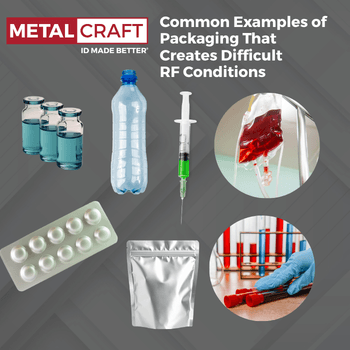
- Polymer bottles
- Prefilled syringes
- Infusion bags
- Aluminum blister packs
- Foil pouches and sachets
- Metallized barrier films
- Induction-sealed bottles
- Cartons containing foil-backed components
- Refrigerated and cold chain packaging
Then add production conditions.
Products rotate. Vials move through nests and trays. Bottles enter cartons. Individual packages become cases. Cases move beside stainless steel machinery. Line speed reduces the time each tag spends in the RFID read zone.
That explains a common development problem: the tag reads on the bench and fails on the line because the bench did not reproduce the package or the process.
Intermittent RFID tracking can create downstream consequences for medication inventory, including:
- Incorrect inventory counts
- Manual recounts
- Missed products
- Incomplete movement records
- Poor real time visibility
- Expiration-management exceptions
- Additional manual entry
- Delays during the recall process
Pharmaceutical manufacturers should therefore treat the tag, package, reader environment, and workflow as one system.
What an RFID Read Failure Actually Means
At the RF level, most apparent read failures can be separated into a few categories.
The tag may receive too little RF energy to power its chip. That can happen when a liquid absorbs energy or foil prevents sufficient reader energy from reaching the tag.
The tag may receive enough energy to power up but return a backscatter signal too weak for the reader to decode reliably.
The opposite can also occur: the RFID read zone may be too large. Reflections can cause products outside the intended area to be captured, creating stray reads.
Finally, the problem may not be RF performance at all.
Encoding errors, incorrect data, reader settings, software configuration, damaged tags, or application defects can all be misdiagnosed as radio-frequency interference.
Separate these possibilities early. Otherwise, teams can spend weeks changing tag placement or increasing reader power when the actual problem is encoding or software configuration.
How Liquids Disrupt RFID Tags for Pharmaceutical Containers
Why Does Liquid Interfere With RFID?
Many pharmaceutical formulations contain significant amounts of water.
At UHF RFID frequencies, water-rich products can absorb and dissipate RF energy. Liquid near an RFID antenna can also change the antenna’s electrical environment and shift its resonant frequency.
That can result in:
- Antenna detuning
- Increased RF loss
- Reduced energy reaching the RFID chip
- Narrower usable bandwidth
- Reduced backscatter
- Shorter or less consistent read range
Not every pharmaceutical product behaves the same way.
Saline, suspensions, alcohol-based formulations, oils, gels, powders, and other products have different electromagnetic properties. A vendor provided RFID tag that performs reliably on one drug container should not automatically be assumed to work on another.
This is especially important when pharmaceutical inventory includes multiple formulations in containers that appear physically identical.
How Liquid Proximity Detunes a UHF RFID Inlay
A UHF RFID antenna is designed to operate within a particular electromagnetic environment.
Once the label is applied, the package becomes part of that environment.
An inlay positioned directly against a filled bottle may behave differently from the same inlay separated from the liquid by additional label material, an air gap, a flag, or another structural element.
Curvature creates another variable. Wrapping a flat antenna around a small bottle or vial changes its geometry and current distribution.
Smaller antennas can help when available label area is limited, but compact size can also leave less tolerance for:
- Placement variation
- Fill-level changes
- Package curvature
- Orientation
- Frequency variation
- Nearby materials
High chip sensitivity alone does not solve those problems. Antenna efficiency and the antenna-to-chip match still matter.
That is why RFID tag options should be compared as complete constructions on the finished pharmaceutical package—not selected by chip specification alone.
Does Liquid Fill Level Affect RFID Tag Performance?
Yes, and the worst-performing state is not always a completely full package.
An empty bottle, half-filled bottle, and full bottle can each create a different RF environment.
As the liquid level moves relative to the RFID antenna, the tag may transition from relatively open-air conditions to direct interaction with the formulation.
That becomes especially important for:
- Multi-dose medications
- Infusion bags
- Bottles dispensed over time
- Flexible containers that collapse during use
- Partially filled packages
- Packages transported horizontally
Test the full fill range.
At minimum, evaluate:
- Empty
- Minimum expected fill
- Intermediate fill
- Nominal fill
- Maximum fill
- Upright orientation
- Horizontal orientation
- Inverted orientation, when realistic
Do not assume the nominal production volume represents the worst case.
Which Liquid Pharmaceutical Formats Require Special Attention?
Liquid interference should receive additional attention with:
- Injectable drugs in glass or polymer vials
- Prefilled syringes
- Ampoules
- Cartridges
- IV bags
- Flexible pouches
- Liquid medication bottles
- Aerosol or pump containers
- Multi-dose products
Prefilled syringes can be particularly challenging because the label area is narrow and the package may include metal components.
IV bags add flexibility and deformation. As the bag changes shape, the relationship between the RFID tag and liquid also changes.
For cold chain pharmaceuticals, temperature adds another variable. Condensation, adhesive performance, material contraction, and package handling can all influence the finished medication label.
RFID combined with sensor technology can also support temperature monitoring for temperature-sensitive pharmaceuticals. Where that functionality is required, sensor performance should be validated separately from basic identification and inventory requirements.
Do RFID Tags Work on Liquid-Filled Bottles?
Yes—but not automatically.
Reliable performance depends on the RFID technology, antenna design, tag placement, package material, formulation, spacing, and required read zone.
Possible approaches include:
- Liquid-optimized inlays
- Application-tuned UHF RFID tags
- Neck labels
- Flag or fin constructions
- Cap-mounted tags
- Hang tags
- Wrap labels
- Secondary-carton identification
Each creates tradeoffs.
A flag construction may improve RF exposure but interfere with automated handling. A larger antenna may improve performance but consume label space required for regulatory information. A secondary-carton tag may read well but no longer provide item-level identification once the carton and primary container are separated.
Validate the exact formulation and package—not a similar bottle filled with water.
How Foil Packaging Changes Pharmaceutical RFID Performance
Metal reflects RF energy and can interfere with a conventional RFID antenna when the tag is placed directly against a conductive surface. Specialty constructions are designed to address those conditions; readers who need the underlying metal-RFID fundamentals can review how metal surfaces affect RFID tag performance.
For pharmaceutical packaging, however, foil creates a more specific problem. Thin gauge, cavities, seams, folds, crimping, and package deformation can make the RF environment change across the package and throughout its lifecycle.
Can RFID Tags Be Read Through Foil?
An uninterrupted foil layer should be treated as an RF barrier rather than a transparent packaging material.
Reader energy can reflect from the conductive foil before sufficient energy reaches a tag hidden behind it. Even if the tag powers up, its return signal may be blocked or redirected before reaching the RFID reader.
That creates an important distinction:
Reading through foil is not the same as reading a tag mounted on the exterior of foil.
Do not assume a conventional RFID label will reliably communicate through a solid aluminum blister layer, foil pouch, or similar barrier.
Instead, evaluate whether the tag can be placed on the reader-facing exterior, separated from the conductive layer, or moved to a secondary packaging level.
Why Foil Packaging Creates Reflection and Detuning
Thin foil is conductive enough to alter RFID behavior, but pharmaceutical foil is rarely a simple flat sheet.
The conductive layer may include:
- Seams
- Folds
- Crimped edges
- Closures
- Cutouts
- Cavities
- Perforations
- Printed or laminated layers
When an ordinary UHF RFID inlay is positioned directly against foil, the conductive surface can alter antenna behavior and detune the tag.
Reflected signals can also create multipath.
In practical terms, the reader’s signal can arrive at the tag through multiple paths. Depending on their phase relationship, those signals can reinforce one another or cancel one another.
The result can be frustrating: a package reads consistently in one location but fails after moving only a few inches.
Thin-gauge foil can also deform during manufacturing, distribution, opening, and use. That means a package may not present exactly the same RF geometry throughout its lifecycle.
Pharmaceutical Foil Formats Most Likely to Create Read Problems
Packaging teams should pay particular attention to:
- Aluminum blister lidding
- Cold-form foil blister packs
- Foil medication pouches
- Sachets
- Induction seals
- Foil-backed labels
- Metallized films
- Foil-lined cartons
- Insulated cold chain packaging
- Packages combining liquid and foil
Not every metallized film behaves like solid aluminum foil.
Thin vapor-deposited coatings, laminates, and barrier structures can vary considerably. Packaging specifications should therefore identify the actual construction rather than simply labeling a package “metalized.”
When sourcing RFID tags for metal surfaces, provide the tag supplier with the foil or metallized structure whenever possible.
Why Blister Packs Are Harder Than Flat Metal Surfaces
Blister packaging creates a particularly dynamic RFID problem.
Instead of a flat conductive plane, the RFID tag may be operating near multiple cavities, formed webs, lidding material, tablets or capsules, perforations, and printed information.
Those cavities create an irregular geometry.
Then the geometry changes again when the package is opened.
As individual doses are removed:
- Foil may tear
- Cavities become empty
- Lidding deforms
- Conductive paths change
- The physical shape of the card changes
An RFID configuration that works on a sealed blister card should therefore be evaluated again after representative doses have been removed if the tag is expected to remain useful throughout the package lifecycle.
Packaging engineers should also define what is actually being tracked:
- Individual dose
- Blister card
- Wallet
- Secondary carton
Those are different RFID applications and should not share an assumed tag configuration.
How Foil-Compatible RFID Constructions Work
A tag intended for use near conductive packaging may create separation between the antenna and foil through a spacer or dielectric layer.
Other antenna designs are engineered to use the conductive surface as part of the RF structure.
HF and NFC applications may use ferrite materials to redirect magnetic fields.
Additional options include:
- On-metal RFID labels
- Encapsulated tags
- Surface-independent constructions
- Flag configurations
- External carton tags
Products such as the Universal MC RFID Tag and Universal RFID Asset Tag illustrate the types of surface-independent constructions available when an application requires more flexibility across challenging substrates. They should still be evaluated on the exact pharmaceutical package rather than treated as universal recommendations.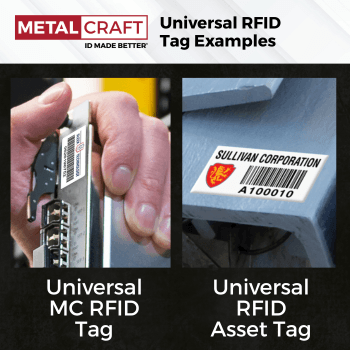
The right construction must balance:
- RF performance
- Thickness
- Flexibility
- Label application
- Packaging appearance
- Cost
- Recyclability
- Production speed
A stronger adhesive does not turn a conventional RFID inlay into an on-metal tag. RF construction and adhesive performance are separate requirements.
Liquid and Foil RFID Troubleshooting Matrix
Match the Symptom to the Likely RF Cause
When an RFID package fails, start with the symptom.
Do not immediately increase reader power or replace the entire RFID system.
| Observed symptom | Likely RF cause | First variable to test | Corrective direction |
|---|---|---|---|
| Tag reads before application but fails on a filled bottle | Liquid detuning or dielectric loss | Move tag above the liquid line | Test liquid-tuned inlay, air gap, neck or flag placement |
| Empty container reads better than full container | Fill-dependent absorption or resonance shift | Test empty, partial and full states | Adjust placement or test an inlay designed for liquids |
| Tag reads from only one side | Liquid blocking energy or antenna orientation | Rotate package and reader antenna | Reposition tag or improve antenna coverage |
| Foil pouch reads inconsistently | Foil detuning and multipath | Increase separation from foil | Test on-metal construction, spacer or external flag |
| Tag cannot be read behind blister card | Foil shielding | Move tag to reader-facing exterior | Test card-level or carton-level external placement |
| Individual packages read but full case fails | Dense liquids, tag shadowing, orientation or case geometry | Map rows and reader angles | Stagger tags, change case orientation or add antenna coverage |
| Reads disappear at one conveyor position | RF null or reflected-signal cancellation | Move antenna or package slightly | Adjust angle, height, polarization or shielding |
| Stray reads occur outside portal | Reflections from surrounding equipment | Reduce and reshape read zone | Lower power, reposition antennas or add RF management |
| Performance declines after converting | Antenna damage, bending or material interaction | Compare raw inlay with finished label | Modify die cut, liner, adhesive or converting process |
| Tag works statically but fails at production speed | Insufficient dwell time or reader configuration | Compare static and dynamic trials | Tune session, antenna sequence, package spacing and line setup |
How to Use the Matrix Without Chasing the Wrong Variable
Use the matrix to choose the next controlled experiment—not as a final diagnosis.
Change one variable at a time.
For each test, record:
- Package configuration
- Fill state
- Tag placement
- Orientation
- Reader distance
- Reader power
- Antenna
- Line speed
- Result
Separate RF failures from printing, encoding, data, application, and software problems.
If moving the tag above the liquid line immediately restores performance, that tells you far more than increasing reader power across ten trials.
Document the findings. Package-specific results should ultimately become part of the packaging specification and validation record so the same issue does not have to be rediscovered during scale-up.
A Four-Part Framework for Improving RFID Tag Performance
First, Optimize Tag Placement Before Changing Hardware
Tag placement is usually the fastest and least expensive variable to test.
For liquid containers, evaluate positions:
- Above the fill line
- Across the fill line
- Below the fill line
- On the shoulder
- On the neck
- Near the cap
- On a flag or extended tab
For foil packaging, maximize useful separation from:
- Foil panels
- Seams
- Metallic closures
- Crimped edges
- Plungers
- Needles
- Induction seals
Avoid sharp folds across sensitive portions of the antenna.
Also account for production tolerance. A position that works only when the RFID inlay is placed within one millimeter of an ideal laboratory coordinate is unlikely to be robust enough for high-speed packaging.
Define an acceptable placement window.
The RFID tag also cannot cover required drug information, lot numbers, expiration dates, warnings, instructions, serialization, or other regulated labeling.
Where Should an RFID Tag Be Placed on a Vial?
There is no universal best position.
For a small vial, compare the:
- Body
- Shoulder
- Neck
- Cap
- Extended flag position
A metal crimp seal may make the top of the vial challenging. The liquid may make the lower body difficult. Curvature can alter the antenna when the label is wrapped around the vial.
Then consider orientation.
Vials rotate in trays and nests, meaning the tag can face toward, away from, or perpendicular to the reader antenna.
Test the expected vial density and tag-to-tag spacing as well.
Finally, repeat the test after secondary packaging. A vial that reads consistently on its own may perform differently inside a carton or tray.
Second, Match Antenna and Inlay Design to the Package
RFID inlays are not interchangeable commodities.
Antenna geometry should be treated as an application variable.
Depending on the package, candidates may include:
- Standard dipole inlays
- Compact inlays
- Near-field designs
- On-metal tags
- Surface-independent tags
- Liquid-optimized designs
- HF or NFC constructions
Chip sensitivity matters, but so does antenna efficiency.
A highly sensitive chip connected to a poorly matched antenna can still produce disappointing results.
Also evaluate whether the design is broadly tuned or narrowly optimized. Pharmaceutical products distributed globally may need reliable UHF performance across regional frequency bands.
The final label construction matters as well. Facestock, adhesive, liner, spacer, printing, and converting can all influence the finished RFID product.
Metalcraft’s custom asset tag solutions can be evaluated when a standard construction does not provide the required combination of physical dimensions, material compatibility, printing, encoding, and RF performance.
Third, Select the Right Frequency
RFID frequency should be selected according to the application—not treated as a ranking from basic to advanced.
UHF RFID offers advantages for:
- Longer read distances
- Fast inventory counts
- Bulk reading
- Portal applications
- Cabinet inventory
- Supply chain workflows
Its challenge is greater sensitivity to water-rich products and conductive packaging.
High frequency RFID and NFC can provide advantages for:
- Short-range interaction
- Controlled item identification
- Close coupling
- Applications near liquids where a short read zone is acceptable
Their limitations include shorter range and reduced suitability for some high-speed bulk inventory applications.
Specialized UHF RFID tags can overcome many liquid-related challenges, so “liquid equals HF” is too simplistic.
Some pharmaceutical manufacturers may use hybrid approaches involving barcode, UHF, and NFC at different stages of the product lifecycle.
The right technology is the one that supports the business process reliably.
Fourth, Tune the Reader After Fixing Tag Fundamentals
Reader tuning comes last for a reason.
Increasing transmit power cannot restore a badly detuned RFID antenna.
Once the tag and placement are appropriate, optimize:
- Reader power
- Antenna gain
- Polarization
- Antenna angle
- Antenna height
- Reader distance
- Conveyor dwell time
- Reader sessions
- Antenna switching
- Filtering
- Inventory parameters
RF-absorbing materials or shielding may help control reflections around stainless steel equipment.
Maximum power should not be the default.
Excess power can enlarge the read zone and create stray reads without solving the actual package-level problem.
How to Test RFID Tags for Liquid and Foil Pharmaceutical Packaging
Define a Measurable RFID Performance Requirement
“RFID must work” is not a validation requirement.
Define measurable acceptance criteria.
Examples include:
- Required item-level read rate
- Maximum false-negative rate
- Maximum stray-read rate
- Minimum read distance
- Maximum read distance
- Line speed
- Required throughput
- Number of packages per test
- Package orientations
- Target regions and frequency bands
- Environmental conditions
For example, a requirement might specify that the RFID system must identify at least 99.5% of tagged units across a defined conveyor speed and placement window without capturing products outside the validated read zone.
The actual threshold should reflect the application and quality requirements.
Define the Package Configurations to Qualify
Do not validate only the easiest SKU.
Include:
- Minimum fill
- Nominal fill
- Maximum fill
- Different formulations
- Different package sizes
- Primary package alone
- Secondary packaging
- Tray configuration
- Carton configuration
- Tote configuration
- Full case
- Sealed foil packages
- Opened foil packages, when relevant
- Manufacturing tolerances
- Multiple tag lots
Where several products share a package family, identify the worst-case configuration using documented engineering rationale.
The same principle applies to pharmacy inventory. A successful read on one vial does not demonstrate reliable medication inventory management across a mixed inventory of bottles, syringes, pouches, blister cards, and cartons.
Establish a Controlled Baseline
Start simple and add complexity systematically.
First, measure the RFID tag in free air. That provides a reference—not an acceptance result.
Then:
- Apply it to an empty nonmetallic package.
- Add the pharmaceutical formulation.
- Add the closure.
- Add foil or metallized components.
- Add secondary packaging.
- Add neighboring products.
- Build the final case or tray.
Record when the largest decline occurs.
This sequence helps identify whether the dominant problem is liquid, metal, curvature, package density, secondary packaging, or another variable.
Keep the reader, antenna, cable, power, and test environment constant while isolating package variables.
Perform a Tag Placement Sweep
Create a repeatable grid of potential RFID tag locations.
Test each location across multiple package orientations.
Then intentionally move the tag within the expected applicator tolerance.
A position should not be approved simply because one perfectly applied prototype performed well.
Evaluate proximity to:
- Liquid level
- Foil seams
- Metal caps
- Package edges
- Closures
- Adjacent packages
Test reader-facing and reader-opposed positions.
The result should be a validated placement range that production can reliably maintain.
Run Static and Dynamic Production Simulations
Bench testing is useful for understanding the physics.
It is not a substitute for a production trial.
Dynamic testing should reproduce:
- Full line speed
- Conveyor spacing
- Random package rotation
- Actual guarding
- Stainless steel equipment
- Production machinery
- Tray density
- Case density
- Reader portal entry and exit
- Multiple reader environments
This is often where the “worked on the bench, failed on the line” problem becomes visible.
A static tag may remain in the RF field for several seconds. A package moving at production speed may have only a fraction of that dwell time.
Reader configuration that is adequate for a hand-fed test may therefore fail at throughput.
Stress-Test the Finished RFID Pharmaceutical Package
Validation should extend beyond day-one read performance.
Evaluate relevant lifecycle conditions such as:
- Adhesive cure
- Refrigeration
- Freezing
- Condensation
- Temperature cycling
- Humidity
- Moisture
- Abrasion
- Distribution vibration
- Cleaning
- Sterilization, when applicable
- Label flexing
- Pouch deformation
- Shelf-life aging
Then verify RFID performance again.
Printing and encoding should also be included. A raw RFID inlay may perform differently after it has been converted into the final medication label.
For adjacent applications involving tubes and vials in laboratory environments, see RFID tags for laboratory specimen containers for additional considerations around small cylindrical packages, liquids, rack density, and cold storage.
Keep a Formal Root-Cause Test Record
Quality teams should be able to reconstruct the test.
Record:
- Package SKU
- Formulation
- Fill level
- RFID tag model
- Inlay
- Chip
- Antenna
- Facestock
- Adhesive
- Exact placement
- RFID reader
- Reader antenna
- Firmware
- Power
- Frequency
- Orientation
- Environment
- Number of reads
- Number of misses
- Number of stray reads
- Corrective action
- Retest result
- Acceptance criteria
- Approver
That documentation becomes especially important when the package, formulation, RFID chip, label material, or reader changes later.
Common Pharmaceutical RFID Fixes That Fail
| Common response | Why it fails | Better move |
|---|---|---|
| Increase reader power | More power cannot correct severe package detuning and may increase reflections and stray reads | Optimize placement, construction and antenna geometry before power |
| Choose the smallest inlay | Smaller antennas can provide less efficiency and tolerance for package variation | Balance footprint with required performance and test multiple geometries |
| Test one package orientation | Cylinders, pouches and blister cards rarely maintain one presentation | Test rotation, orientation, spacing and repeated runs |
| Select from published read-range claims | Free-air performance does not represent a finished pharmaceutical package | Require package-specific data and conduct sample testing |
| Treat all liquids or foil as equivalent | Formulation, foil gauge, laminates, resin and geometry vary | Define package families and validate representative worst cases |
A recurring theme runs through every one of these mistakes: the fastest-looking fix during development often creates more work later.
Changing reader power is easy. Properly diagnosing the package takes more effort.
But the second approach produces a specification that can be repeated, validated, and transferred into production.
Metalcraft RFID for Reliable Pharmacy Inventory Management
Maintaining Reads Across a Mixed Pharmacy Inventory
Pharmacy inventory rarely consists of one package type.
A single pharmacy may need to identify:
- Glass vials
- Polymer bottles
- Prefilled syringes
- Foil blister cards
- Pouches
- Cartons
- Refrigerated medications
- Surgical kits
- Durable assets
One generic RFID label is unlikely to provide optimal performance across every format.
A better approach maps RFID constructions to the physical inventory while maintaining consistent encoding and data standards.
Reliable RFID reads can support:
- Medication inventory counts
- Stock-level visibility
- Expiration monitoring
- Replenishment
- Product location
- Recall identification
- Audit readiness
RFID technology also allows multiple items to be identified in a single scan without direct line of sight, reducing the tedious work associated with historically barcode-driven workflows.
This is where hospital RFID inventory management can deliver practical benefits. Automated data capture can reduce manual scanning and help pharmacy personnel spend less time performing repetitive inventory tasks.
RFID-enabled medication systems have also been used to automate kit and tray workflows. Published examples from Texas Children’s Hospital describe efforts to streamline medication RFID tagging from a multi-step process into a much shorter workflow, illustrating why tag application labor needs to be considered alongside RFID performance.
Tagging medications can still require pharmacy personnel to physically affix tags, verify data, and double check exceptions. If implementing RFID simply transfers many hours of tedious work from inventory counting to manual tag application, the efficiency calculation changes.
That is why Metalcraft approaches the application from the business outcome first.
The best solution might involve a mix of healthcare RFID tags, pre-encoded tags, onsite printable RFID tags, barcode identification, or other RFID solutions based on the package and workflow.
For pharmaceutical packaging upstream, RFID for medical device manufacturers provides another example of how RFID can support automated identification, supply chain visibility, and regulated manufacturing workflows.
| Explore RFID Constructions for Mixed Pharmacy Inventory | |
|
Different pharmaceutical packages create different RFID requirements. Metalcraft can help evaluate constructions for liquid containers, foil packaging, plastic, glass, and mixed pharmacy inventory. Have the package material, liquid content, foil location, available label area, required read distance, and storage density ready when discussing the application. Explore Metalcraft RFID solutions for pharmacy and healthcare inventory management and use the RFID product selector to begin comparing available constructions. |
|
  |
|
Pharmaceutical RFID Validation, Quality and Compliance
Treat RFID Performance as a Controlled Packaging Requirement
Once RFID becomes part of a pharmaceutical packaging or inventory workflow, performance should be treated as a defined requirement.
User requirements should identify the intended manufacturing, distribution, or inventory process.
Design inputs can then define:
- RFID frequency
- Tag placement
- Required read rate
- Encoded data
- Read zone
- Package configurations
Component testing verifies the RFID tag itself.
Validation verifies the finished package under production conditions.
That distinction matters.
A component that passes incoming inspection can still fail after application to a liquid-filled or foil package.
Change control should therefore consider modifications to:
- RFID chip
- Antenna
- Label construction
- Adhesive
- Foil
- Bottle
- Closure
- Formulation
- Reader
- Antenna
- Packaging equipment
Supplier notification requirements should address inlay or chip substitutions that could alter validated performance.
Connect RFID Testing to Packaging Quality Systems
RFID validation should connect the approved package specification with the test evidence supporting it.
Quality controls may include:
- Incoming inspection
- Encoding verification
- Print verification
- RFID functionality testing
- Risk-based sampling
- Periodic line checks
- Reader health checks
- Retention of baseline samples
RFID technology can support traceability, automated inventory management, and recall readiness, but only when the underlying identification remains accurate.
RFID tags can help identify affected products during a recall more quickly, while serialization and electronic records can support the broader traceability process.
RFID may also support medication authenticity and anti-counterfeiting strategies. Depending on the technology and implementation, authentication or tamper-evident features can help reduce the risk of counterfeit drugs entering legitimate pharmaceutical supply chains.
Those benefits should not be confused with automatic regulatory compliance. RFID implementation still needs to be integrated into the organization’s quality and regulatory framework.
Protect Regulated Label Content and Package Functionality
RFID placement cannot compromise the pharmaceutical package’s primary functions.
Do not obscure:
- Drug name
- Dosage
- Lot number
- Expiration date
- Serialization
- Warnings
- Instructions
- Required barcode information
Also evaluate whether the RFID label changes:
- Container closure integrity
- Opening behavior
- Tamper evidence
- Machinability
- Recyclability
- Package dimensions
Watch for edge lift, label migration, adhesive interaction, and deformation.
Packaging engineering, quality, regulatory, IT, supply chain, and pharmacy stakeholders should review the design together when RFID data will move across multiple business processes.
Plan for Standards-Based Pharmaceutical Identification
RFID should fit into the broader pharmaceutical identification ecosystem.
That may include:
- GS1 identifiers
- Serialized product information
- EPC-compatible encoding
- Lot information
- Expiration dates
- Product identifiers
- Barcode identification
- Human-readable data
Interoperability matters because pharmaceuticals move between manufacturers, distributors, health systems, hospitals, and pharmacies.
The U.S. Drug Supply Chain Security Act establishes pharmaceutical traceability requirements, but RFID is a technology that may support broader identification and supply-chain workflows rather than a substitute for meeting the specific legal requirements that apply to a product.
The FDA has not established a universal pharmaceutical RFID encoding standard, so organizations should define data structures according to applicable standards, trading-partner requirements, and system architecture.
Avoid proprietary structures that make downstream integration unnecessarily difficult.
Where RFID Creates Value Beyond the Packaging Line
Once reliable package-level RFID is established, the technology can support workflows beyond manufacturing.
Potential applications include:
- Pharmaceutical inventory
- Medication inventory management
- Real time visibility
- Expiration management
- Automated replenishment
- Recall identification
- Supply chain tracking
- Operating room inventory
- Medication management workflows
RFID technology can reduce manual scanning mistakes and automate inventory tasks. Because multiple RFID tags can be identified without direct line of sight, many facilities can perform inventory counts much faster than traditional one-at-a-time scanning.
RFID can also provide current stock levels and trigger replenishment when inventory falls below defined thresholds, helping reduce shortages.
In some implementations, RFID-enabled medication systems have reported substantial reductions in inventory waste and medication-management errors. These results should be interpreted in the context of the complete workflow rather than attributed to the RFID tag alone: software, process redesign, inventory rules, EHR integration, and staff procedures all play a crucial role.
The same applies to patient safety.
RFID can help reduce human error by automating medication verification, improving identification, and reducing manual entry. But technology complements—not replaces—clinical checks, pharmacy procedures, and regulatory controls.
For teams evaluating broader healthcare identification programs, Metalcraft’s custom asset tag solutions and healthcare RFID capabilities provide options beyond medication packaging, including inventory and durable-asset applications.
Turn RFID Read Failures Into a Validated Packaging Solution
Follow the Diagnostic Sequence in Order
When a pharmaceutical RFID tag reads on the bench but fails on the line, resist the urge to immediately change the reader.
Work through the problem in order.
First, identify the dominant mechanism:
- Liquid absorption
- Antenna detuning
- Foil shielding
- Reflection
- Multipath
- Orientation
- Package density
- Insufficient dwell time
- Reader configuration
Then test the finished package.
Optimize placement before increasing reader power.
Next, select an antenna and label construction appropriate for the package material and contents.
Choose frequency according to the workflow and required read range.
Finally, tune the reader environment and validate the system under actual production conditions.
This sequence keeps teams from using expensive system changes to compensate for a tag-package mismatch.
Carry the Validated Specification Into Production
Once the problem has been solved, document what made the solution work.
The production specification should define:
- Approved RFID tag by package family
- RFID chip and inlay
- Label construction
- Adhesive
- Placement window
- Applicator tolerance
- Reader configuration
- Antenna configuration
- Minimum acceptable read rate
- Stray-read threshold
- Line speed
- Environmental qualification
- Lifecycle requirements
- Encoding requirements
- Change-control triggers
Also establish when retesting is required.
Changes to formulation, fill volume, foil gauge, foil supplier, metallized film, bottle resin, closure, label construction, RFID chip, or production equipment may affect performance.
The validation should therefore follow the package into production rather than remaining a one-time development exercise.
Choose the RFID Solution Around the Application
Pharmaceutical RFID works best when technology selection follows the application rather than the other way around.
UHF RFID may be ideal for high-speed bulk inventory. HF or NFC may provide a better controlled interaction for another workflow. Semi passive RFID tags or sensor-enabled designs may make sense when monitoring temperature or other environmental conditions is required. Barcode may remain the most practical choice for some package levels.
Metalcraft’s technology-agnostic approach is designed around that reality.
Start with:
- What are you identifying?
- What is the package made from?
- What is inside it?
- Where is the foil?
- How much label area is available?
- How far away must it read?
- How fast is the line?
- How densely will products be packed?
- Where will the product be distributed?
Then evaluate the technology and construction that best fits those requirements.
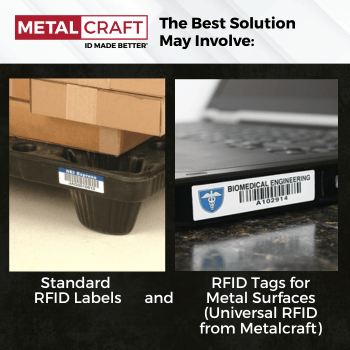
That can include standard RFID labels, liquid-optimized designs, RFID tags for metal surfaces, surface-independent constructions such as a universal RFID asset tag, or custom configurations when standard products do not meet the application.
Sample testing should happen before scale-up.
A bench read proves the tag can communicate. A successful production validation proves the RFID solution can support the pharmaceutical workflow.
| Solve Pharmaceutical RFID Read-Rate Problems Before Scale-Up |
|
If your RFID tag works on the bench but becomes inconsistent after filling, foil application, aggregation, or line-speed testing, send Metalcraft the actual application requirements. Include the container material and dimensions, formulation category and fill range, foil or metallized layers, metal closures, available label area, required read distance, inventory density, line speed, and target frequency regions. Metalcraft can help narrow the RFID tag options, identify constructions worth sample testing, and develop an application-specific recommendation before you commit to production volumes. Request a custom RFID tag quote based on your actual pharmaceutical package and read requirements. |
 |
About the Author: Mark Maliszewski

Mobile Phone: 641-423-9460
Office Phone: 641-428-9156
Email: [email protected]
Office: 3360 9th St SW, Mason City, IA 50401
Subscribe To The Blog
Find More Blogs
Recent Posts
- Chemical-Resistant RFID Tags: How to Choose Tags for Cleaning, Disinfectants and Harsh Environments
- Medical Supply Recall Tracking: How RFID Closes Traceability Gaps
- RFID vs. Barcodes for Laboratory Sample and Specimen Tracking: Which Is Right for Your Lab?
- What is ITAR? – The Complete Guide to ITAR Compliance for 2026
- Top RFID Companies to Know in 2026