

Returnable Container Tracking: What It Is and Why It Matters
Returnable containers are a critical but often overlooked asset across modern supply chains. From automotive manufacturing to food distribution, companies rely on reusable containers to move parts, ingredients, and finished goods efficiently between facilities, suppliers, and customers. Unlike single-use packaging, returnable containers circulate continuously—making visibility, control, and data accuracy essential.
Returnable container tracking provides the foundation for managing these assets across multiple cycles. Without a reliable returnable container tracking system, organizations face visibility gaps, rising replacement costs, inefficient pooling, and ongoing container loss. As supply chains become more complex, tracking returnable containers is no longer optional—it is a critical operational requirement.
What Are Returnable Containers?
Returnable containers—also known as returnable transport items (RTIs)—are reusable assets designed to move goods repeatedly throughout the entire supply chain. Common examples include:
- Totes and tote boxes

- Plastic bins and reusable containers
- Pallets (plastic or metal)
- Roll cages and racks
- Intermediate bulk containers (IBCs)
- Reusable plastic containers (RPCs)
These containers are typically used in closed-loop supply chains, where manufacturers, suppliers, logistics providers, and customers exchange containers on a recurring basis. Because they remain in circulation, companies must track location, quantity, status, and movement to maintain control.
Industry studies consistently show annual returnable container loss rates between 6–10%. That loss represents wasted assets, increased waste, higher costs, and operational blind spots. Without accurate container data, companies struggle to manage utilization, plan effectively, and minimize loss.
Why Tracking Returnable Containers Matters
Visibility
A lack of visibility is the root cause of most returnable container management failures. When containers move across multiple sites, facilities, and partners, blind spots emerge quickly. Automated tracking provides real time visibility into container location, status, and movement—eliminating guesswork across operations.
Cycle Speed
Faster container cycles directly improve operational efficiency. When companies know where assets are and when they will return, they can reduce delays, prevent shortages, and keep production lines moving. Tracking systems enable better shipment planning and smoother logistics flow.
Loss Prevention
Returnable container loss drives continuous replacement costs. Containers misplaced at customer sites, mixed with competitors’ assets, or written off as waste quickly erode savings. Secure identification using durable tags creates accountability and helps companies recover assets before they disappear.
Inventory Accuracy
Manual processes often lead to manual errors, inaccurate counts, and unreliable data. A container tracking solution ensures accurate inventory levels across facilities, suppliers, and customers—supporting better control, planning, and decision-making.
How Returnable Container Tracking Works
A modern returnable container tracking system combines durable identification with automated data capture:
- Barcodes, RFID tags, or BLE tags are applied to every container
- Containers are scanned or read at each touchpoint
- Data is captured automatically using fixed readers, mobile phones, or handheld devices
- A cloud-based system logs movement, location, and status
- Teams access a complete audit trail, real time location data, and cycle counts
RFID-based container tracking enables hands-free, automated tracking that eliminates manual scanning and improves data integrity across the entire supply chain.
Use Cases for Returnable Container Tracking
Operations Director (Automotive Manufacturing)
Automotive manufacturers depend on large volumes of returnable containers—including totes, racks, pallets, and specialty dunnage—to move components between suppliers, consolidation points, and assembly plants. These containers circulate constantly across multiple sites, often crossing company boundaries and geographic regions.
Problem:
Containers frequently fail to arrive where and when they’re needed. Visibility gaps across suppliers and inbound logistics make it difficult to know whether containers are delayed, sitting idle at a customer site, or lost entirely. The result is part shortages, line stoppages, expedited shipments, and rising replacement costs. Manual tracking methods simply can’t keep up with the speed and complexity of automotive operations.
Outcome:
By deploying RFID tags on returnable containers, automotive operations gain automated tracking at dock doors, yards, and production facilities. Containers are identified without manual scanning, providing real time visibility into location, status, and movement. Operations teams can proactively rebalance inventory, coordinate with suppliers more effectively, and keep production running without disruption. Over time, improved utilization and reduced returnable container loss deliver measurable savings and stronger operational control.
Pooling Program Manager (Container Rental Company)
Container pooling and rental providers manage tens of thousands—or even hundreds of thousands—of reusable containers shared across multiple customers, industries, and locations. Maintaining accountability across this ecosystem is critical to profitability.
Problem:
Containers are frequently misplaced, damaged, or mixed with competitors’ assets at customer sites. Disputes over quantities are common, and inefficient pooling drives excess inventory, lost revenue, and customer dissatisfaction. Without reliable container data, managers struggle to enforce accountability or accurately track utilization across the entire supply chain.
Outcome:
Durable barcode labels and RFID tags establish a single source of truth for every container. Each movement—shipment, receipt, transfer, or return—is captured automatically or with fast, accurate scans. This visibility reduces disputes, improves customer accountability, and minimizes loss. With accurate data, pooling managers can optimize container utilization, reduce waste, and scale operations without adding unnecessary assets.
Warehouse Manager (CPG / Distribution Centers)
Consumer packaged goods and food distribution centers handle extremely high volumes of reusable containers, tote boxes, pallets, and roll cages on a daily basis. Speed and accuracy are essential to maintaining throughput and meeting customer demand.
Problem:
Manual scanning processes slow down labor, introduce manual errors, and create bottlenecks at receiving, picking, and shipping points. In fast-moving environments, missed scans lead to inaccurate inventory counts and blind spots that impact planning and fulfillment.
Outcome:
Automated tracking using RFID or Bluetooth Low Energy enables hands-free reads as containers move through the facility. Warehouse teams gain accurate, real-time visibility into container location and status without interrupting workflows. Faster movement, improved data accuracy, and reduced labor requirements translate directly into higher throughput, better inventory control, and improved operational efficiency.
Cost Savings from Better Tracking
Returnable container tracking delivers measurable financial benefits:
- Lost containers drive continuous replacement costs
- Fewer shortages reduce emergency shipments and downtime
- Accurate tracking lowers rental overages and penalties
- Automated tracking reduces labor tied to manual scanning
- Better data improves utilization and reduces safety stock
When companies track containers effectively, savings compound across logistics, manufacturing, and operations.
Why Container Durability Matters
Returnable containers operate in some of the harshest environments in the supply chain. They are repeatedly stacked, dragged, and handled by forklifts, then cycled through washing systems and exposed to chemicals, oils, moisture, heat, and cold. Over time, these conditions quickly degrade standard labels and tags that are not designed for repeated reuse.
When labels peel, fade, or crack, identification fails. Barcodes become unreadable, RFID tags stop responding, and container data is lost. Even a small percentage of failed tags creates visibility gaps that undermine automated tracking, introduce manual errors, and drive returnable container loss. Once identification fails, the entire tracking system becomes unreliable, forcing teams back to manual processes and increasing replacement costs.
Durability is critical to data integrity and long-term visibility. Metalcraft addresses this challenge with subsurface printing technology and engineered adhesives that protect barcodes and RFID inlays beneath the surface of the label. This construction shields critical data from abrasion, chemicals, and repeated wash cycles while maintaining secure adhesion to plastic and metal containers.
The result is long-lasting identification that performs through multiple reuse cycles—preserving container tracking accuracy, maintaining real time visibility, and protecting the value of reusable assets.
Best Tags for Returnable Containers
Selecting the right tag depends on container material, environment, and tracking goals.
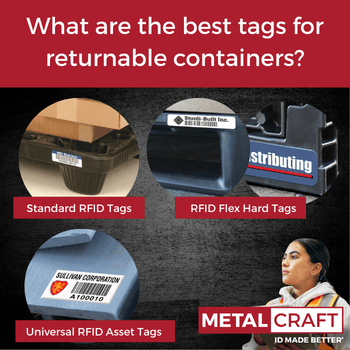
RFID Options:
- Passive UHF RFID tags for automated tracking at dock doors and facilities
- RFID tags designed for plastic or metal containers like Metalcraft’s RFID Tags, RFID Flex Hard Tags or our Universal RFID Asset Tags.
- Specialized RFID for racks, roll cages, and pallets
Barcode Label Options:
- High-durability polyester or metal barcode labels
- Subsurface printed labels for washing and abrasion resistance
Material Recommendations:
- Plastic containers: Flexible RFID or durable barcode labels
- Metal containers and racks: On-metal RFID tags or Metalphoto® aluminum tags
Metalcraft offers container tracking solutions engineered for long-term performance across manufacturing, food, automotive, and logistics environments.
The Breakdown
Returnable containers represent a recurring operational cost and a critical asset class. Without effective returnable container management, companies face loss, waste, and ongoing inefficiencies.
Returnable container tracking delivers lower loss, faster cycles, improved visibility, and better control across the entire supply chain. With the right tracking system and durable tags, organizations gain real time visibility, accurate data, and sustainable operational savings.
See our Container Tracking Solutions and compare options.
About the Author: John Fitzsimmons

Mobile Phone: 641-423-9460
Office Phone: 641-423-9460
Email: [email protected]
Office: 3360 9th St SW