

RFID for AV Rental Companies: How It Prevents Loss and Speeds Up Turnaround
The AV rental industry runs at full speed. Crews load in overnight, strike gear in minutes, and move high-value audio visual equipment across multiple locations with little margin for error. Cameras, wireless packs, lighting, cables, and road cases are constantly in motion—handled by different teams, shipped between event venues, and reused across tight schedules.
In this environment, manual inventory tracking breaks down quickly. Human error, rushed load-outs, and missing paperwork lead to lost equipment, delayed shows, and frustrated customers. That’s why more rental companies are turning to passive RFID equipment tracking. By using RFID technology to track AV equipment automatically at key touchpoints, teams gain near real-time visibility, reduce losses, and speed up turnaround between events—without slowing crews down.
Who Uses RFID in AV?
Passive RFID for AV equipment supports multiple roles across rental companies, tours, and production teams.
Road Crews
Road crews are responsible for fast pack-in and pack-out under intense time pressure. Passive RFID tags allow crews to scan entire cases at once—no line of sight required—so they can confirm that all equipment is loaded or returned without manual scanning or paperwork. This significantly reduces mistakes during late-night load-outs and tight changeovers.
AV Techs
AV technicians need to locate critical gear immediately. Whether it’s a missing wireless mic, camera, or lighting controller, delays cost time and credibility. Passive RFID asset tracking gives techs fast access to equipment status and last scan location, minimizing downtime and reducing manual intervention during shows and setups.
Logistics Managers
Logistics and inventory managers oversee full inventories across tours, warehouses, and multiple locations. Passive RFID systems provide accurate inventory levels, faster inventory reconciliation, and reliable movement data—supporting maintenance planning, equipment usage analysis, and long-term business growth.
Industry Examples

Passive RFID tracking is already proving valuable across the AV industry.
Concert tours with 10+ semi trucks
Tours move thousands of tagged assets nightly. Passive RFID scanning at load-out and load-in verifies that road cases, lighting trusses, and backline equipment are accounted for—reducing losses between cities.
College GameDay and live TV sports
Broadcast crews rely on precise equipment tracking across multiple event venues. Passive RFID helps ensure cameras, audio kits, and transmission gear are returned, scanned, and ready for the next show.
Corporate conference A/V setups
High-value items move between ballrooms, storage areas, and staging zones. Passive RFID equipment tracking improves return status verification, reduces disputes, and increases customer satisfaction.
Theater lighting and backline rentals
Passive RFID tags track equipment across long runs and multiple cycles, supporting maintenance schedules and reducing lost equipment between productions.
RFID Solves the Big Problems for AV Teams
Misplaced Cables
Cables are small, numerous, and easy to lose. Passive RFID tags allow teams to read multiple tags at once, quickly confirming that all cables are present without counting manually. There are also barcode cable label options.
Lost Wireless Packs
Wireless packs are high-value items that often disappear during fast strikes. Passive RFID tracking provides visibility into when and where items were last scanned, helping teams resolve losses quickly and reduce disputes.
Unreturned Gear
Passive RFID equipment tracking automates check-in and check-out at warehouses and event sites. Missing items are identified immediately—rather than weeks later during inventory audits.
Slow Load-Outs
Manual scanning slows crews down. Passive RFID scanning reads dozens or hundreds of tags simultaneously, dramatically speeding up load-outs and reducing operational friction.
Manual Inventory Headaches
Manual inventory processes rely on spreadsheets and memory, increasing errors. Passive RFID systems automate data capture, reduce human error, and provide actionable insights into inventory levels and equipment usage.
How Passive RFID Works for AV Rentals
RFID—radio frequency identification—uses radio waves to transmit data between tags and readers. Unlike barcodes, passive RFID does not require line of sight and does not use batteries.
In an AV rental environment:
-
Passive RFID tags are attached to cables, cameras, lighting fixtures, wireless packs, and road cases
-
Tags are energized by the RFID reader’s radio frequency signal and transmit their ID when scanned
-
Handheld RFID readers are used by crews for fast mobile scanning during load-ins and load-outs
-
Fixed RFID readers are installed at warehouse doors or loading docks to automate check-in and check-out
-
The RFID system updates equipment status, return status, and location based on scan events
Using ultra-high-frequency (UHF) radio waves, passive RFID readers can read multiple tags at once, enabling fast inventory reconciliation and accurate tracking across the system—without batteries, maintenance, or added complexity.
Choosing the Best RFID Tags for AV Equipment (Passive RFID)
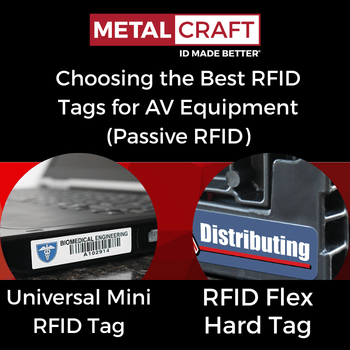
For AV rental companies, passive RFID tags are the preferred solution for equipment tracking. Passive tags require no internal power source, are lightweight, cost-effective at scale, and are well suited for high-volume inventory environments where equipment is scanned frequently during load-ins, load-outs, and returns.
Cable Tag Recommendations
Cables are among the most commonly misplaced AV assets. Flexible, low-profile passive RFID cable tags—such as flag-style or encapsulated designs—are ideal for audio, power, and data cables. These tags are engineered to withstand repeated bending, coiling, and abrasion while maintaining consistent read performance. Proper tag placement avoids connectors and strain points while still allowing crews to read multiple tags at once during RFID scanning.
Cameras, Audio, and Wireless Equipment
High-value items such as cameras, wireless microphone packs, audio processors, and control units benefit from durable passive UHF RFID tags with high read sensitivity. Because many AV devices include metal housings, metal-tuned passive RFID tags are recommended to ensure reliable performance without interference. These tags support fast inventory reconciliation and accurate equipment status updates across venues and warehouses.
Road Cases, Racks, and Lighting Equipment
Road cases, racks, carts, and lighting fixtures are well suited for rugged passive RFID asset tags. Their size and predictable movement through dock doors and storage areas make them easy to scan with handheld RFID readers or fixed readers. Passive tags enable fast verification of full cases during load-outs without requiring line of sight or manual scanning.
Harsh Travel and Touring Conditions
AV equipment experiences vibration, shock, temperature swings, and frequent transport. Passive RFID tags must be rated for abrasion, heat, and repeated handling. Industrial-grade passive UHF tags are designed to survive tours, music festivals, and demanding event schedules while continuing to transmit reliable RFID data.
A proven RFID equipment tracking system for AV rentals relies on passive RFID tags, paired with handheld and fixed RFID readers, to deliver fast scans, accurate inventory data, and reduced equipment loss—without batteries, maintenance, or added complexity.
The Breakdown
For AV rental companies, RFID equipment tracking delivers measurable results:
- Faster turnarounds between events
- Fewer losses of high-value audio visual equipment
- Cleaner, more accurate inventory management
- Reduced manual scanning and human error
- Better maintenance planning and equipment usage data
RFID works because it removes friction from tracking equipment at speed. With real time tracking, automated check-in and check-out, and reliable RFID systems, AV teams gain control without slowing down operations.
View RFID tag options for AV equipment tracking for additional information.
About the Author: John Fitzsimmons

Mobile Phone: 641-423-9460
Office Phone: 641-423-9460
Email: [email protected]
Office: 3360 9th St SW