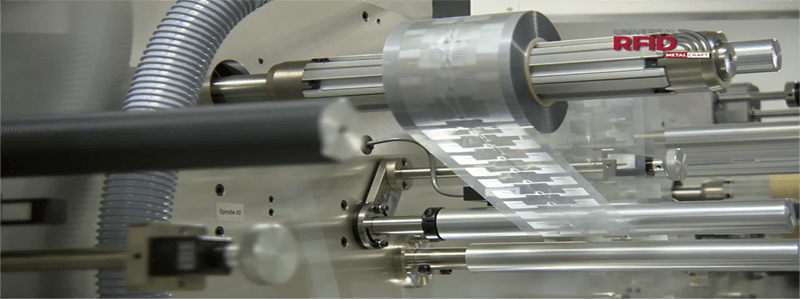
RFID converting is the manufacturing process of taking raw components—such as printed materials, RFID inlays, and adhesives—and turning them into a fully functional RFID tag. The completed product often includes encoding, printing, quality assurance, and format customization. This converting process is essential to the RFID industry, bridging the gap between raw materials and finished labels ready for use in the field.
As RFID technology continues to grow, more label converters are transitioning into RFID converters, developing specialized capabilities to integrate electronic components into printable formats. They’re building on decades of experience in conventional label manufacturing, but now also accommodating chips, antennas, and inlays using high-tech equipment.
The Rise of RFID in the Label Industry
Conventional label converters are evolving rapidly. With increasing demand in the RFID market, companies are adapting their production processes to include radio frequency identification components. These additions include dry inlays, wet inlays, adhesive layers, and printed formats designed for high performance in retail, logistics, manufacturing, and asset tracking environments.
As RFID penetrates more industries, suppliers must meet the demand for smarter labels. High-performance RFID tags now operate across various frequencies (LF, HF, UHF) and can be used for numerous applications from vehicle access control to inventory tracking. The ability to read simultaneously across multiple tags is a key advancement, enabling real-time decision-making across supply chains.
The RFID Converting Process Explained
The converting process starts with selection of substrates, inlays, and adhesives. The converter then uses specialized machines to laminate, encode, test, and cut the materials into the desired form. Throughout this production run, precision is vital to ensure that each RFID label performs correctly.
Core Steps in RFID Converting:
-
Insertion of RFID Inlays
The heart of the RFID tag is the inlay, which includes the chip and antenna. These can be dry inlays (no adhesive backing) or wet inlays (with adhesive). The inlay is attached to the substrate with high precision. -
Printing and Encoding
Labels are printed with human-readable information, barcodes, or logos. At the same time, the RFID chip is encoded with data such as an Electronic Product Code (EPC), enabling the tag to be uniquely identified. -
Cutting and Finishing
The machine die-cuts or laser-cuts the labels, separating them for rolls or sheets. Each finished label is inspected for quality, alignment, and encoding accuracy. -
Quality Assurance
RFID readers test each tag to verify proper encoding and antenna performance. Tags that fail are discarded, reducing waste and ensuring high quality standards.
Metalcraft’s RFID Converting Technology
Metalcraft stands out in the RFID industry due to its advanced RFID converting capabilities. Their Viper machine is a roll-based converter that handles wet and dry inlays in a single pass. It’s designed for speed and efficiency, handling layered constructions without switching out die or anvil sets.
The Viper’s in-line verification can read up to 2,000 RFID labels per minute across the UHF spectrum, ensuring each tag is accurately encoded and perfectly aligned. The machine also minimizes labor and downtime, offering a strong return on investment through automation and precision.
According to COO Kyle Bermel, the Viper machine “leads in a faster turnaround [for Metalcraft] and more product out the door.” This reduction in cycle time lowers the cost per unit, helping both converters and customers.
NFC and Hybrid RFID Capabilities
Metalcraft also manufactures high-frequency RFID labels with NFC capabilities. These RFID tags allow for close-range communication with consumer electronics such as smartphones. This hybrid setup is increasingly used in retail promotions, product authentication, and interactive packaging.
NFC-enabled RFID tags operate at 13.56 MHz and can trigger specific actions in mobile apps. If compliant with ISO 15693, the read range extends to 1.5 meters—well beyond traditional NFC applications.
These solutions are gaining traction in the RFID market, especially among companies seeking to bridge physical products with digital experiences.
RAIN RFID and the Expansion of Smart Labeling
One major trend shaping the RFID market is the rise of RAIN RFID, a global alliance promoting UHF RFID adoption. RAIN RFID tags operate in the UHF band and enable long-distance reading, ideal for tracking items in warehouses or retail floors. This segment is growing rapidly thanks to high-volume use cases in logistics and apparel.
As demand for RAIN RFID increases, so does the need for high-quality RFID inlays and printed tags. Partnering with the right inlay supplier is critical. These suppliers provide tested inlays that can be integrated into a variety of formats, from perforated labels to tamper-evident seals.
The Importance of Label Converters in the RFID Ecosystem
Label converters are pivotal players in the RFID industry. They ensure that raw inlay materials are transformed into functional, compliant RFID labels. Their role is more than just printing and cutting—they handle data encoding, quality control, and customer-specific formatting.
Many converters also maintain association files to match encoded data with printed visuals, ensuring full traceability. These files are key for auditing and validation in regulated industries like pharmaceuticals, aerospace, and defense.
Label converters must also work closely with equipment vendors, RFID reader suppliers, and RFID inlay manufacturers to deliver seamless solutions. A strong converter can help companies reduce waste, ensure compliance, and improve logistics workflows.
Why RFID Labels Are an Investment Worth Making
While RFID technology may have a higher upfront cost than barcodes, the ROI is significant. Tags can be read simultaneously at high speeds, without line of sight, and in bulk. This enhances inventory accuracy, reduces theft, and improves operational efficiency.
A single RFID tag can hold vast amounts of data and be reused multiple times. Tags also discourage counterfeiting by uniquely identifying each product.
RFID labels also provide advanced capabilities:
-
Access control via RFID windshield tags
-
Real-time tracking across supply chains
-
Improved customer experiences through smart packaging
For companies in manufacturing, retail, healthcare, and transportation, the ability to identify, track, and manage assets with RFID brings a competitive edge.
How RFID Works: From Chip to Reader
How does RFID work? At its core, it relies on the transmission of radio waves. A RFID reader sends out an electromagnetic field. When a RFID tag enters the field, the antenna captures energy, powers the chip, and sends back a signal containing the encoded data.
There are various tag types:
-
Passive: No internal power source; activated by the reader
-
Active: Powered by an internal battery; used for long-range tracking
-
Semi-passive: Battery-powered but only transmits when pinged
The system enables fast, accurate, and contactless identification of objects. This technology has revolutionized inventory management, retail checkout, asset tracking, and much more.
Choosing the Right Partner for RFID Label Conversion
With so many companies entering the RFID market, it’s important to select converters with experience, high quality standards, and a commitment to innovation. Look for providers with:
-
In-house printing and encoding capabilities
-
Access to premium RFID inlays
-
Scalable production capacity
-
Proven equipment like high-speed converters and testers
-
Partnerships with top inlay suppliers and machine manufacturers
An ideal RFID converter helps reduce waste, maintain consistency, and optimize the format for your application—whether you’re using it on pallets, packages, or equipment.
Conclusion
The evolution of RFID converting reflects the larger transformation within the RFID industry. As demand grows, label converters are becoming essential players, combining traditional printing skills with advanced RFID technology. With innovations like RAIN RFID, smarter equipment, and advanced inlay designs, today’s converters are enabling smarter labels and more efficient operations.
Whether you’re a logistics firm, retailer, or manufacturer, the right RFID label can streamline your workflow, reduce losses, and improve visibility—all through the power of radio frequency identification.
As RFID technology continues to develop and the RFID market expands across industries, investing in top-tier RFID tags, inlays, and converters will be key to staying competitive.