

The Benefits of RFID Tracking in Schools
Implementing RFID tracking in educational institutions delivers far-reaching benefits that improve everything from asset management to budget planning. Schools, districts, and universities alike can streamline processes, reduce risk, and make smarter decisions by leveraging RFID technology across their campuses.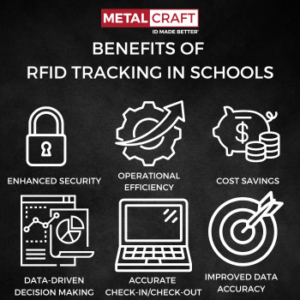
Here’s a deeper look at the key advantages:
1. 🔒 Enhanced Security
RFID technology strengthens school security protocols by enabling real-time tracking of valuable equipment and learning resources. With RFID tags affixed to items such as laptops, tablets, lab gear, and audio-visual equipment, schools can instantly detect and log asset movement across different locations. If an item leaves a designated area or exits the building without authorization, RFID systems can trigger alerts, preventing theft or loss before it occurs.
In high-traffic areas like libraries or media centers, RFID-integrated security systems offer automated asset monitoring without the need for additional personnel. This constant oversight discourages unauthorized use and supports campus-wide accountability.
2. ⚙️ Operational Efficiency
Manually managing school inventory can be time-consuming and error-prone, especially in large districts with thousands of assets. RFID automates these processes, allowing staff to conduct audits, monitor check-outs, and track items across departments with minimal effort.
With the ability to scan multiple items at once—without line-of-sight—RFID drastically cuts the time required for inventory management. This allows administrative and support staff to reallocate time and resources to more meaningful educational activities, rather than being bogged down by repetitive data entry tasks.
3. 💰 Cost Savings
Budget-conscious school administrators often struggle with lost, misplaced, or underutilized assets. RFID tracking helps eliminate these inefficiencies by providing full visibility into asset status, location, and utilization.
With this insight, schools can:
-
Avoid unnecessary replacements
-
Identify underused equipment
-
Make smarter purchasing decisions
-
Maximize the use of shared resources
Over time, these improvements can significantly reduce both capital and operational expenditures, making RFID a cost-effective solution even for budget-restricted districts.
4. 📊 Data-Driven Decision Making
One of the most powerful features of RFID is its ability to generate actionable, real-time data. RFID software platforms record detailed usage histories, location changes, and status updates for every tagged item. School administrators can analyze this information to:
-
Identify purchasing trends
-
Predict maintenance needs
-
Optimize asset distribution
-
Plan for future equipment investments
This data-centric approach enhances long-term planning and supports evidence-based decision making, enabling schools to operate more strategically and efficiently.
5. 🔁 Accurate Check-In/Check-Out
Managing shared resources like Chromebooks, textbooks, or sports equipment can be challenging. RFID simplifies check-in and check-out processes, making it easy to assign and return items while maintaining real-time inventory accuracy.
With RFID readers at circulation desks or mobile scanning stations, staff can instantly log item transfers—eliminating paperwork, manual errors, and confusion over item responsibility. The result is a smoother, more accountable system that ensures equipment is tracked throughout its lifecycle.
This is especially useful for:
-
Classroom equipment rotation
-
IT device lending programs
-
Temporary use of audio/visual tools
-
Art and science department materials
6. ✅ Improved Data Accuracy
RFID systems significantly enhance data integrity and accuracy across all departments. Unlike manual methods or barcode systems—which require direct line-of-sight and are vulnerable to human error—RFID allows for quick, contactless scans and captures item information even when tags are obscured or nested.
By removing manual input from the process, RFID reduces miscounts, duplicates, and inventory gaps. It ensures your data is:
-
Consistent across databases
-
Updated in real-time
-
Trusted for compliance and reporting
This level of precision is especially important during audits, funding applications, or when demonstrating resource utilization to stakeholders and school boards.
How RFID Asset Tracking Works in Schools
A typical RFID inventory system includes RFID tags, handheld or fixed readers, and inventory management software. Each RFID tag contains a microchip and antenna with a unique ID. When scanned, it sends data to the reader, which updates the central system.
RFID in Action
Implementing an RFID asset tracking system in schools provides powerful real-time insights into what assets schools own, when they are available, and exactly where they are located. Here’s how RFID supports day-to-day operations in real-world educational environments:
📦 Know What You Have
One of the most immediate advantages of RFID technology is the ability to instantly verify what assets your school owns. Each asset—whether it’s a laptop, textbook, microscope, or musical instrument—is equipped with an RFID tag that stores a unique identification number. When scanned by a handheld or fixed RFID reader, the system automatically pulls up relevant data, including asset name, serial number, purchase details, and assigned location.
Unlike manual entry or barcode systems, which require line-of-sight and individual scanning, RFID readers can capture data from multiple items simultaneously, even when they are hidden inside cabinets, boxes, or storage carts. According to Motorola, this technology can reduce inventory time by up to 95%, allowing staff to conduct complete audits in a fraction of the time and with significantly higher accuracy.
The result? Schools gain complete visibility over their asset inventory, minimize discrepancies, and drastically reduce the labor burden of traditional asset tracking methods.
📅 Know When You Have It
Maintaining accurate, up-to-date inventory records is vital for schools—especially when equipment is loaned out, shared between departments, or frequently rotated. Passive RFID tags, which are affordable and require no internal power source, make it easy for schools to conduct routine cycle counts without incurring high costs or operational disruption.
Using mobile RFID readers, staff can perform daily, weekly, or monthly scans in high-traffic areas like tech hubs, libraries, science labs, or shared classrooms. This ensures administrators always know what items are currently available, what has been checked out, and what may need servicing or replacement.
Regular inventory updates not only help maintain accountability but also reduce over-purchasing and ensure proper asset utilization. Knowing when you have the item on-hand eliminates guesswork and empowers more efficient budget planning and resource allocation.
📍 Know Where It Is
In large school buildings—or across multiple campuses—keeping track of mobile assets can be a logistical challenge. RFID solves this by providing real-time location data for any tagged item. Whether it’s a set of tablets moved between classrooms, a cart of Chromebooks stored in a different hallway, or a projector temporarily assigned to a student group, RFID makes sure every item is visible and traceable.
Readers placed at entrances, exits, or strategic checkpoints can capture asset movement as items pass by. For example, if a laptop is removed from a media center without proper authorization, the system can flag the event immediately and trigger a security response or alert.
This capability is especially valuable for:
-
Monitoring high-value equipment in motion
-
Facilitating resource sharing between teachers or departments
-
Supporting loaner programs and check-in/check-out tracking
By knowing where assets are in real time, schools can streamline retrieval, reduce time spent searching for misplaced items, and even enable geofencing protocols to prevent unauthorized transfers.
Best Practices for RFID Asset Tracking in Schools
Implementing a successful RFID asset tracking system in schools requires careful planning, the right technology, and a strategic rollout. To maximize the value of your investment and ensure long-term success, follow these proven best practices:
1. 📝 Conduct a Needs Assessment
Before selecting any RFID solution, it’s essential to clearly define your objectives and inventory priorities. Conduct a comprehensive needs assessment that includes:
-
Inventory analysis: Identify which assets are most valuable, most mobile, or most frequently lost (e.g., Chromebooks, lab equipment, instruments, or projectors).
-
Stakeholder interviews: Gather feedback from IT, admin staff, department heads, and teachers to understand workflow pain points.
-
Compliance requirements: Consider any regulatory or audit requirements that may impact how assets must be tracked or reported.
This foundational step ensures that your RFID system is tailored to your school’s specific needs—not a one-size-fits-all solution.
2. 📡 Select the Right Technology
Choosing the appropriate RFID technology is critical to performance and cost-effectiveness. Consider these factors:
-
Tag Type: Use passive RFID tags for cost-effective tracking of general assets, and active or semi-passive tags for high-value or mobile assets that require longer read ranges.
-
Frequency: For most schools, Ultra High Frequency (UHF) RFID is ideal due to its extended range and fast data transmission. High Frequency (HF) RFID may be better for short-range applications like secure access control.
-
Reader Requirements: Choose between handheld readers for mobile scanning or fixed readers for entrances/exits and high-traffic areas.
-
Software Compatibility: Ensure your asset tracking software can integrate with existing systems, such as your SIS or library management platforms.
Selecting the right combination of tags, readers, and software improves both usability and ROI.
3. 🔐 Focus on Security
When managing school assets, especially expensive or sensitive equipment, security must be a top priority. Choose RFID tags that offer built-in deterrents to tampering and theft.

Use Metalcraft’s tamper-evident RFID tags, such as:
-
DuraDestruct® Tags: Designed to fracture when removal is attempted, these tags prevent reuse or unauthorized transfers.
-
Destructible RFID Windshield Tags: Ideal for tracking school vehicles or issuing tags for controlled campus access, these labels are engineered to self-destruct when tampered with.
-
These tags not only improve security but also provide visual cues for unauthorized handling—reducing loss and increasing accountability.
4. 🚀 Start Small
Begin with a pilot program to test your RFID system in a controlled environment. This approach allows you to:
-
Validate the technology in real-world conditions
-
Identify any implementation issues early
-
Collect user feedback and refine workflows
-
Build internal champions who can support broader adoption
For example, you might pilot RFID in the IT department for Chromebook tracking, or in the science department to monitor lab equipment. Once the pilot proves successful, scale the program across other areas of the school or district.
5. 🤝 Compare Vendor Options
Choosing the right vendor is as important as selecting the right technology. Not all RFID providers offer the same level of support, scalability, or education-sector experience.
When evaluating vendors, consider:
-
Cost transparency: Understand the total cost of ownership, including software licenses, hardware, training, and maintenance.
-
Scalability: Choose a system that can grow with your needs—from a single campus to district-wide coverage.
-
Training and support: Ensure the vendor offers onboarding, technical support, and resources to train your staff effectively.
-
Integration expertise: Opt for vendors or integrators who understand how to connect RFID with student information systems, asset management platforms, or library databases.
Metalcraft not only offers durable, school-ready RFID tags but can also connect you with experienced integrators and implementation partners who specialize in education-focused RFID solutions.
Real-World Case Studies of RFID in Schools
Many schools are already seeing success with RFID technology:
-
Western Illinois University
Implemented RFID using Metalcraft’s Universal Mini RFID Tags. Combined with legacy barcodes, they significantly reduced inventory labor and achieved a faster-than-expected ROI. -
Tehachapi Unified School District
Partnered with Hayes Software to implement RFID district-wide. The system improved inventory accuracy and operational efficiency. -
Yakima Valley College
Used Grey Trunk RFID software and Metalcraft tags to increase accuracy and reduce audit time. -
Rochester Public School District
Deployed RFID for tracking Chromebooks. Even early in the implementation, time savings alone justified the effort.
Addressing and Overcoming the Challenges of RFID Adoption in Schools
While RFID technology offers significant benefits for educational institutions, the path to successful implementation is not without its obstacles. Schools must address financial constraints, privacy concerns, technical demands, and cultural resistance to fully realize the potential of RFID asset tracking systems.

Here’s a deeper look at the most common challenges—and strategies to overcome them:
1. 💸 Cost: Budget Limitations for RFID Implementation
One of the most cited barriers to adopting RFID in schools is the initial cost. Purchasing RFID tags, readers, software, and support services—especially for large-scale deployments—can strain tight educational budgets.
How to Overcome It:
-
Pursue Education Technology Grants: Many state and federal agencies offer grant programs specifically designed to support technology in education.
-
Seek Vendor Discounts: Work with RFID vendors experienced in the education sector who may offer special pricing or bundled packages for schools and districts.
-
Use a Phased Rollout Approach: Start with a pilot program in one department or location, assess results, and expand incrementally based on budget availability and demonstrated ROI.
-
Leverage Existing Infrastructure: Some RFID systems can integrate with existing inventory or security platforms, reducing the need for additional purchases.
By approaching implementation strategically, schools can spread costs over time and demonstrate value before committing to full-scale deployment.
2. 🔐 Privacy & Security Concerns
Data privacy and security are especially sensitive topics in educational environments. RFID systems collect and store information that, if not properly managed, could raise concerns among parents, staff, and privacy advocates.
How to Overcome It:
-
Establish Transparent Privacy Policies: Clearly define what data is collected, how it’s stored, who has access, and for what purposes.
-
Limit Data Collection: Only collect information that is essential for asset tracking or administrative purposes—avoid linking RFID tags to personal student data unless absolutely necessary.
-
Use Data Encryption and Access Controls: Protect data with encryption protocols and limit access to authorized personnel through role-based permissions.
-
Conduct Regular Security Audits: Periodically review systems and policies to ensure ongoing compliance with data protection regulations such as FERPA, COPPA, and GDPR.
When stakeholders understand that student privacy and data security are top priorities, they’re more likely to support the initiative.
3. ⚙️ Technical Complexity
RFID systems can be technically complex—requiring proper hardware setup, software integration, and network infrastructure. Schools may lack in-house IT staff with the expertise needed to manage RFID system design, deployment, and troubleshooting.
How to Overcome It:
-
Partner with Experienced Vendors: Choose vendors or system integrators who specialize in educational settings and understand your existing technology ecosystem.
-
Request End-to-End Support: Work with providers that offer installation, training, maintenance, and long-term support as part of their RFID packages.
-
Use Scalable, Compatible Systems: Select RFID software that can integrate with your current student information systems (SIS), library management tools, security platforms, and inventory software.
-
Start Simple: Avoid overly complex setups. A well-designed, simplified pilot implementation can provide the foundation for future expansion.
By involving trusted partners and simplifying the initial deployment, schools can reduce downtime and technical risks.
4. 🔄 Resistance to Change
Any new technology initiative is likely to face resistance from staff, faculty, or administration—especially if it alters established workflows or seems unfamiliar.
How to Overcome It:
-
Communicate the “Why”: Clearly explain the benefits of RFID in terms of time savings, accuracy, and security. Show how it supports teaching and learning—not just administration.
-
Engage Stakeholders Early: Involve teachers, administrators, IT, and even students in the planning and testing stages to increase ownership and buy-in.
-
Offer Training and Support: Equip users with the knowledge and tools to feel confident in using RFID technology. Provide hands-on training, tutorials, and accessible help resources.
-
Pilot First, Scale Later: A small-scale pilot helps demonstrate value and ease concerns before district-wide implementation. It also creates internal champions who can promote the system to peers.
Managing change is a process. With thoughtful engagement and strong communication, schools can ease the transition and turn initial hesitation into long-term support.
Funding and Cost-Effective Strategies
Make RFID Affordable for Your School
Implementing an RFID system doesn’t have to break the budget. Schools can make RFID more accessible by exploring a variety of funding strategies. Start by applying for state and federal education technology grants, and consider reallocating funds from outdated or inefficient asset management systems. Hosting community fundraisers can also generate support and financial backing for tech upgrades. To cut costs further, leverage open-source software solutions that are both flexible and budget-friendly. Lastly, partner with RFID vendors who offer educational discounts or bundled pricing—especially for district-wide or multi-school implementations.
Managing Stakeholder Concerns
Overcoming Resistance to Change
Successfully implementing RFID in schools requires more than just technology—it requires people to embrace it. To overcome resistance to change, schools should communicate clearly and transparently through forums, updates, and open discussions. Demonstrating the tangible benefits of RFID—like cost savings and improved security—using real-world case studies can build confidence and support. It’s also essential to include staff, students, and parents in the planning and rollout process to foster a sense of ownership. Providing comprehensive training ensures everyone understands how to use the system effectively, reducing uncertainty and boosting adoption.
Ensuring Privacy and Security
Protecting student and staff data is critical when implementing RFID in schools. To ensure privacy and security, schools should collect only the data necessary for asset tracking and use it solely for clearly defined purposes. All RFID data should be securely stored using encryption, with access limited to authorized personnel. Conducting regular security audits helps identify vulnerabilities and maintain compliance with privacy regulations. Most importantly, schools should establish and communicate transparent data policies so all stakeholders understand how information is collected, used, and protected.
Policy Guidelines for RFID in Schools
Clear policies are essential for the responsible use of RFID in educational settings. Schools should define the specific purpose of RFID implementation—such as asset tracking or attendance monitoring—and outline exactly what data will be collected and how it will be used. Access to this data should be restricted to authorized personnel, with strong security measures like encryption and secure servers in place. Data retention policies must be established to determine how long information is stored, and regular policy reviews should be conducted to ensure ongoing compliance. Additionally, all staff and users should receive proper training to understand system use, privacy expectations, and security protocols.
Final Thoughts
RFID tracking in schools is more than just a convenience—it’s a strategic investment in security, efficiency, and accountability. With the right approach, RFID can reduce losses, enhance asset visibility, and give school staff more time to focus on education.
By leveraging case studies, planning carefully, and engaging stakeholders at every step, schools can successfully adopt RFID in a secure, scalable, and cost-effective way.
For more information, check out Metalcraft’s Ultimate Guide to Asset Tracking, explore our Asset Tracking Checklist, or contact us at
📧 [email protected] | ☎ 800-437-5283