
Returnable containers are designed to reduce cost, waste, and operational friction across the supply chain. Unlike single use containers, reusable bins, pallets, plastic totes, and boxes are built for repeated use over multiple cycles. When managed correctly, they lower packaging costs, reduce transportation costs, and support circular economy initiatives that prioritize recycling and sustainability.
Yet many companies fail to realize the full benefits of returnable packaging. Not because the containers themselves are flawed—but because the management process behind them is.
Small returnable container management mistakes compound over time. A missing bin here, an untracked pallet there, unclear ownership between suppliers and customers—each issue may seem minor in isolation. But across many containers and multiple facilities, those gaps can quietly cost businesses millions in hidden costs and lost asset utilization.
Let’s explore the most common mistakes with returnable containers—and how to avoid them.
Mistake #1: Treating Returnable Containers Like Packaging, Not Assets
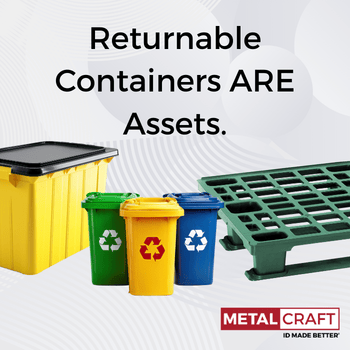
One of the most damaging errors companies make is viewing returnable containers as simple packaging rather than high value assets.
When containers are treated like disposable packaging:
- There is no formal ownership model.
- Accountability is unclear.
- Loss is accepted as unavoidable.
Supply chain managers would never treat production equipment or critical components this casually. Yet reusable containers that protect valuable product during delivery and transport often receive far less oversight.
Returnable assets represent tied-up cash and operational value. They are essential tools that enable supply chain operations. Without control, asset utilization drops. Containers go missing. Replacement orders increase. Packaging costs creep upward.
In many instances, companies launch returnable packaging programs with excitement at the beginning, expecting cost savings and efficiency. But without asset-level visibility, the system deteriorates.
If containers are not recognized as assets, they won’t be managed like assets. And that’s where losses begin.
Mistake #2: Tracking Containers Without Enforcing Accountability
Many companies invest in returnable container tracking—barcode systems, RFID tools, or tracking software—but stop short of enforcing accountability.
The data exists. The tracking system shows status, location, and movement in real time. But no one follows up on overdue returns. No escalation process exists. No consequences are defined for non-return.
Tracking without action is simply observation.
For example, a facility may see that dozens of bins remain at a supplier site beyond expected transit time. Yet without a defined process to recover them, those containers remain missing in practice—even if the data shows their last known location.
Returnable container management must connect tracking to responsibility. If suppliers, carriers, or customers fail to return containers, there must be a structured follow-up process.
Otherwise, even the best technology won’t prevent loss. Control requires both visibility and action.
Mistake #3: Accepting Shrinkage as “Normal”
Shrinkage in returnable packaging programs is often written into budgets as a fixed percentage of loss. Companies assume that some containers will inevitably disappear.
- Root causes are never investigated.
- Recovery efforts are minimal.
- ROI erodes quietly year over year.
What appears to be minor loss across one line or one facility can multiply across supply chain operations. With many containers circulating between manufacturers, suppliers, and customers, small percentage losses translate into significant cash outflow.
Loss is rarely caused by theft alone. More often, it’s process failure: unclear handoffs, missing data, improper repairs, or containers returned to the wrong location.
When businesses accept shrinkage as “just part of the industry,” they ignore preventable inefficiencies. Over time, hidden costs overshadow the projected savings that justified returnable packaging in the first place.
Mistake #4: Using Identification That Doesn’t Match the Environment
Another common mistake with returnable containers is selecting identification that fails before the container itself.
Returnable containers are built for repeated use across multiple cycles. They move through wash systems, endure abrasion, face extreme heat or cold storage, sit outdoors in the elements, and travel through repeated transport across the supply chain. Yet many companies choose identification solutions based on upfront cost—not environmental performance or specific needs.
When identification fails:
-
Tracking gaps appear.
-
Containers become invisible.
-
Asset status becomes unreliable.
For example, plastic bins moving through an automated wash system may experience label delamination if the adhesive or face stock isn’t designed for moisture and heat. Metal pallets exposed to harsh industrial environments can quickly destroy low-durability labels, eliminating scannability and disrupting returnable container tracking. Over time, even a small percentage of tag failures undermines visibility across many containers, eroding control and asset utilization.
The solution is not just “a stronger label”—it’s matching identification technology to the environment and container material.
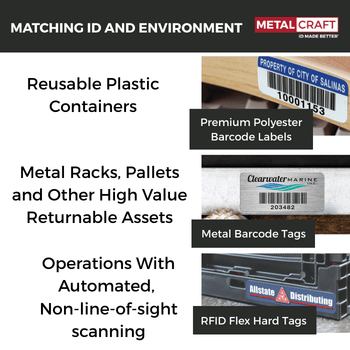
For reusable plastic containers, Metalcraft’s Premium Polyester Barcode Labels provide excellent durability against moisture, abrasion, and chemicals. Designed for industrial settings, these labels maintain readability through repeated handling and cleaning cycles, making them ideal for bins, totes, and boxes that require consistent scanning across facilities.
For metal racks, pallets, and other high value returnable assets, Metal Barcode Tags offer superior durability. Constructed to withstand extreme temperatures, outdoor exposure, and harsh conditions, metal tags maintain long-term identification where traditional labels would fail. They are especially effective in heavy manufacturing and high-abrasion environments where equipment and containers take a beating.
In operations requiring automated, non-line-of-sight scanning, RFID Flex Hard Tags provide rugged RFID performance built specifically for demanding supply chain operations. These tags are engineered to handle impact, vibration, wash cycles, and outdoor conditions while delivering reliable real time tracking data. When properly matched to the container material and environment, they support scalable returnable container management across complex networks.
Choosing identification that aligns with real-world conditions is essential to maintaining data integrity. The right barcode label, metal tag, or RFID solution ensures that tracking remains intact through transit, maintenance, and repeated use.
If you’re evaluating identification options, explore solutions designed specifically for harsh environments—such as those discussed in our guide to the Best Tags for Returnable Containers.
Visibility only works when identification survives the process.
Mistake #5: Undefined Handoffs Between Suppliers, Carriers, and Customers
Returnable containers move across organizational boundaries. They pass from manufacturers to suppliers, to customers, to third-party carriers, and back again.
When responsibility during these handoffs is undefined, problems multiply:
- Containers are returned to the wrong facility.
- Disputes replace data.
- No one accepts ownership for loss in transit.
In one instance, a company discovered that containers were routinely left at a customer dock because drivers assumed someone else would manage the return. No formal transfer of custody existed.
Clear agreements must define:
- Who owns the container at each stage.
- Expected return timelines.
- Documentation requirements.
- Escalation steps for missing assets.
Without defined accountability at every location, returnable assets fall into grey areas. And grey areas are where losses occur.
Mistake #6: Relying on Spreadsheets After Scale
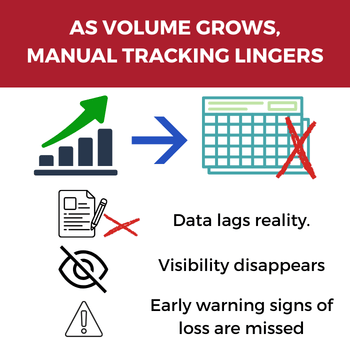
Spreadsheets can work at the beginning of a small returnable container program. But as volume grows, manual tracking lingers too long.
But when shrinkage is normalized:
As supply chain complexity increases:
- Data lags reality.
- Real time visibility disappears.
- Early warning signs of loss are missed.
Managing many containers across multiple facilities, suppliers, and customers requires more than static reports. Manual updates create delays. Errors accumulate. Status information becomes unreliable.
Modern returnable container management requires software designed to optimize asset utilization, improve efficiency, and provide control across the network.
When data is accurate and accessible in real time, supply chain managers can make informed decisions about container allocation, repairs, maintenance, and recovery.
Spreadsheets cannot support large-scale circular economy programs indefinitely. Eventually, systems must evolve.
Mistake #7: Never Auditing or Recovering Lost Containers
Even with strong tracking and identification, companies often fail to conduct regular audits or implement recovery workflows.
No cycle reviews are scheduled. No one analyzes trends in missing containers. No structured recovery process exists.
Over time:
- Loss compounds year over year.
- Replacement purchases increase.
- Asset value steadily declines.
For example, a company may discover during a facility expansion that thousands of containers are unaccounted for. By then, recovery becomes far more difficult.
Proactive audits identify gaps early. Recovery processes—such as supplier reconciliation, dock checks, and transit verification—help recapture valuable assets before they disappear permanently.
Returnable packaging is designed for multiple cycles. But without review, containers quietly exit the loop.
How to Avoid These Mistakes
Avoiding these common mistakes with returnable containers requires disciplined management—not just better equipment.
High-level best practices include:
Treat containers as owned assets.
Assign financial value, track them like equipment, and measure asset utilization.
Assign responsibility across the loop.
Define accountability at every handoff—from suppliers to carriers to customers.
Match identification to real conditions.
Select durable tags and labels that withstand wash cycles, abrasion, heat, and transit.
Review loss trends regularly.
Audit status reports, analyze data, and investigate root causes instead of accepting shrinkage as normal.
Additionally, align returnable container tracking tools with operational goals. Focus on process improvement, not just technology implementation. The most effective solutions integrate tracking, accountability, maintenance planning, and recovery workflows.
When businesses maintain clear ownership, enforce accountability, and optimize container movement, the benefits multiply: improved productivity, reduced waste, lower transportation costs, and measurable cost savings.
The Breakdown
Returnable containers only deliver savings when management practices support them.
Most returnable container loss is preventable. Process failures cause more damage than theft. Identification and tracking only work when paired with accountability and follow-through.
Returnable packaging supports sustainability goals, protects valuable product during delivery, and reduces reliance on single use containers. But without structure, the hidden costs erode the expected savings.
Supply chain operations depend on visibility, control, and consistency. When companies treat returnable assets as high value tools rather than disposable packaging, they create stronger systems across the industry.
The difference between success and loss is rarely the container itself. It’s the management discipline behind it.
If your organization is experiencing missing containers, rising packaging costs, or declining asset utilization, now is the time to reassess your process.
Talk to an asset tracking expert about reducing returnable container loss—and turn your returnable packaging program into a measurable driver of efficiency and savings.
About the Author: John Fitzsimmons

Mobile Phone: 641-423-9460
Office Phone: 641-423-9460
Email: [email protected]
Office: 3360 9th St SW